The company and program
| Client | A Series A spend-management platform: corporate cards, bill pay and expenses for startups with 20–200 employees. |
| Stage | Series A |
| Industry | B2B fintech |
| Timeline | 12 weeks, 8 June – 30 August 2026. First read in week 2 |
| Channels | Podcast and live-show host reads, YouTube integrations, newsletter sponsorships |
| Team | 1 dedicated Kiko growth lead, plus agents for show research, read-script compliance checks and weekly CRM matching |
The approach
- Hypothesis: founders and finance leads book better demos after a host they trust explains the product than after a LinkedIn ad.
- Comparison: sponsorship-sourced demos against the prior 12 weeks of LinkedIn and search ads, on qualification rate, cost per qualified demo and demo-to-opportunity rate. Within the test, founder shows against finance newsletters.
- Decision rule: after each placement's first two runs, renew anything under $700 per qualified demo. Cut anything above $900.
What we changed
- Weeks 1–2: pick shows and book. We scored 23 shows and newsletters on Kiko's six-point rubric and booked six: a daily founder and tech-operator live show, a founder and product-leader interview podcast, a business-history YouTube channel for founders, a CFO and controller newsletter, a startup-finance newsletter and an operator newsletter.
- Week 2: scripts and compliance. One read script per show, built around a single offer: a free month-end close review. Kiko checked every script against the FTC Endorsement Guides, and the client's counsel signed off card, rewards and bank-partner wording.
- Weeks 2–5: first runs. The first two runs of every placement went live, each with its own vanity URL. The demo form made "How did you hear about us?" a required field.
- Week 6: renew or cut. The daily show, the CFO newsletter and the startup-finance newsletter came in under $700 per qualified demo and were extended to the end of the quarter. The interview podcast and the operator newsletter sat between the two thresholds, so their booked runs finished without an extension. The business-history channel had already run both its integrations.
- Weeks 6–12: run and match. Every Monday we matched new demos to placements in the CRM and reported booked, held, qualified and opportunity counts.
The results
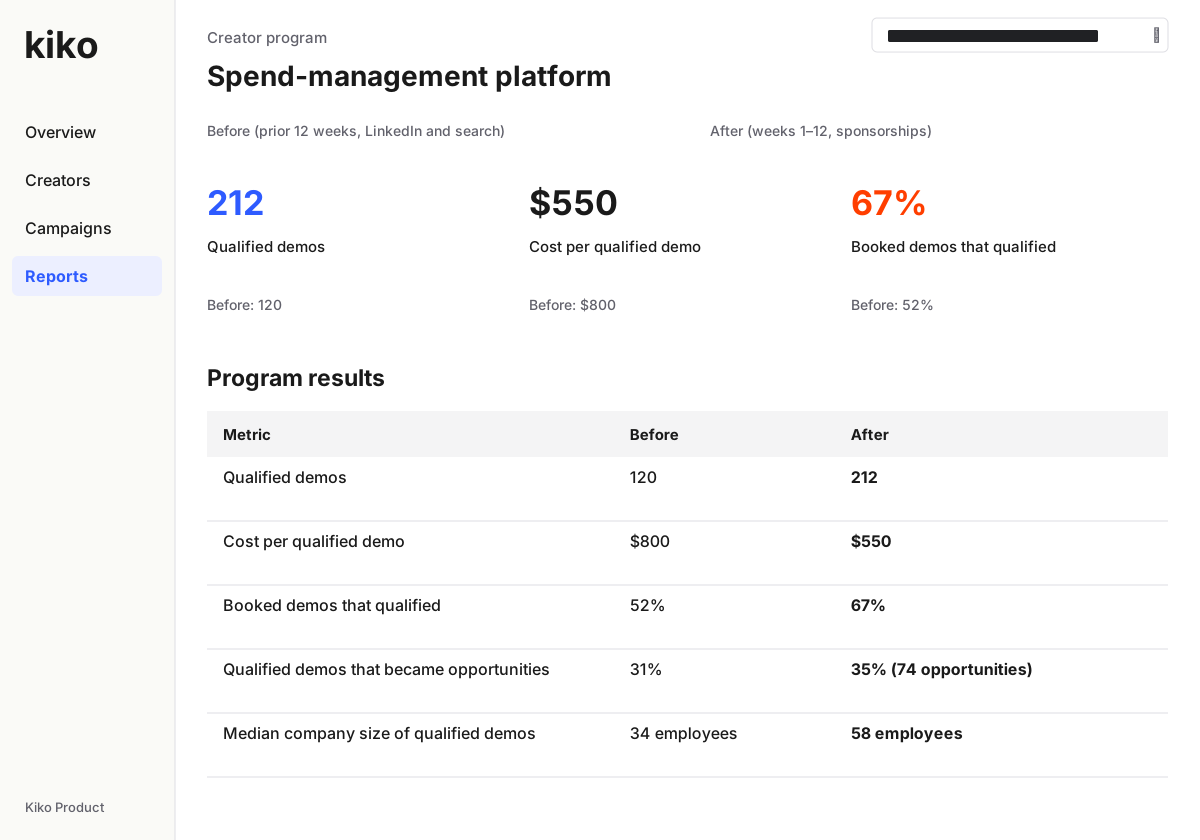
| Metric | Before (prior 12 weeks, LinkedIn and search) | After (weeks 1–12, sponsorships) | Change |
|---|---|---|---|
| Qualified demos | 120 | 212 | +77% |
| Cost per qualified demo | $800 | $550 | −31% |
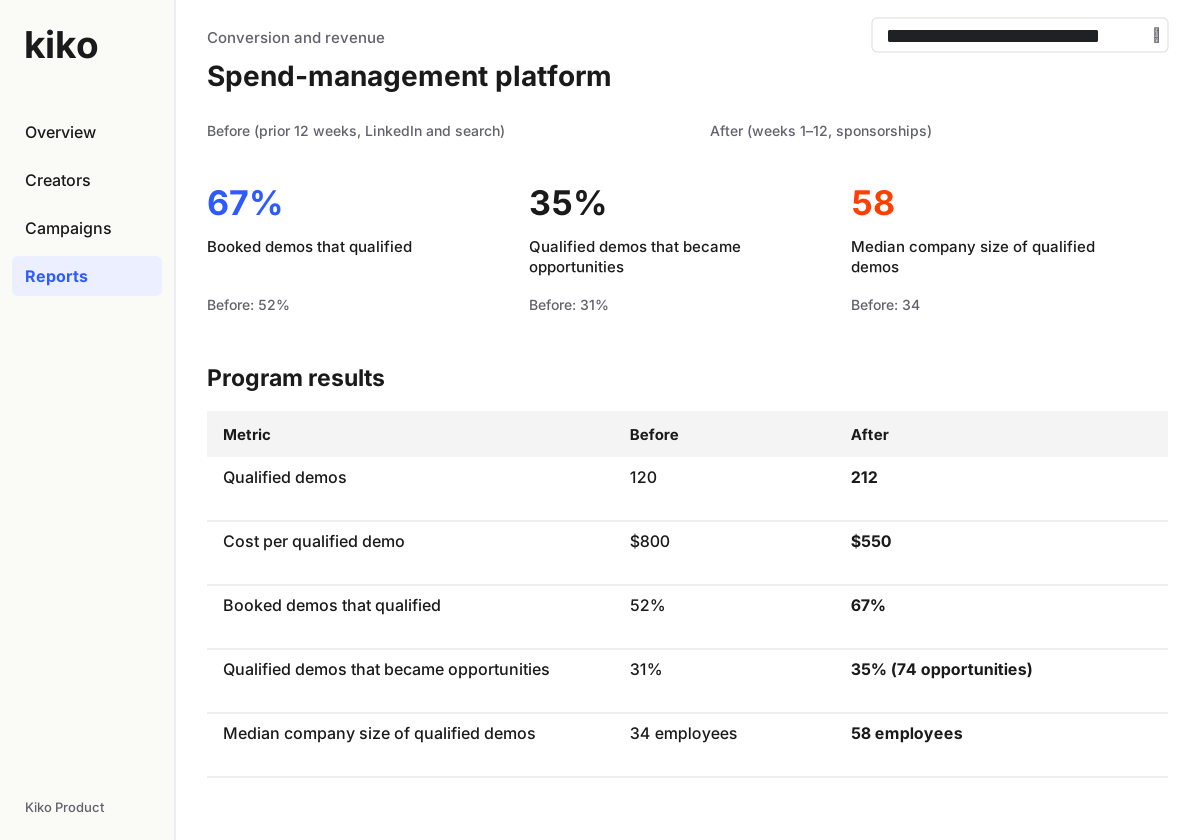
| Booked demos that qualified | 52% | 67% | +15 pts |
| Qualified demos that became opportunities | 31% | 35% (74 opportunities) | +4 pts |
| Median company size of qualified demos | 34 employees | 58 employees | +24 employees |
What didn't work
- The interview podcast was the most expensive reach. Its two episodes brought 41 qualified demos at $732 each. Its listeners skew to product leaders, who rarely own the card decision.
- Operator readers were the wrong buyers. The operator newsletter ran at $750 per qualified demo. Its readers were mostly employees at companies already locked into a competitor's card.
- Vanity URLs undercounted. Only 58% of qualified demos used a vanity URL; the rest typed the main domain. Without the required "How did you hear about us?" field, we would have lost 42% of attribution.
What we learned
- Put the CFO newsletter first. It produced qualified demos at $325, the cheapest of the six, because its readers own the spend decision.
- Make "How did you hear about us?" required on every demo form before the first read goes out.
- Run one offer across every show. A single, concrete offer (the close review) made results comparable between placements.
Frequently asked questions
How much do podcast sponsorships cost for a B2B fintech?
Here, $550 per qualified demo across six placements and 28 runs, against $800 from LinkedIn and search ads. The CFO newsletter was cheapest at $325; the interview podcast cost $732. Most Series A sponsorship programs like this run $25,000–$50,000 a month in sponsorship fees.
How long before sponsorships produce demos?
The first read aired in week 2. By week 6 every placement had two runs and a cost per qualified demo, enough to renew three and let the rest finish. The 212 demos came over 12 weeks.
Would this work for a seed-stage payroll startup selling to 5-person companies?
The attribution setup transfers: vanity URLs plus a required "How did you hear about us?" field. The shows don't. Qualified demos here had a median company size of 58 employees, so finance-leader audiences fit; 5-person buyers need different shows.
Related case studies and guides
Same industry, other angles:
- Paid ads: Cost per qualified demo down from $1,240 to $610 in 12 weeks
- Product growth: Time from signup to first card swipe down from 11 days to 4
- Full growth system: tripled qualified pipeline to $9M in 9 months
More on B2B fintech: