The company and program
| Client | A Series A corporate card and spend-management platform for US startups and small businesses, with cards issued by a partner bank. |
| Stage | Series A |
| Industry | B2B fintech |
| Timeline | One 90-day sprint, March 2 to May 31, 2026 |
| Channels | Signup and KYB flow, bank linking, card issuing, the admin dashboard, lifecycle email |
| Team | A Kiko growth lead plus agents: a funnel-audit agent, a review-queue agent that flagged applications waiting more than 4 working hours, and an experiment write-up agent. The client's onboarding engineers built the changes; its risk team and partner bank signed off each one. |
The approach
- Hypothesis: most of the 11 days is waiting between steps, not risk review. Remove the waits before approval and give a usable card at approval, and first swipes come days earlier without loosening any check.
- Comparison: the KYB checklist and the instant bank-link default ran as 50/50 splits of new signups. The virtual card on approval shipped to all approved accounts once the partner bank approved it. The final read compares signups from February 16 to March 1 with April 13–26, each over 30 days.
- Decision rule: ship if the median days to the step falls, the approval rate of submitted applications holds, and fraud flags per 1,000 accounts stay at or below baseline. Kill it otherwise.
What we changed
- Weeks 1–2: time every step. Timestamps for 300 recent applications showed 61% of the wait sat between steps: a document request in an inbox, a micro-deposit in flight, a card in the mail.
- Weeks 3–5: the KYB checklist. Every document was listed before the application started and the beneficial-owner form was prefilled. Median time to a complete submission fell from 2.0 days to 0.5.
- Weeks 3–5: instant bank linking by default. Micro-deposits became the fallback. Instant links rose from 62% to 89% of bank links.
- Weeks 4–6: same-day review and a virtual card on approval. The partner bank approved virtual cards in week 4, pushed to Apple Pay and Google Pay, and they shipped to every approved account in week 6.
- Week 6: the first-swipe checklist. Admins saw two first actions on the dashboard: move one software subscription to the card, or pay one vendor.
- Weeks 7–13: the read and handover. Everything was live from April 13. We read 30 days of first swipes for April 13–26 signups and handed over the step-timing dashboard.
The results
| Metric | Before (Feb 16 to Mar 1 signups) | After (Apr 13–26 signups) | Change |
|---|---|---|---|
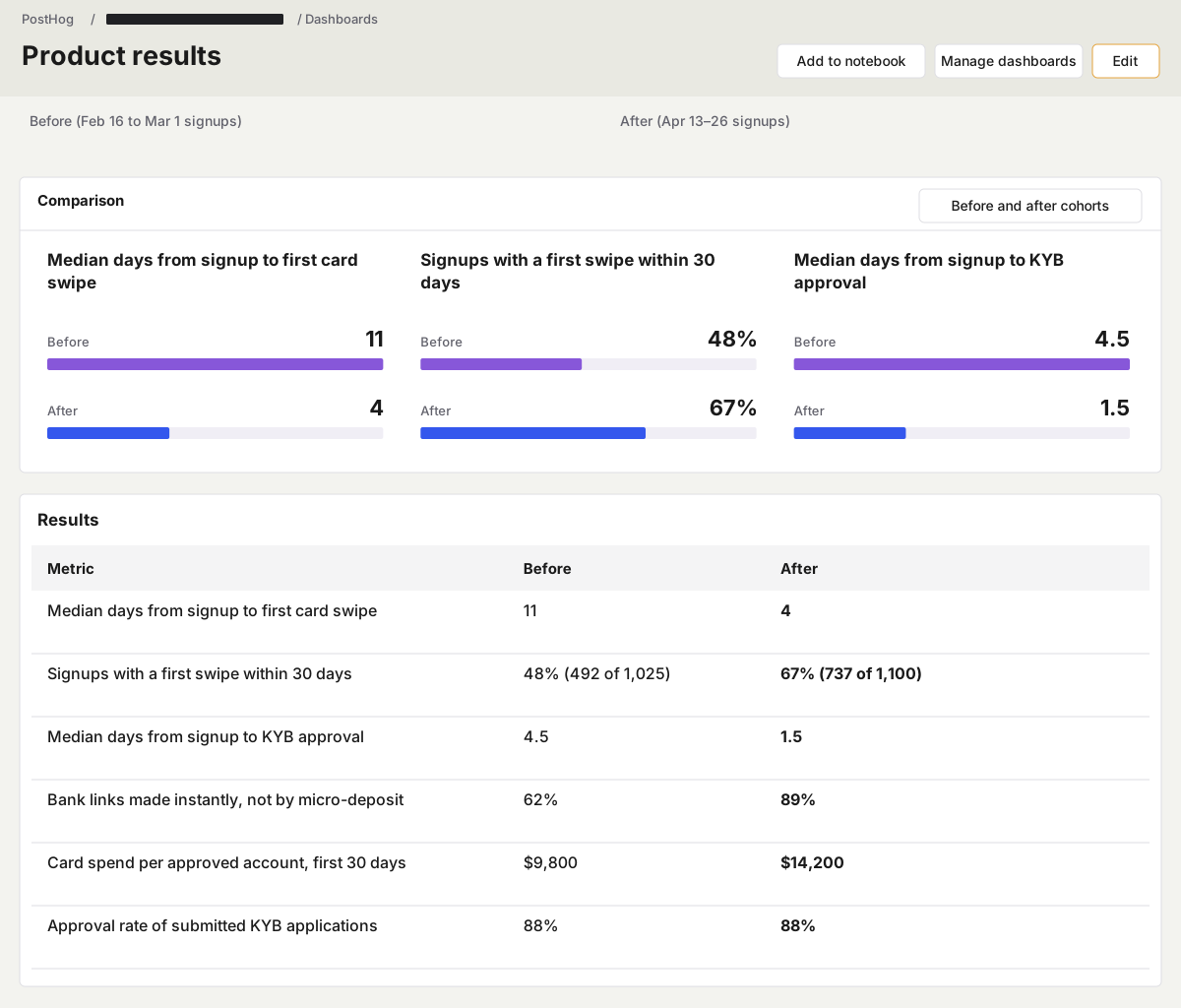
| Median days from signup to first card swipe | 11 | 4 | −7 days |
| Signups with a first swipe within 30 days | 48% (492 of 1,025) | 67% (737 of 1,100) | +19 pts |
| Median days from signup to KYB approval | 4.5 | 1.5 | −3 days |
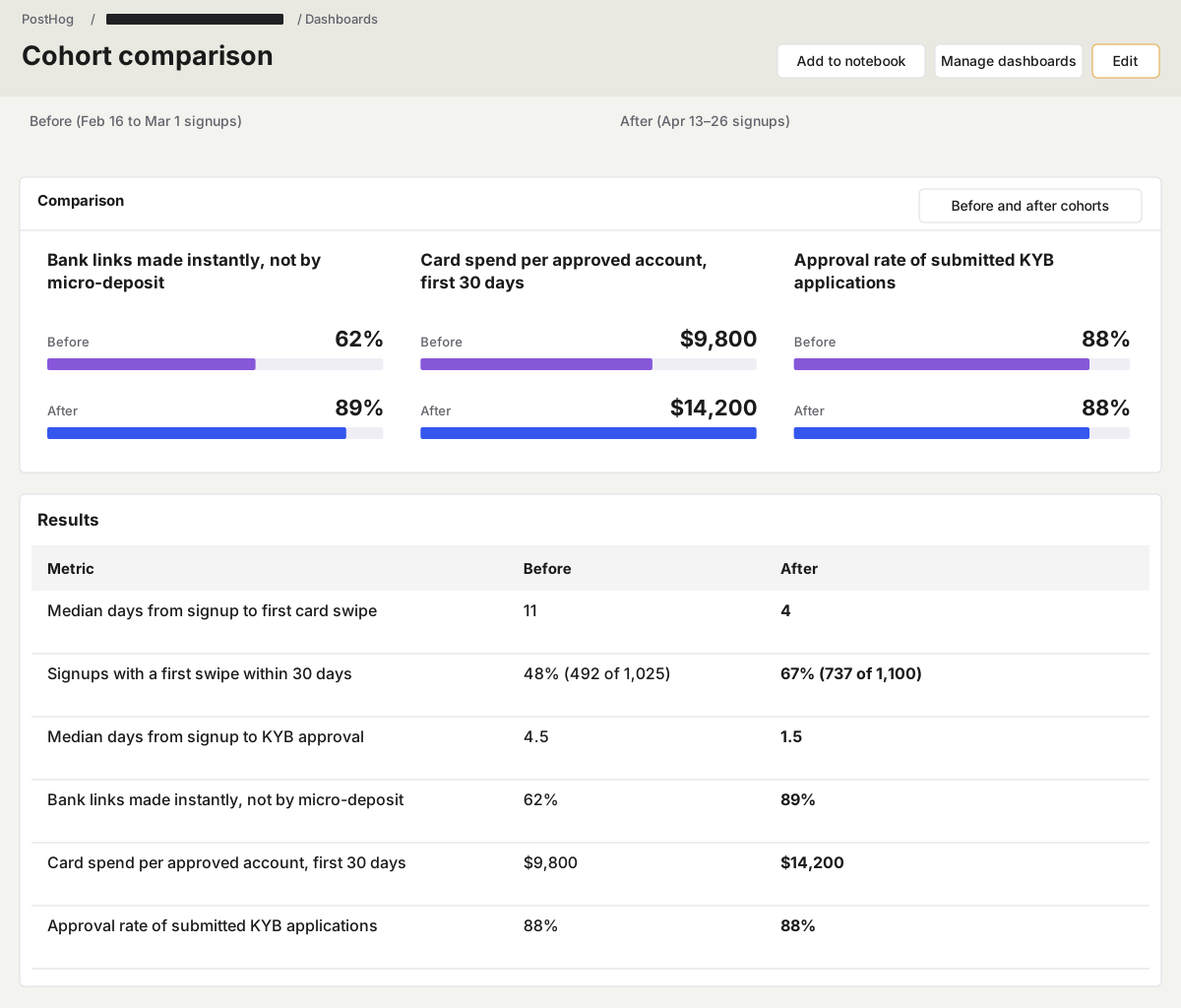
| Bank links made instantly, not by micro-deposit | 62% | 89% | +27 pts |
| Card spend per approved account, first 30 days | $9,800 | $14,200 | +45% |
| Approval rate of submitted KYB applications | 88% | 88% | 0 |
What didn't work
- Inviting employees first. Asking admins to invite their team before using the card slowed the admin's own first swipe by a median of one day. Invites now come after the first swipe.
- Wallet push reached only half the cards. 54% of virtual cards were added to a phone wallet, because most admins sign up on a desktop. A scan-to-phone code went in during week 12, too late to read in this sprint.
- Weekends still wait. Same-day review runs on weekdays, so applications submitted on a Friday afternoon wait until Monday. They make up most of the remaining tail past 7 days.
What we learned
- Time every step from real timestamps before changing anything. The waits were between steps, not inside them.
- Give a usable card at approval. Don't make the first swipe wait for the mail.
- Bring the risk team and partner bank in during week one, so approvals don't stall the sprint.
Frequently asked questions
How much does it cost to fix corporate card onboarding with Kiko?
There was no creator or media spend, so the only cost was Kiko's 90-day sprint, priced from $10,000 a month. The client's own engineers built the changes; Kiko ran the diagnosis, test design, the review-queue agent and the read. Card spend per approved account in the first 30 days rose from $9,800 to $14,200.
How long did it take to get first swipes from 11 days to 4?
Two weeks of timing every step, four weeks shipping four changes, then a 30-day read. All changes were live by April 13, week 7 of a 90-day sprint, and the final cohort was read by week 13.
Would this work for a consumer fintech or a card program without a partner bank?
Partly. The checklist, instant bank-link default and same-day queue apply to any KYC or KYB flow. The virtual card on approval depends on your issuer agreeing to it; here the partner bank took until week 4.
Related case studies and guides
Same industry, other angles:
- Creator marketing: 212 qualified demos in 12 weeks from podcast and newsletter sponsorships
- Paid ads: Cost per qualified demo down from $1,240 to $610 in 12 weeks
- Full growth system: tripled qualified pipeline to $9M in 9 months