The company and program
| Client | A Series A treasury management platform |
| Stage | Series A |
| Industry | B2B fintech |
| Pillars | Creator marketing + Paid ads + Product growth |
| Timeline | 9 months, Jan 1 – Sep 30, 2026: three 90-day sprints, one per quarter |
| Channels | Finance-leader newsletters and podcasts, founder podcasts, LinkedIn Thought Leader Ads, YouTube ads, Meta retargeting, self-serve onboarding and email |
| Team | A dedicated Kiko growth lead plus agents for show research, placement tracking, ad reporting and funnel pulls. The client's engineers built the onboarding changes Kiko specced; its sales team qualified every opportunity |
| Headline result | Qualified pipeline created per quarter from $3.0M to $9.0M |
| Measured in | CRM opportunity stages, product analytics, LinkedIn, YouTube and Meta ads managers, a vanity URL per show and a source question at sign-up |
The approach
- Hypothesis: a CFO books a treasury call once they have seen their own idle-cash number. If trusted hosts name the problem, ads repeat the strongest read, and the product shows each sign-up their forgone yield before any sales call, every source produces more qualified opportunities per dollar.
- Comparison: Q4 2025 was the baseline: LinkedIn lead-gen form ads at $2,143 per qualified opportunity from paid, 100 qualified opportunities worth $3.0M, 18 customers won and 34% of sign-ups connecting a bank account within 7 days. Each quarter was read against it, by source.
- Decision rule: a show earned a recurring run only if its first two placements produced a qualified opportunity for $1,200 or less. Ad concepts got $500–$1,000 or 7 days and were killed above $1,500 per qualified opportunity. Onboarding changes shipped only after a 50/50 test lifted 7-day bank connection by 5 points or more.
How the three pillars connected
Creator marketing
We bought host reads and newsletter placements as runs, not one-offs: two finance-leader newsletters for CFOs and controllers, including one with about 70,000 subscribers, two CFO podcasts, and a daily founder show whose audience chooses a company's first bank and treasury setup. Each show had its own vanity URL. Every script stated yields with the partner's required disclosures and was signed off by the client's counsel before a host read it. Sponsorships produced 72 qualified opportunities in Q3, at $833 each.
Paid ads
The previous agency ran gated-whitepaper lead forms on LinkedIn at $2,143 per qualified opportunity from paid. We replaced them with LinkedIn Thought Leader Ads boosting finance creators' posts, YouTube ads cut from the best podcast reads, and Meta retargeting of site visitors only. Monthly media rose by half from Q1 to Q3, and paid produced 88 qualified opportunities in Q3, at $1,023 each.
Product growth
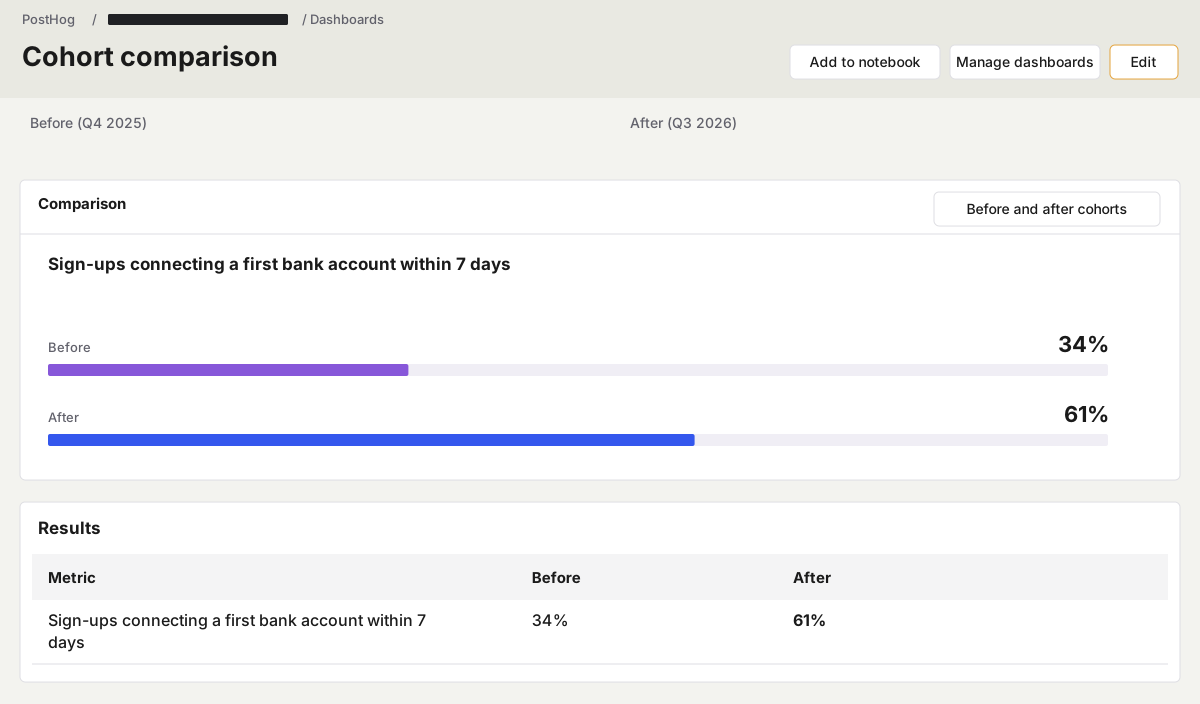
Before Kiko, connecting a bank account was gated behind a sales demo. We specced a free cash-visibility tier: connect bank accounts read-only, get a cash report within minutes that shows balances across banks and the yield idle cash is forgoing, then book a treasury review from the report. A "share with your controller" link brought a second finance user into the account. Bank connection within 7 days rose from 34% to 61%, and sign-up-to-qualified-opportunity from 26% to 33%.
How they fed each other
The host read that converted best was a single line: what a $10M cash balance earns sitting in a checking account versus Treasury bills. That line became the LinkedIn and YouTube ad hook and the headline of the cash report. Paid volume exposed the demo gate in the first month; removing it raised conversion for podcast and inbound sign-ups as well. Sales notes on which pain closed deals (multi-bank visibility for companies with three or more banks) went back into the next quarter's host briefs, and the win rate on qualified opportunities rose from 18% to 24%.
What we changed
- Weeks 1–2: CRM and event audit, a shared definition of a qualified opportunity with the sales lead, the Q4 2025 baseline by source, and a show shortlist scored on Kiko's six-point rubric.
- Weeks 3–6: compliance-approved scripts, first newsletter placements in week 3 and first podcast reads in week 5. Lead-gen forms paused; Thought Leader Ads tested at $500–$1,000 per concept.
- Weeks 7–13: the ungated cash report into a 50/50 test, shipped to all sign-ups in week 11. Three shows passed the rule and moved to quarterly runs.
- Weeks 14–26 (Q2): YouTube ads cut from podcast reads launched and the "share with your controller" link went live. Media rose by a quarter.
- Weeks 27–39 (Q3): media rose again, the daily founder show moved to a recurring run, and sales-note themes rotated into every brief.
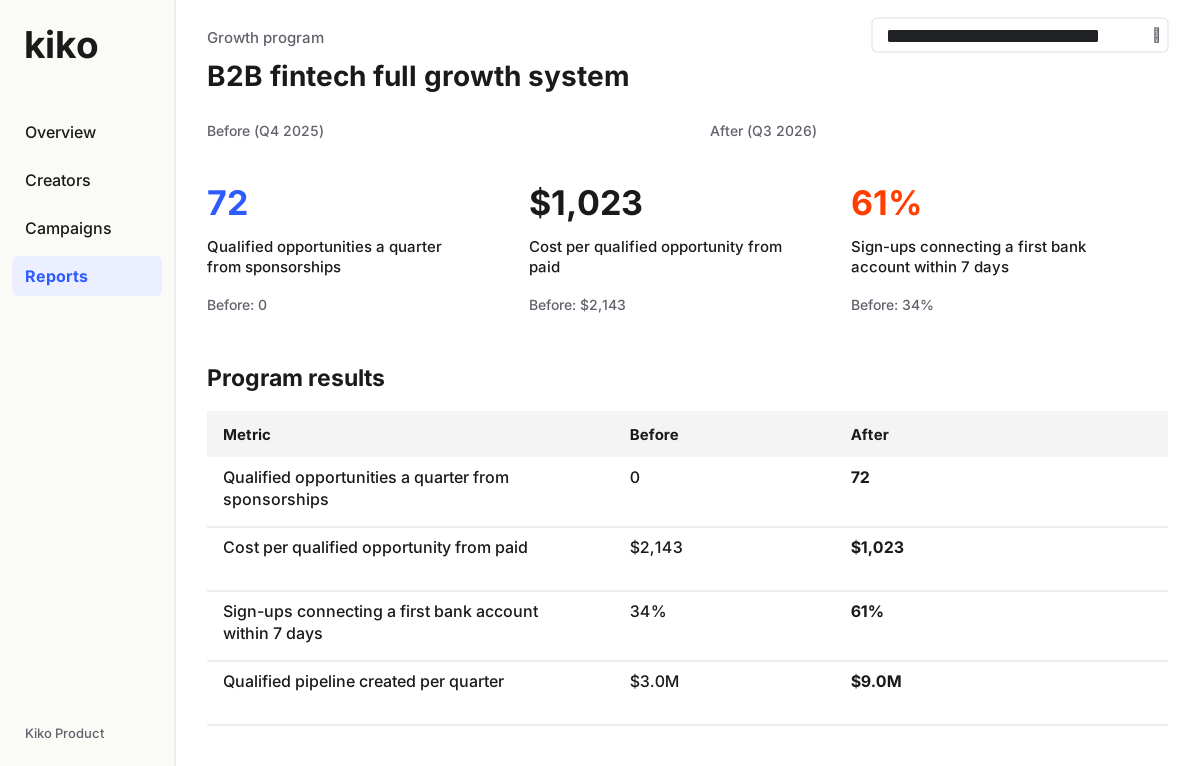
The results
| Pillar | Metric | Before (Q4 2025) | After (Q3 2026) | Change |
|---|---|---|---|---|
| Creator marketing | Qualified opportunities a quarter from sponsorships | 0 | 72 | +72 |
| Paid ads | Cost per qualified opportunity from paid | $2,143 | $1,023 | −52% |
| Product growth | Sign-ups connecting a first bank account within 7 days | 34% | 61% | +27 pts |
| Combined | Qualified pipeline created per quarter | $3.0M | $9.0M | 3x |
New ARR won per quarter grew from $504,000 to $1.56M, blended CAC per customer won fell from $4,167 to $3,261, and total ARR grew from $5.4M to $8.4M.
What didn't work
- Meta prospecting. Broad Meta campaigns aimed at business owners produced 4 qualified opportunities at about $4,500 each. Most clicks came from companies below the platform's $5M cash minimum. Meta now runs as retargeting only.
- A general business show. A run on a general business YouTube show produced 3 qualified opportunities at about $4,000 each. Its audience skewed to owners of small, cash-light businesses.
- Gated whitepapers. We kept one lead-gen form live in month 1 as a control. It produced cheap leads, but only 2% became qualified opportunities.
What we learned
- Put the buyer's own number in front of them before the first sales call; the cash report did more for qualified pipeline than any channel change.
- Buy finance shows as recurring runs and judge them on qualified opportunities after two placements, not on downloads.
- Send sales notes back into creator briefs every quarter, so hosts talk about the pain that closes.
Frequently asked questions
What did it cost to triple qualified pipeline for a B2B fintech?
Cost per qualified opportunity fell from $750 to $625, and blended CAC per customer won fell 22%, from $4,167 to $3,261. Most Series A programs like this run $35,000–$50,000 a month in sponsorship fees and media.
How long does podcast sponsorship take to show up in pipeline?
Newsletter placements started in week 3 and podcast reads in week 5. Each show was judged after two placements, and three had moved to quarterly runs by week 13. Sponsorships produced 72 qualified opportunities in Q3 2026, at $833 each.
Would this work for a seed-stage fintech selling to small businesses?
Partly. The ungated cash report and the two-placement show rule carry over. The channel mix does not: Meta prospecting and a general business show failed here because of the $5M cash minimum, and that is a small-business audience.
Related case studies and guides
Same industry, other angles:
- Creator marketing: 212 qualified demos in 12 weeks from podcast and newsletter sponsorships, a Series A spend-management platform
- Paid ads: Cost per qualified demo down from $1,240 to $610 in 12 weeks, a Series A accounts-payable automation platform
- Product growth: Time from signup to first card swipe down from 11 days to 4, a Series A corporate card platform
Playbooks and lists:
- Creator marketing for B2B fintech, the industry front door
- How B2B finance startups use podcasts and newsletters, the sponsorship playbook
- Creator lists by industry, the creators hub
- Fractional growth team, how Kiko runs all three pillars together