The company and program
| Client | A Series A accounts-payable automation platform for finance teams at companies with 50–1,000 employees. |
| Stage | Series A |
| Industry | B2B fintech |
| Timeline | 12 weeks: weeks 1–2 tracking and creative, 3–8 tests, 9–12 scale |
| Channels | LinkedIn video and retargeting ads; Meta retargeting and a CRM customer-list audience |
| Team | A Kiko growth lead and a paid media buyer, plus agents for CRM sync checks, spend monitoring and the weekly pipeline report. The client's head of sales defined "qualified" |
The approach
- Hypothesis: finance leaders book a demo when they see their own month-end close fixed on screen, not when they download a guide. Sending the CRM's qualified-demo stage back to LinkedIn and Meta teaches delivery to find more of the right people.
- Comparison: demo-led video ("month-end close in one afternoon", "invoice to payment in 90 seconds") and an AP cost calculator, against the client's gated-ebook lead forms, at a similar weekly budget.
- Decision rule: each concept got 7 days or $1,000, whichever came first, judged on cost per demo request. Kill any concept more than 30% above the best one. From week 6, budget moved weekly toward the lowest cost per qualified demo, read from the CRM.
What we changed
- Weeks 1–2: tracking. We mapped the CRM's "Qualified" stage to an offline conversion on LinkedIn and Meta, so both platforms saw which demo requests the sales team accepted.
- Weeks 1–2: creative. The client's product lead and a customer's controller recorded a real month-end close in the product, cut into four LinkedIn videos and three Meta videos. The client's counsel signed off every claim about payments and time saved.
- Weeks 3–8: tests. Six LinkedIn concepts and four Meta concepts ran against the ebook forms, which were turned off in week 5. Meta interest-based prospecting was cut in week 4 and replaced by a customer-list audience of contacts at 1,400 target accounts. The AP cost calculator went live for LinkedIn retargeting.
- Weeks 9–12: scale. The two winning LinkedIn videos, Meta site retargeting and the customer-list audience took the budget.
The results
| Metric | Before (4 weeks before kickoff) | After (weeks 9–12) | Change |
|---|---|---|---|
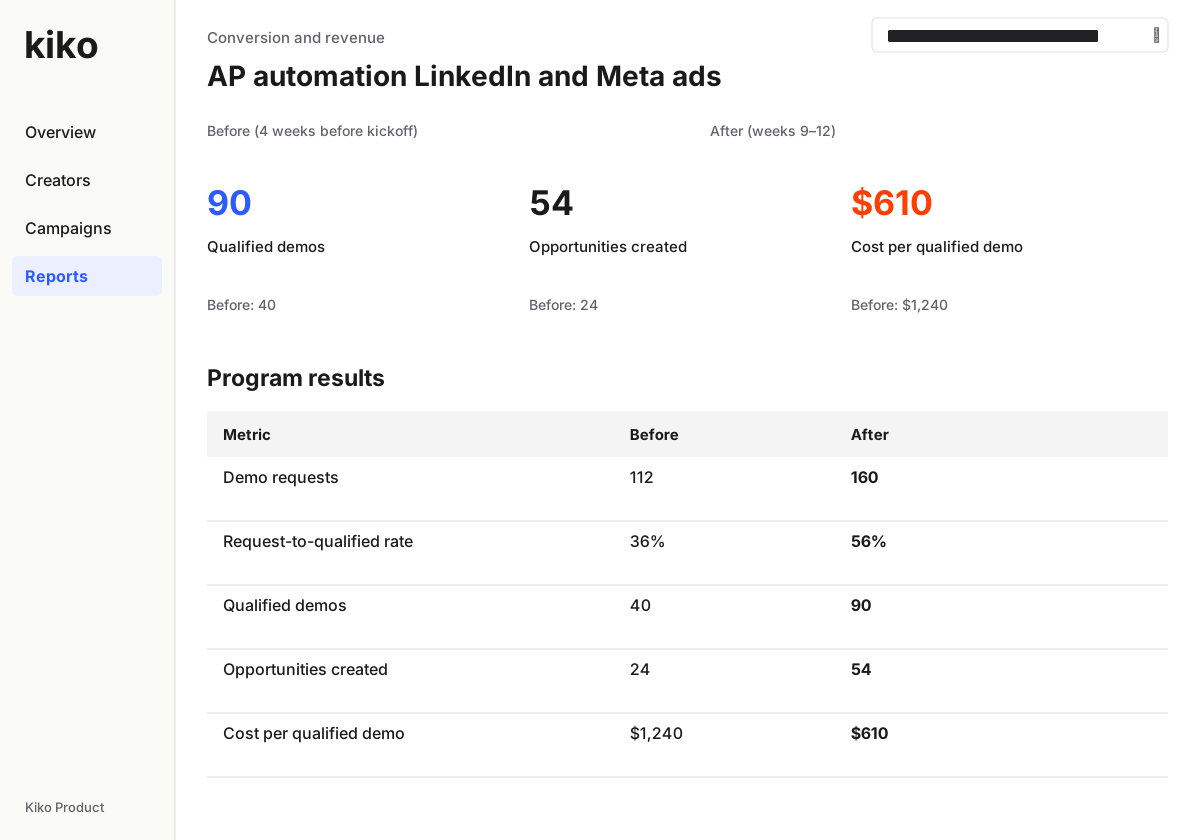
| Demo requests | 112 | 160 | +43% |
| Request-to-qualified rate | 36% | 56% | +20 pts |
| Qualified demos | 40 | 90 | 2.25x |
| Opportunities created | 24 | 54 | 2.25x |
| Cost per qualified demo | $1,240 | $610 | −51% |
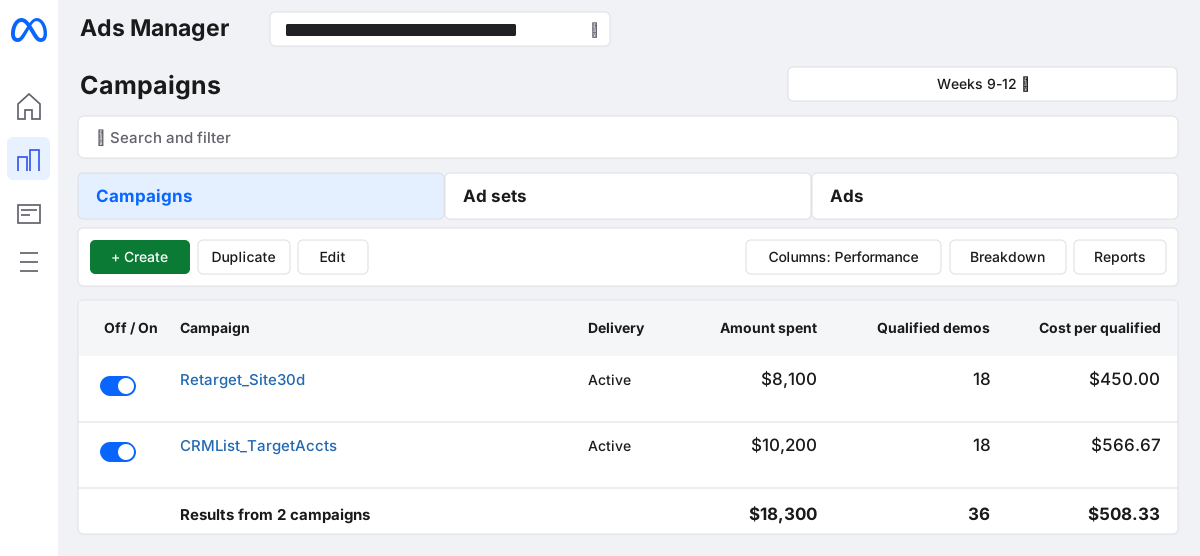
LinkedIn brought 54 qualified demos at $677.78 each. Meta brought 36 at $508.33, almost all from people who had already visited the site or worked at a target account.
What didn't work
- Gated ebook lead forms. They produced the cheapest leads, but fewer than 1 in 25 became a qualified demo. We turned them off in week 5.
- Meta interest targeting. Finance-related interests spent $4,000 in weeks 3–4 without a single qualified demo. Meta only worked for this buyer on the client's own lists and site visitors.
- The calculator as a retargeting offer. It ran at $800 per qualified demo, just under the kill line, and never earned more budget. Controllers wanted to see the product, not a spreadsheet estimate.
What we learned
- Send the CRM's qualified stage back to the ad platforms in week 1, before any creative test.
- Put a real month-end close on screen in the first 5 seconds.
- Build Meta audiences from the client's target accounts and site visitors, never from interests.
Frequently asked questions
What does a qualified demo cost for a B2B fintech platform on LinkedIn and Meta?
Here, $610 in weeks 9–12: $677.78 on LinkedIn and $508.33 on Meta, with no creator fees. Series A programs like this typically run $45,000–$65,000 a month in media.
How long does it take to halve cost per qualified demo?
Twelve weeks. Weeks 1–2 wired the CRM's qualified stage to both platforms, weeks 3–8 tested ten concepts, and the $610 figure is from weeks 9–12.
Would this work for a seed-stage fintech selling to small businesses instead of mid-market finance teams?
Not as run. The program depended on a sales team marking demos "Qualified" in a CRM and a list of 1,400 target accounts. Without an AE-qualified stage to send back, the platforms have nothing to learn from.
Related case studies and guides
Same industry, other angles:
- Creator marketing: 212 qualified demos in 12 weeks from podcast and newsletter sponsorships
- Product growth: Time from signup to first card swipe down from 11 days to 4
- Full growth system: tripled qualified pipeline to $9M in 9 months