The company and program
| Client | A seed-stage AI agent startup: an operations agent for small teams that works across email, calendar and CRM. |
| Stage | Seed |
| Industry | AI agents |
| Timeline | 12 weeks (one 90-day sprint): weeks 1–2 tracking and demo footage, 3–6 opening tests, 7–12 scale |
| Channels | YouTube in-stream ads; LinkedIn video ads |
| Team | A Kiko growth lead plus agents for creative tagging, daily spend checks and the weekly activation report. The client's founder recorded the demo runs |
The approach
- Hypothesis: an ad that opens on a finished task ("here's my week, handled") brings fewer curious clicks and more people who connect a tool. Cost per activated workspace should fall even if cost per sign-up barely moves.
- Comparison: four openings with identical seconds 5–30: (A) finished result first, (B) the task stated as a pain ("200 unread emails"), (C) a face and a claim, (D) the agent hits a problem and recovers. Each ran on YouTube and LinkedIn against the client's existing capability-claim ads.
- Decision rule: each cell got 7 days or $1,000, whichever came first. Kill any cell more than 30% above the best cell on its platform for cost per activated workspace, and move its budget to the winner. A campaign optimizes to activated workspace once it reaches 50 a week; until then, to tool connected.
What we changed
- Weeks 1–2: event and footage. We defined "activated workspace" with the client's engineer and sent it server-side to YouTube and LinkedIn. The founder recorded 14 unedited demo runs on real inboxes and calendars while the existing ads kept running.
- Weeks 1–3: one creator review. We booked an agent-strategy YouTuber with about 330K subscribers for a sponsored review. The fee included 90 days of paid usage, and the cut-down became cell C on YouTube.
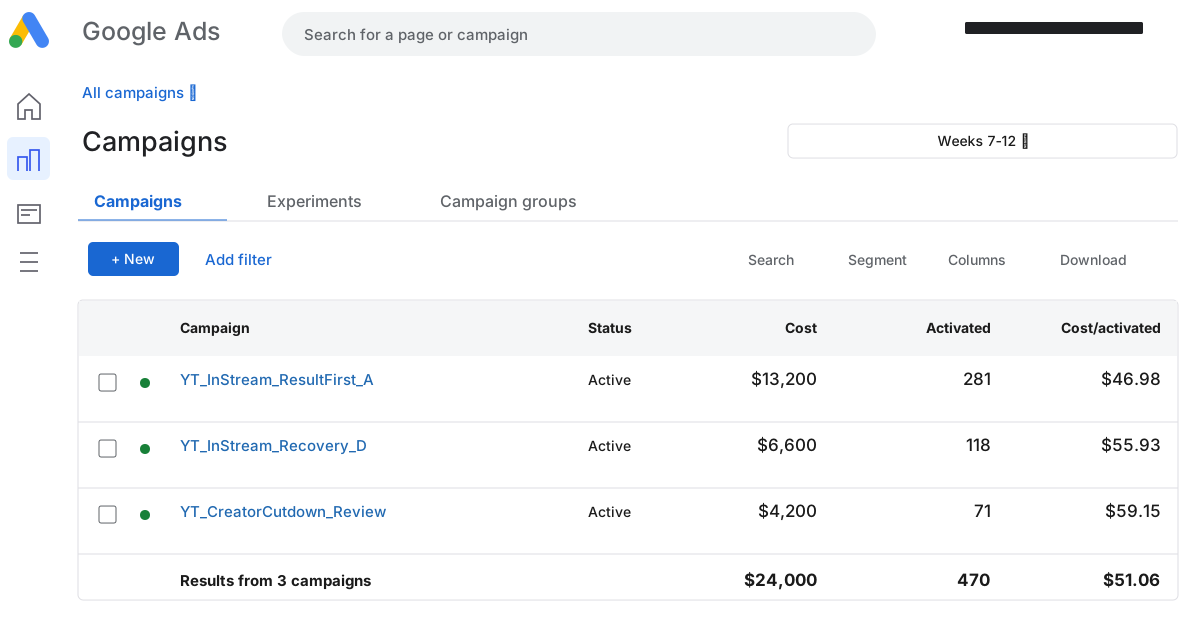
- Weeks 3–6: opening tests. All four cells ran on both platforms. YouTube cell B and LinkedIn cell C were killed at their first review, and the capability-claim ads were switched off in week 4.
- Weeks 7–12: scale. Cells A and D scaled on both platforms, alongside the creator cut-down on YouTube, with two new demo runs a week. LinkedIn cell B was paused in week 8 under the 30% rule.
- Weeks 7–12: optimization event. YouTube optimized to activated workspace at 78 a week. LinkedIn stayed on tool connected at 45 activated workspaces a week, under the 50 threshold.
The results
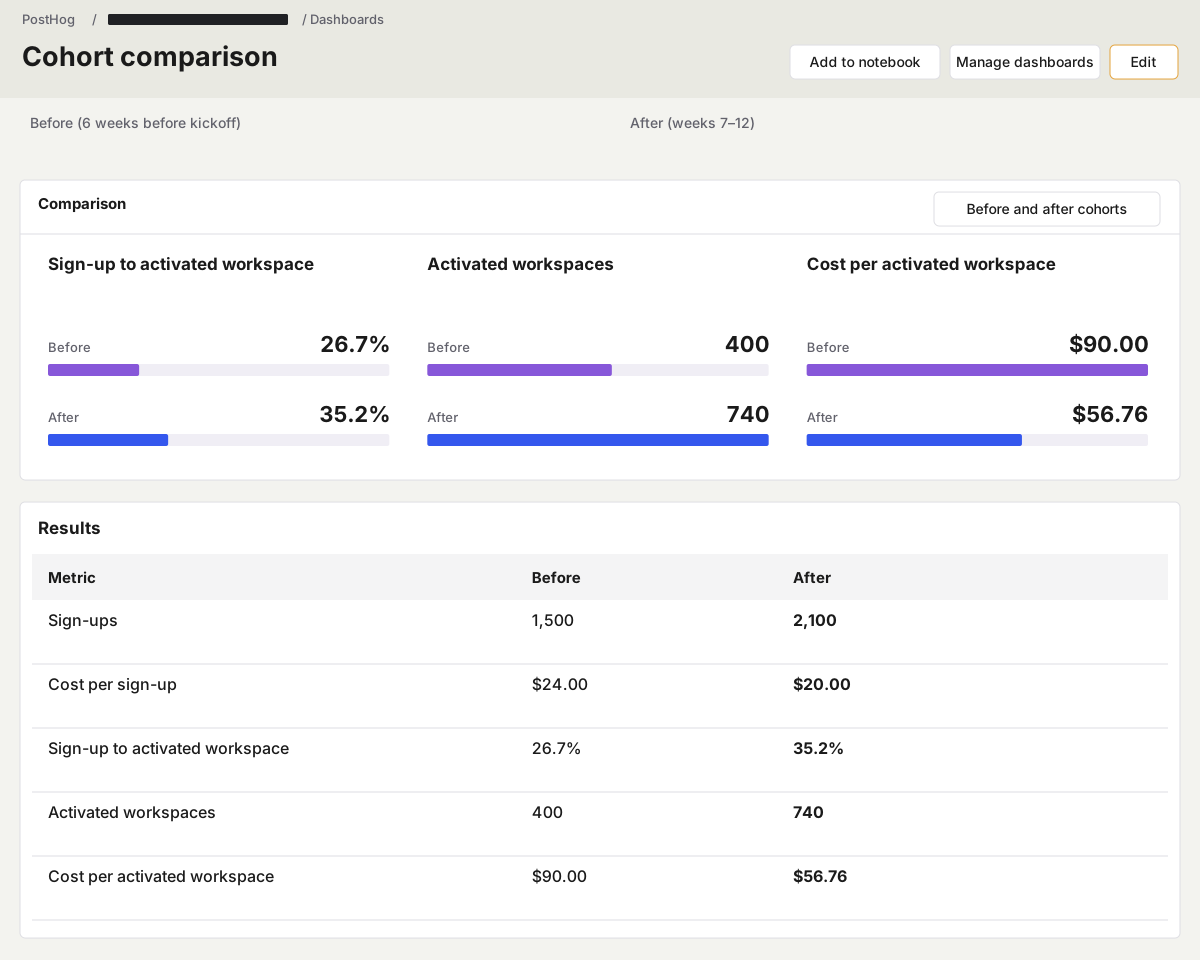
| Metric | Before (6 weeks before kickoff) | After (weeks 7–12) | Change |
|---|---|---|---|
| Sign-ups | 1,500 | 2,100 | +40% |
| Cost per sign-up | $24.00 | $20.00 | −17% |
| Sign-up to activated workspace | 26.7% | 35.2% | +8.5 pts |
| Activated workspaces | 400 | 740 | +85% |
| Cost per activated workspace | $90.00 | $56.76 | −37% |
YouTube did the most work: $51.06 per activated workspace against $66.67 on LinkedIn.
What didn't work
- Pain-first openings. "200 unread emails" pulled cheap sign-ups on LinkedIn, but only 21% of them activated, for $94.74 per activated workspace. It was paused in week 8.
- A face and a claim on LinkedIn. A talking head without the product on screen lost to the demo and was killed at its first review. The same idea worked on YouTube only as a cut-down of a real review.
- LinkedIn never reached the deeper event. At 45 activated workspaces a week, LinkedIn optimized to tool connected for the whole sprint and stayed 31% more expensive per activated workspace than YouTube.
What we learned
- Define the activation event and send it server-side before the first ad goes live.
- Open on the finished task, keep seconds 5–30 fixed, and test only the opening.
- Record new unedited demo runs every week. Winning ads lost efficiency after about two weeks.
Frequently asked questions
What does a paid ads sprint for an AI agent startup cost?
In weeks 7–12, each activated workspace cost $56.76, against $90.00 before kickoff, and each sign-up $20.00. Most seed programs like this run $15,000–$35,000 a month in creator fees and media.
How long until cost per activated workspace drops?
Weeks 1–2 went to tracking and demo footage, weeks 3–6 to opening tests. The 37% drop is measured in weeks 7–12, so plan on about six weeks before the number moves.
Would this work for a smaller AI agent startup with a lower ad budget?
Only partly. Optimizing to activation needs 50 activated workspaces a week per platform. LinkedIn never got there at 45 a week and stayed 31% more expensive than YouTube. At a lower budget, expect to run on tool connected.
Related case studies and guides
Same industry, other angles:
- Creator marketing: 1,840 activated workspaces in 8 weeks from 9 YouTube creators
- Product growth: Week-one activation up from 22% to 41% in a 90-day sprint
- Full growth system: grew ARR from $1.2M to $4.1M in 9 months