The company and program
| Client | A seed-stage AI email agent that drafts replies and follow-ups for founders and sales teams. |
| Stage | Seed |
| Industry | AI agents |
| Timeline | One 90-day sprint, June to September 2026 |
| Channels | Product onboarding, lifecycle email and push, and the client's existing ads and creator scripts |
| Team | A Kiko growth lead plus agents: an event-audit agent, a cohort-report agent that logged model and prompt version per cohort, and an experiment write-up agent. The client's two engineers built the product changes |
The approach
- Hypothesis: most new users fail before the agent does any work, at the permission screen or a blank first request, so fixing setup and the first task moves activation more than model quality does.
- Comparison: each change against a 50/50 split of new signups, with at least 200 signups per arm and 14 days. Every cohort was tagged with the model and prompt version it first used.
- Decision rule: ship if week-one activation rises at least 3 points with no drop in week-4 retention. Kill if it doesn't.
What we changed
- Weeks 1–2: definition and events. "Two drafts sent within 7 days" predicted week-4 retention best: 52% of users who reached it were still active at week 4, against 3.5% of those who didn't. We instrumented
inbox_connected,task_attemptedanddraft_sent, plus the share of first tasks the agent supports. - Weeks 3–5: scopes. Signup asked only for read and draft access; calendar and send permissions came later, when a task needed them. Activation rose from 22.4% to 28.9%.
- Weeks 5–7: suggested first tasks. The first screen offered three tasks matched to the signup answer ("follow up on unanswered threads", "reply to inbound leads"). 28.6% to 34.4%.
- Weeks 6–8: sample inbox. A demo run on sample emails before connecting. No change, so we killed it.
- Weeks 7–9: one-tap send. Draft notifications got a send button, so a good draft didn't wait for the user to open the app. 34.5% to 38.6%.
- Weeks 8–11: promise alignment. We rewrote the client's ad and creator scripts around the three tasks the agent does best. Paid users whose first task was in scope went from 58% to 81%.
The results
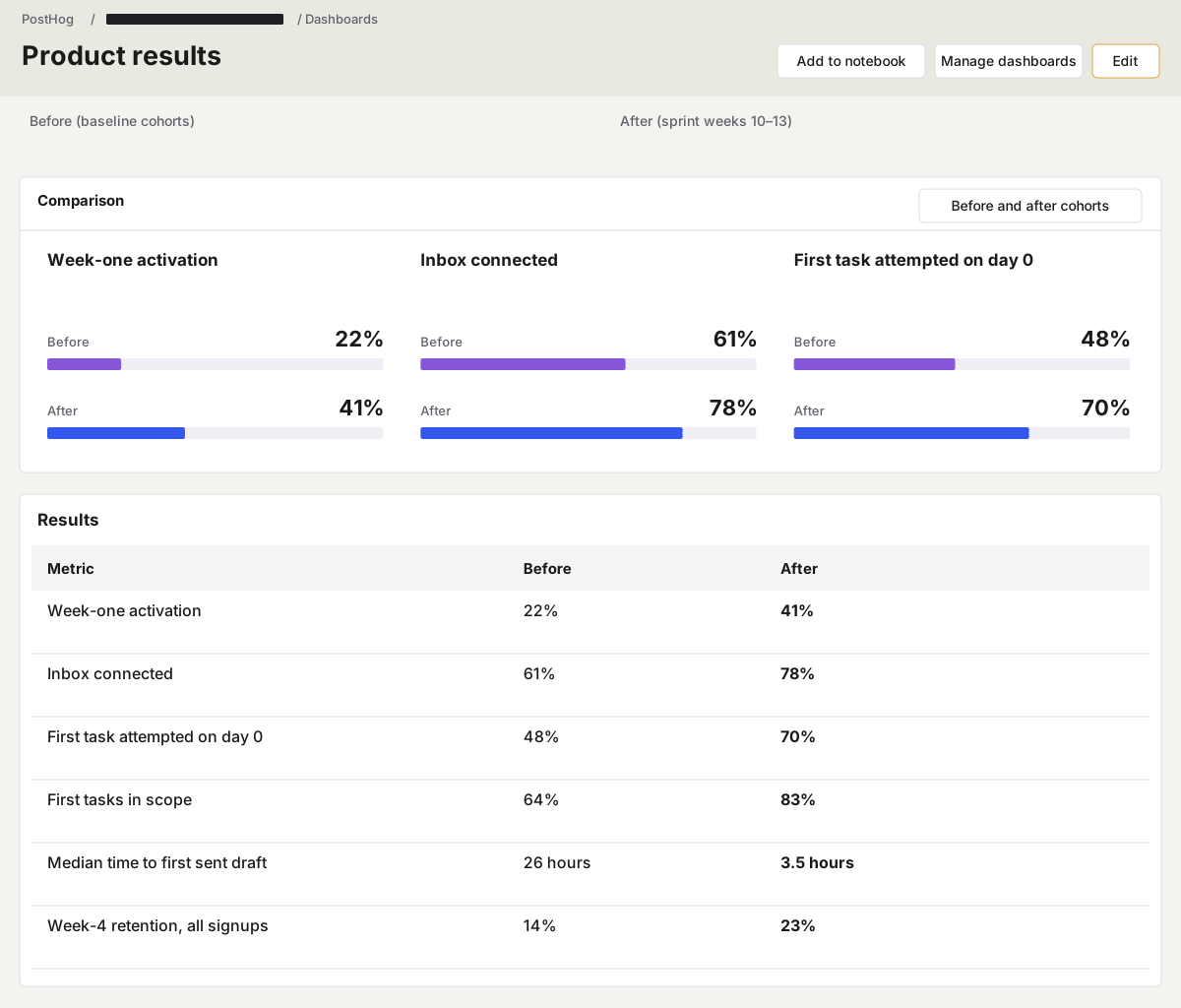
| Metric | Before (baseline cohorts) | After (sprint weeks 10–13) | Change |
|---|---|---|---|
| Week-one activation | 22% | 41% | +19 pts |
| Inbox connected | 61% | 78% | +17 pts |
| First task attempted on day 0 | 48% | 70% | +22 pts |
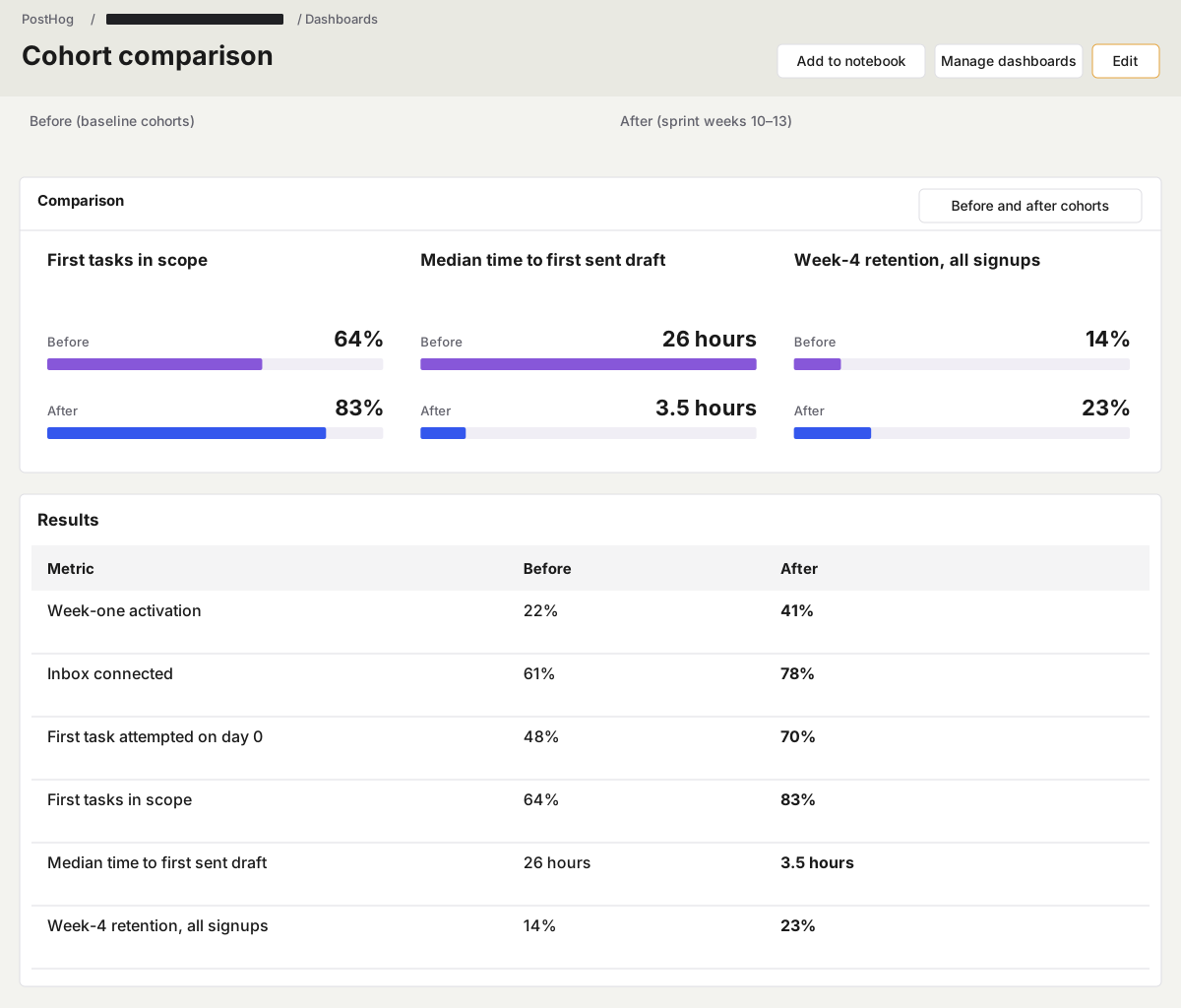
| First tasks in scope | 64% | 83% | +19 pts |
| Median time to first sent draft | 26 hours | 3.5 hours | −87% |
| Week-4 retention, all signups | 14% | 23% | +9 pts |
What didn't work
- The sample inbox. People liked watching it, then still stalled at the permission screen. Activation went from 29.1% to 28.7%.
- A model upgrade nearly muddied the read. The client shipped a new model version in week 8. Because every cohort carried its version tag and the tests ran as splits, we could separate the two effects. Without the tags, the one-tap send result would have looked bigger than it was.
- Rescue emails from the founder to stalled team-plan signups recovered 11% of them, too few to matter at this volume, so they stayed manual.
What we learned
- Define activation as an outcome the user acts on, and check it against retention before testing anything.
- Ask for the least access the first task needs.
- Fix the promise in ads and creator scripts so users arrive with a task the agent can do.
Frequently asked questions
How much does a 90-day activation sprint cost?
There was no media or creator spend: Kiko ran the sprint and the client's two engineers built the changes. Kiko's 90-day sprints start from $10,000 a month. Every shipped test cleared the 3-point bar; the first one, fewer permissions, added 6.5 points on its own.
How long before week-one activation moves?
Weeks 1–2 went to the definition and events. The first shipped test read out in week 5 at 28.9% against 22.4%. All three shipped changes were live by week 9, and the 41% figure comes from weeks 10–13.
Would this work for a Series A AI agent, or an agent that isn't for email?
Yes, if signups stall before the agent does any work. The method needs at least 200 signups per arm over 14 days, so about 400 signups per test. Below that volume you can't read a split in 14 days.
Related case studies and guides
Same industry, other angles: