The company and program
| Client | A YC-backed, seed-stage AI agent startup. |
| Stage | Seed, YC-backed |
| Industry | AI agents |
| Timeline | 8 weeks, 6 July – 30 August 2026. First video live on day 16 |
| Channels | YouTube: 3 dedicated videos and 10 sponsored integrations from 9 creators |
| Team | 1 dedicated Kiko growth lead, plus agents for creator scoring, script accuracy checks and daily link reporting |
The approach
- Hypothesis: small-business owners sign up and activate when they watch the agent finish a real task they already do by hand, not when they watch a feature tour.
- Comparison: full-run videos (one real task, start to finish, on screen) against feature-tour integrations, across the same creator groups. Cost per activated workspace against the founders' LinkedIn ads from the 8 weeks before.
- Decision rule: after 7 days of organic data on each video, rebook any creator under $40 per activated workspace. Drop any creator over $80.
What we changed
- Weeks 1–2: score and sign. We scored 64 channels on Kiko's six-point rubric, shortlisted 14 and signed 9. The roster: three small-business automation YouTubers at 150K–450K subscribers, two agent-builder tutorial channels at 90K–250K, two AI-for-operators analysis channels at 200K–400K and two AI agency-owner channels at 80K–200K.
- Week 2: brief. One page per creator: pick one task the viewer does every week (chasing unpaid invoices, triaging a shared inbox, updating a CRM), connect the tool live, and let the run finish on screen. Kiko checked every script for feature accuracy and FTC disclosure.
- Weeks 3–5: first wave. Nine videos went live with tracked links and a free-month code, and the sign-up form asked "Where did you hear about us?".
- Week 6: read and rebook. After 7 days of data per video, five creators came in under $40 per activated workspace; we rebooked the four with open slots and dropped promo codes from the new briefs.
- Weeks 6–8: second wave. Four more videos went live, and the client added a "start with the task you saw" onboarding template keyed to each creator's link.
The results
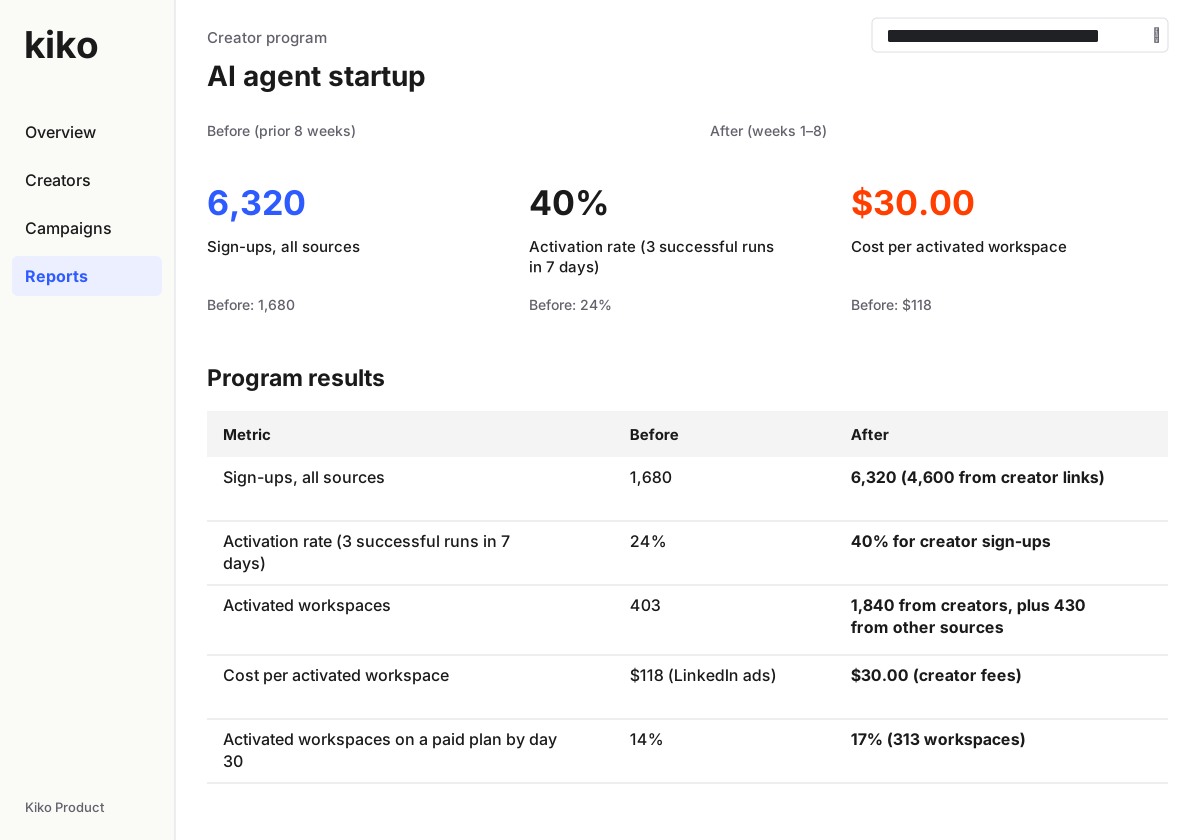
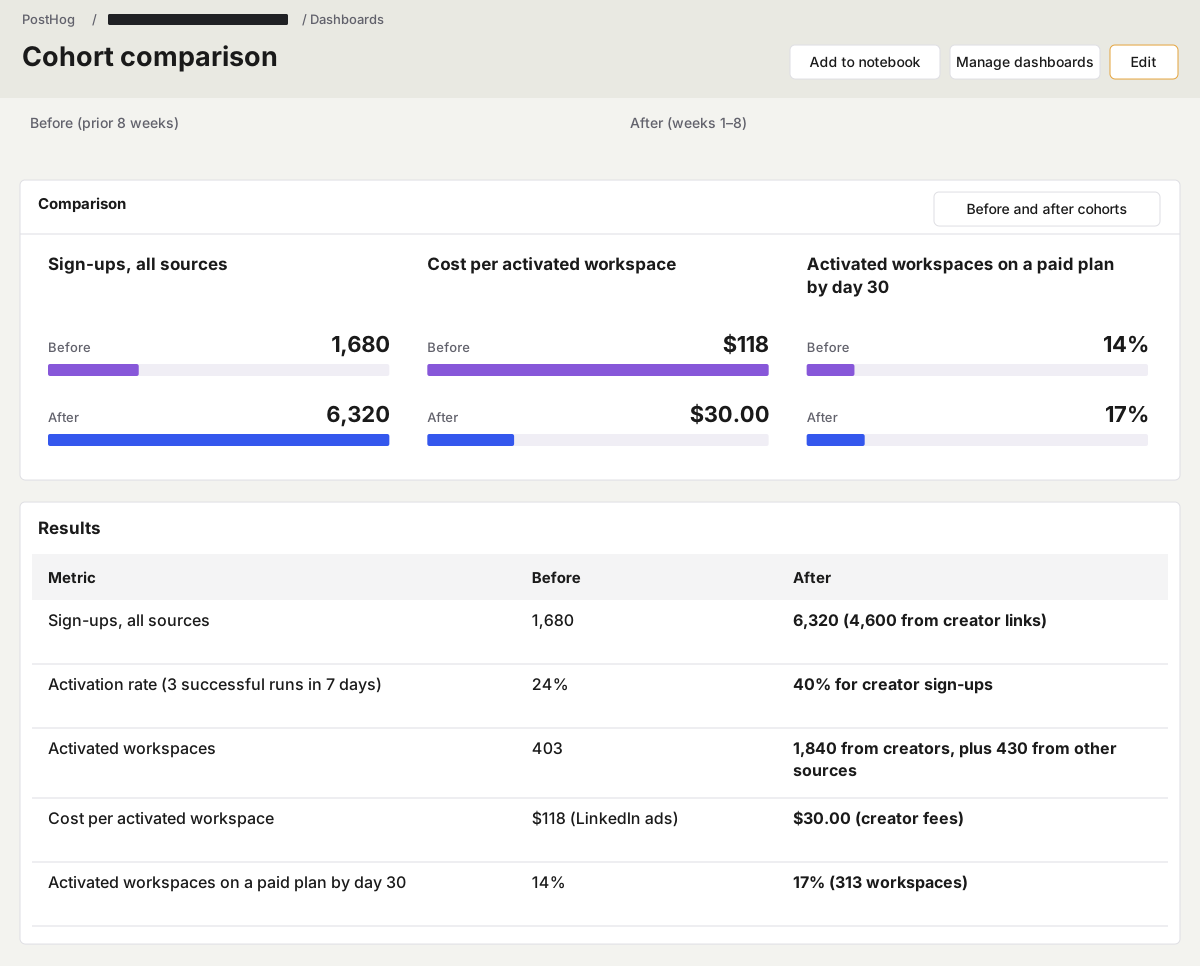
| Metric | Before (prior 8 weeks) | After (weeks 1–8) | Change |
|---|---|---|---|
| Sign-ups, all sources | 1,680 | 6,320 (4,600 from creator links) | 3.8x |
| Activation rate (3 successful runs in 7 days) | 24% | 40% for creator sign-ups | +16 pts |
| Activated workspaces | 403 | 1,840 from creators, plus 430 from other sources | 5.6x all sources |
| Cost per activated workspace | $118 (LinkedIn ads) | $30.00 (creator fees) | −75% |
| Activated workspaces on a paid plan by day 30 | 14% | 17% (313 workspaces) | +3 pts |
What didn't work
- Analysis channels drove views, not activations. The two operator-analysis creators delivered 616K views but cost $40 and $56 per activated workspace. Their viewers wanted to understand agents, not install one this week.
- Promo codes added nothing. Only 9% of creator sign-ups used the free-month code; the rest came through the tracked link. We dropped codes from the second wave.
- A live run failed on camera. One agent run timed out on an accounting sync mid-recording. The creator reshot it, and the video went live a week late.
What we learned
- Brief one real task per video and let the run finish on screen. Full-run videos activated 44% of their sign-ups; feature tours activated 33%.
- Rebook winners after 7 days of data instead of booking the whole quarter up front. All four rebooked creators beat their first video.
- Match onboarding to the video. Starting new users on the task they just watched lifted tool connections in weeks 6–8.
Frequently asked questions
How much does a YouTube creator campaign for an AI agent startup cost?
Each activated workspace cost $30.00, against $118 on the founders' LinkedIn ads, with no paid media. Most seed programs like this run $15,000–$35,000 a month in creator fees and media.
How long until creator videos drive sign-ups?
The first video went live on day 16; nine ran in weeks 3–5 and four rebooked videos in weeks 6–8. Each got 7 days of organic data before the rebook call. The 13 videos drew 2.86M views and 4,600 sign-ups.
Would this work for a Series A AI agent platform selling to enterprise teams?
The full-run brief carries over; the audience doesn't. These creators reach small-business owners who install a tool the same week, and even the operator-analysis channels here cost $40–$56 per activation. For enterprise buyers, judge creators on demos, not activations.
Related case studies and guides
Same industry, other angles:
- Paid ads: Cost per activated workspace down 37% with demo-led YouTube and LinkedIn ads
- Product growth: Week-one activation up from 22% to 41% in a 90-day sprint
- Full growth system: grew ARR from $1.2M to $4.1M in 9 months
Guides and creators: