The company and program
| Client | A Series A AI agent platform |
| Stage | Series A |
| Industry | AI agents |
| Pillars | Creator marketing + Paid ads + Product growth |
| Timeline | 9 months, Jan 1 – Sep 30, 2026: three 90-day sprints |
| Channels | YouTube creators (plus small LinkedIn and TikTok creator tests), YouTube ads, Meta ads, onboarding and lifecycle email |
| Team | A dedicated Kiko growth lead plus agents for creator research, ad reporting and funnel and cohort pulls. The client's product engineers built the onboarding changes Kiko specced |
| Headline result | ARR from $1.2M to $4.1M in 9 months |
| Measured in | Product analytics, Stripe, YouTube and Meta ads managers, tracked creator links and a "how did you hear about us" question at sign-up |
The approach
- Hypothesis: the same thing limits all three channels. A small-business owner buys an agent once they have watched it finish a task they recognise and then got it to finish that task in their own account. If creators show the task, ads repeat it and onboarding gets new users to it in one session, every channel's cost per paying workspace falls together.
- Comparison: December 2025 was the baseline: search and Meta ads, 45 new paying workspaces, a blended CAC of $400 and 24% of sign-ups completing a first task within 7 days. Every later month was read against it, by source.
- Decision rule: a creator post got 7 days of organic data, and we put paid spend behind it only if its sign-ups completed a first task at 35% or better. Ad concepts got $500–$1,000 or 7 days, whichever came first, and were killed above a $450 cost per paying workspace. An onboarding change shipped to everyone only if it lifted first completed task by 3 points or more in a 50/50 test.
How the three pillars connected
Creator marketing
We booked 10 YouTube creators in the first 30 days and 14 over the engagement: small-business automation channels, such as a 1.1M-subscriber automation YouTuber, and long-form build tutorial channels, such as a 600K-subscriber channel. Every brief asked for one unedited task run in the creator's own business. By sprint 3, five creators were on recurring monthly integrations. Creators brought 730 new paying workspaces at $255 each.
Paid ads
The previous paid program ran search and static Meta ads at a $1,200 cost per paying workspace. We rebuilt it around creator footage: YouTube in-stream and Meta partnership ads cut from the creator videos that passed the decision rule, plus Meta retargeting of sign-ups who had not finished a task. Media tripled from January to September, and paid brought 900 new paying workspaces.
Product growth
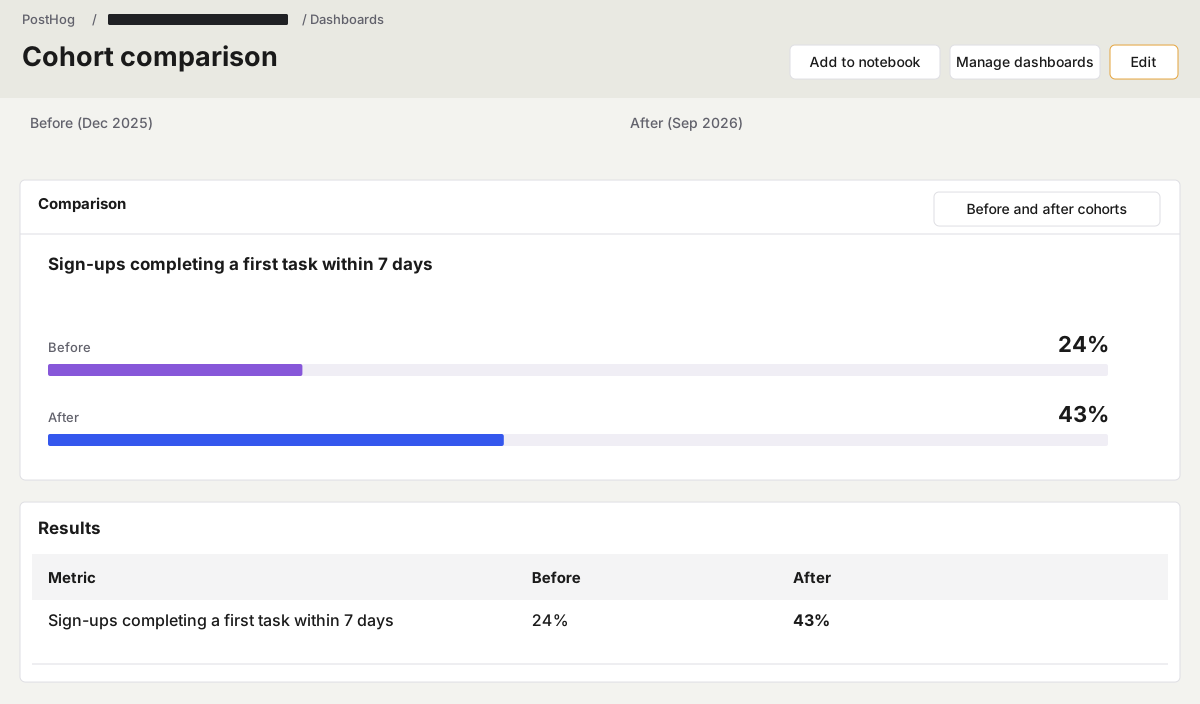
Funnel data showed 48% of December sign-ups never connected a tool, so they never saw a task run. We specced a template-first onboarding: pick one of six task templates matching what the ads showed, connect the inbox or calendar that template needs, then watch the agent run on the user's own data. A day-2 email recapped what the agent had done. First completed task within 7 days rose from 24% to 43%, and sign-up-to-paid within 30 days from 11% to 17%.
How they fed each other
The creator videos that converted best all showed inbox triage, not scheduling, so inbox triage became the first onboarding template and the opening shot of every ad. Paid traffic, at higher volume, exposed the tool-connection leak within two weeks; fixing it lifted conversion for creator and organic sign-ups too. Better activation then cut paid CAC from $1,200 to $375, which let us triple media spend while blended CAC fell 45%.
What we changed
- Weeks 1–2: event audit, a first-task definition agreed with the founders, the December baseline by source, and a 10-creator shortlist scored on Kiko's six-point rubric.
- Weeks 3–6: first creator posts live in week 3, 12 ad concepts tested at $500–$1,000 each, and the tool-connection step moved into onboarding as a 50/50 test.
- Weeks 7–13: the four creator videos that passed the decision rule ran as YouTube and Meta partnership ads. Template-first onboarding shipped to all users in week 10.
- Weeks 14–26 (sprint 2): five creators moved to monthly integrations and four new ones were added. Media scaled up month by month; the day-2 recap email and Meta retargeting launched.
- Weeks 27–39 (sprint 3): media scaled further on the winning concepts. Annual and team plans promoted inside the product lifted average revenue per workspace to $122 a month.
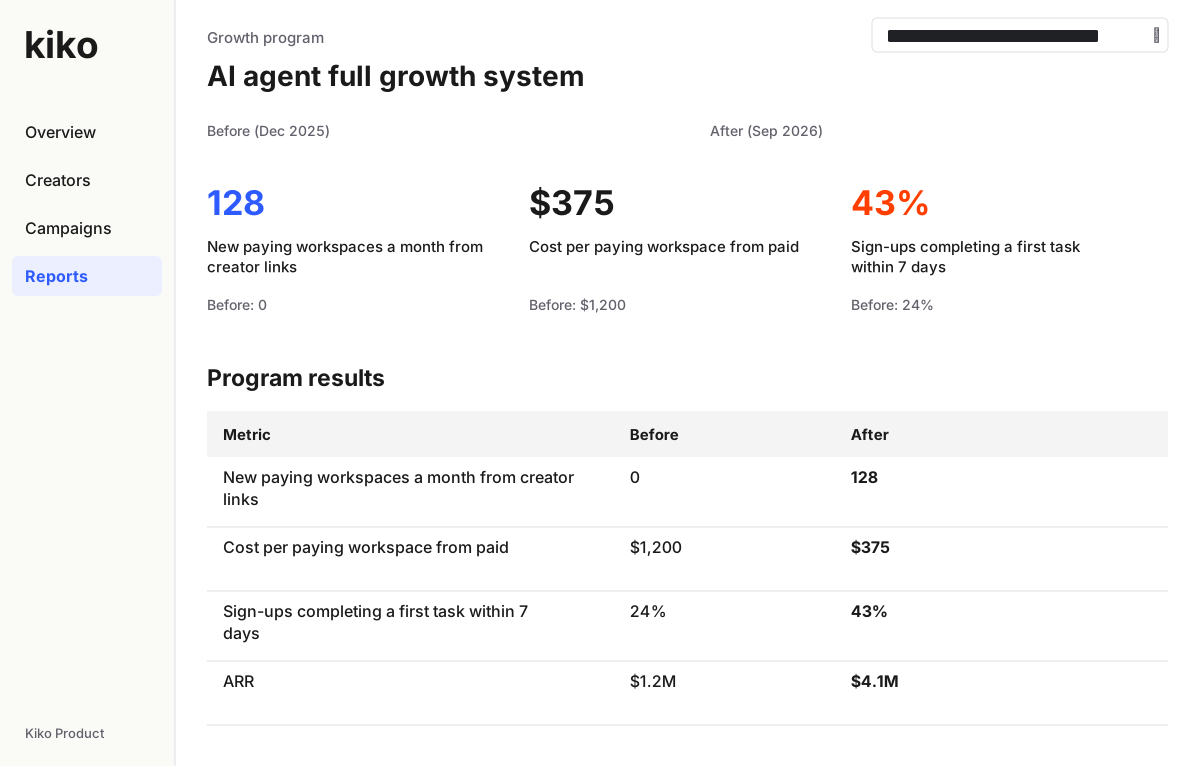
The results
| Pillar | Metric | Before (Dec 2025) | After (Sep 2026) | Change |
|---|---|---|---|---|
| Creator marketing | New paying workspaces a month from creator links | 0 | 128 | +128 |
| Paid ads | Cost per paying workspace from paid | $1,200 | $375 | −69% |
| Product growth | Sign-ups completing a first task within 7 days | 24% | 43% | +19 pts |
| Combined | ARR | $1.2M | $4.1M | 3.4x |
Blended CAC fell from $400 to $220 over the same period, and monthly logo churn from 4.1% to 2.8%.
What didn't work
- LinkedIn creator posts. Three posts by operations creators produced 9 paying workspaces at about $1,560 each. Small-business owners watch YouTube for this; we stopped after sprint 1.
- Short-form demos. Two TikTok creators brought 8 paying workspaces at $750 each. An agent run takes longer than the first 30 seconds of a short, and cutting it made the task look fake.
- A 30-day trial. Extending the free trial from 14 to 30 days lowered sign-up-to-paid within 30 days. We reverted after 4 weeks.
What we learned
- Pick the onboarding template from the creator video that converts best, not from the feature list.
- Read paid, creator and organic cohorts against one first-task definition from week 1, so every channel is judged on the same bar.
- Scale media only after activation moves; the paid CAC drop came from the product fix as much as from the creative.
Frequently asked questions
How much does a full growth system cost for an AI agent startup?
Judge it by unit cost: blended CAC fell from $400 to $220 per paying workspace, creators brought customers at $255 each and paid CAC fell from $1,200 to $375. Most Series A programs like this run $40,000–$85,000 a month in creator fees and media.
How long before ARR moved?
Creator posts went live in week 3 and the onboarding rebuild shipped in week 10, so sprint 1 was mostly setup and tests. Media scaled in sprint 2, once activation had moved. ARR reached $4.1M at month 9.
Would this work for a seed-stage AI agent startup with one founder on growth?
Parts of it. The seed-stage creator and activation cases linked below ran one pillar each, in 8 weeks and a 90-day sprint. Running all three at once takes a dedicated growth lead and a Series A media budget.
Related case studies and guides
Same industry, other angles:
- Creator marketing: a YC-backed, seed-stage AI agent startup, 1,840 activated workspaces in 8 weeks from 9 YouTube creators
- Paid ads: a seed-stage AI agent startup, Cost per activated workspace down 37% with demo-led YouTube and LinkedIn ads
- Product growth: a seed-stage AI agent startup, Week-one activation up from 22% to 41% in a 90-day sprint
- Creator marketing for AI agent startups, the industry front door
- How should an AI agent define activation? and demo-led ads for AI agents
- AI agent creators, the creator shortlist
- Fractional growth team, how Kiko runs all three pillars together