The company and program
| Fact | Detail |
|---|---|
| Client | A seed-stage test-prep app for nursing students preparing for the NCLEX licensure exam. |
| Stage | Seed |
| Industry | Education apps |
| Timeline | 10 weeks, Aug 18 – Oct 26, 2026. Results compare weeks 7–10 (Sep 29 – Oct 26) with the 4 weeks before Kiko started (Jul 21 – Aug 17) |
| Channels | TikTok and YouTube, US, ages 18+ only. Meta paused in week 1 |
| Team | A Kiko growth lead plus agents for creative tagging, budget pacing and weekly reporting. The client's counsel approved every claim |
The approach
| Test | Hypothesis | Compared against | Decision rule |
|---|---|---|---|
| Question-led creative | Nursing students stop scrolling for a hard practice question, not a feature list | "Thousands of practice questions" feature ads | Each concept gets $500–$1,000 or 7 days. Kill it if cost per trial is 30% above the best concept |
| YouTube in-stream | A 90-second walkthrough of one question converts students already studying on YouTube | Meta feature ads at the same budget | After 4 weeks, keep the channel with the lower cost per paid learner |
| Exam-date timing | Learners within 30 days of their exam convert at a higher rate | All nursing-student interest audiences | Keep the audience if trial to paid is higher at no more than 20% higher cost per trial |
A paid learner is a first purchase, monthly or 3-month pass. Cost per paid learner is media spend divided by paid learners and leaves out creator fees and Kiko's fee. The app costs $39 a month or $99 for a 3-month pass, after a 7-day free trial.
What we changed
- Weeks 1–2. Paused Meta feature ads and set first purchase as the optimization event on TikTok and YouTube. Signed 4 creators who are nursing students or new nurses, all over 18, with 90 days of paid usage in the base fee.
- Weeks 3–4. Ran creator "question of the day" posts as TikTok Spark Ads. Tested a 90-second YouTube walkthrough against a 60-second study-plan ad and YouTube Shorts.
- Weeks 5–6. Cut YouTube Shorts and launched the exam-in-30-days audience test.
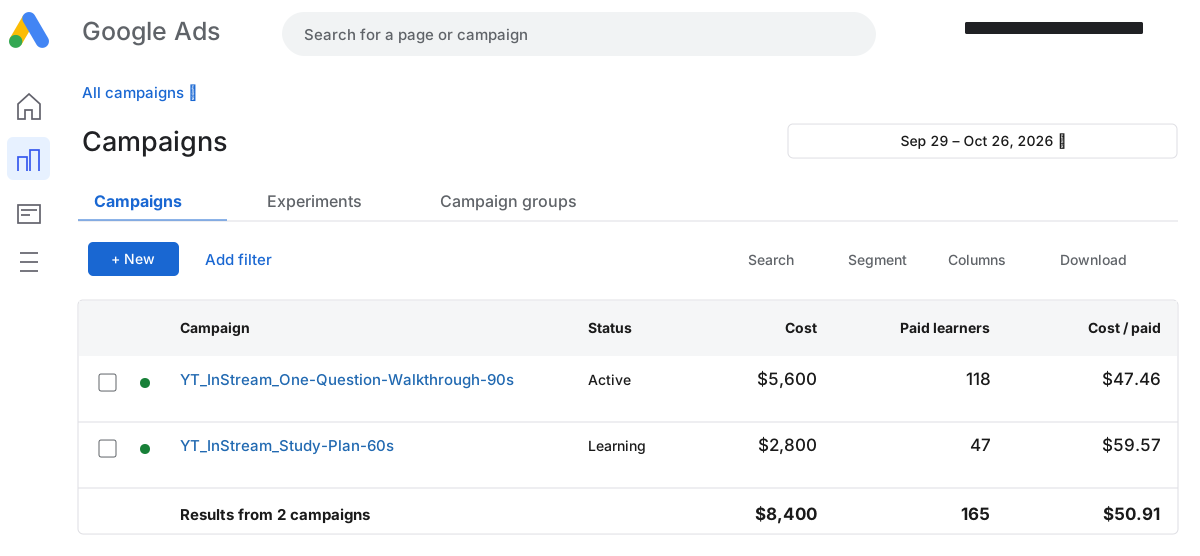
- Weeks 7–10. Put the budget behind three TikTok and two YouTube campaigns, with two new question videos a week.
The results
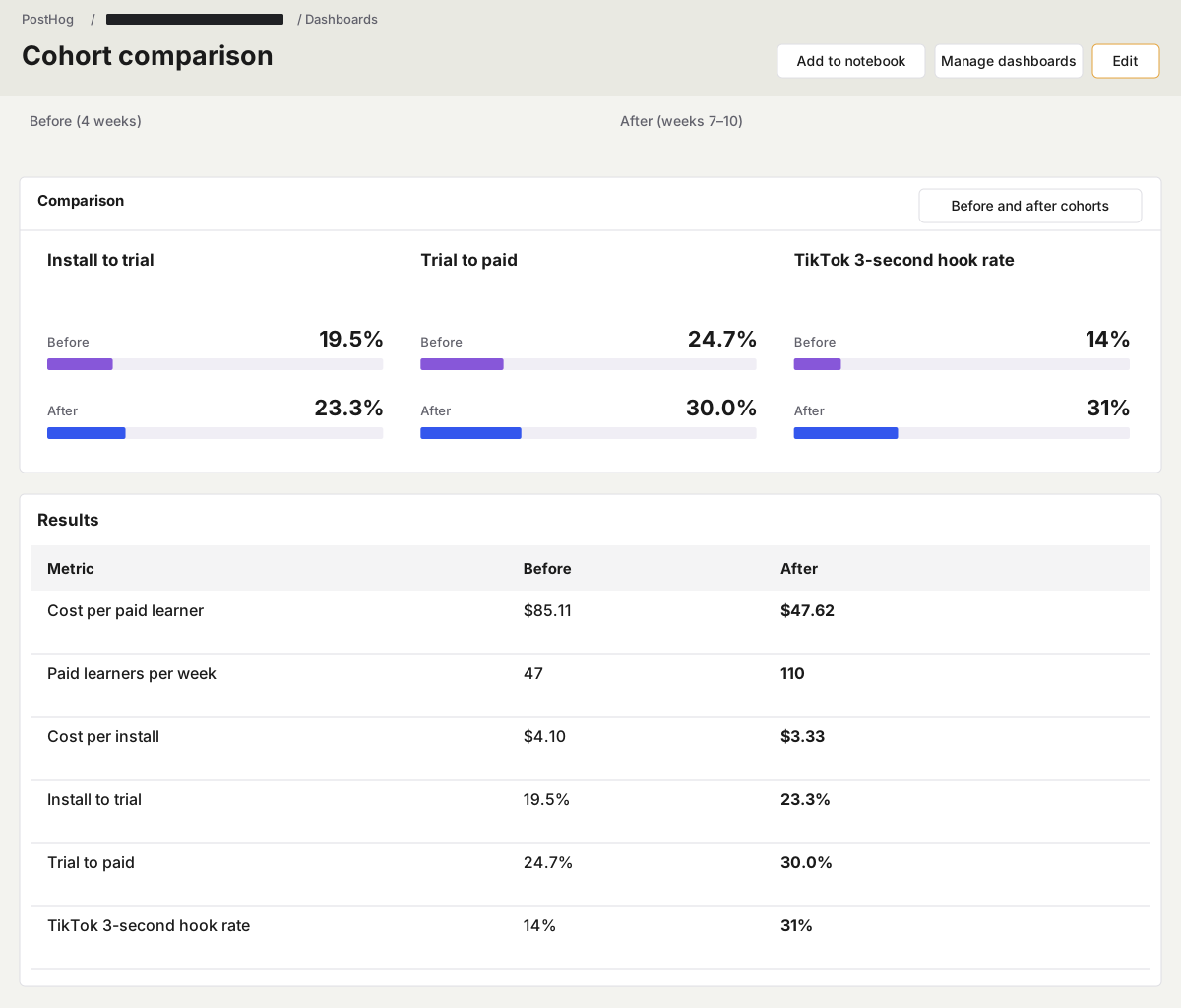
| Metric | Before (4 weeks) | After (weeks 7–10) | Change |
|---|---|---|---|
| Cost per paid learner | $85.11 | $47.62 | −44% |
| Paid learners per week | 47 | 110 | 2.3x |
| Cost per install | $4.10 | $3.33 | −19% |
| Install to trial | 19.5% | 23.3% | +3.8 pts |
| Trial to paid | 24.7% | 30.0% | +5.3 pts |
| TikTok 3-second hook rate | 14% | 31% | +17 pts |
Across all 10 weeks, 884 learners paid, at $54.30 each.
What didn't work
- Exam-countdown audiences. Learners within 30 days of their exam converted from trial to paid at 27%, below the 30% average. Most of them had already bought a prep course. The audience runs as a small always-on cell, not a priority.
- YouTube Shorts. They cost $68 per paid learner in weeks 3–5. Students who wanted a walkthrough skipped a 20-second clip. We cut them in week 5.
- The pass-rate claim. The client wanted to lead with its users' pass rate. The figure came from a self-reported survey of 212 users, so counsel did not approve it, and no ad used it.
What we learned
- Lead with one hard question and the reasoning, not the size of the question bank.
- Book creators who are nursing students or new nurses: their viewers are the exact learners.
- Optimize to the first purchase, not the install, from week 1.
Frequently asked questions
What does it cost to acquire a paid learner for a test-prep app on TikTok and YouTube?
Here, $47.62 per paid learner in weeks 7–10 and $54.30 across all 10 weeks. Most seed programs like this run $15,000–$35,000 a month in creator fees and media.
How long before cost per paid learner falls?
Ten weeks in total, with the 44% drop measured in weeks 7–10. The first six weeks went to channel, creative and audience tests at smaller budgets.
Would this work for a Series A language-learning app with a consumer subscription?
The format fits any app with a hard question to show. The numbers depend on an 18+ exam audience that already studies on YouTube, and on a 7-day trial. Learners close to their exam converted below average, at 27%.
Related case studies and guides
Same industry, other angles:
- Creator marketing: Day-7 retention up from 18% to 31% for creator-sourced users
- Product growth: Day-7 streak rate up from 22% to 39%
- Full growth system: grew paid learners 2.9x in 9 months
- Creator marketing for education apps
- How to work with TikTok creators for a learning app, plus TikTok ads and YouTube ads
- Study, teaching and language creators
- All case studies
Want a program like this? Book a call.