The company and program
| Client | A Series A coding bootcamp app. |
| Stage | Series A |
| Industry | Education apps |
| Pillars | Creator marketing + Paid ads + Product growth |
| Timeline | 9 months (three 90-day sprints), January–September 2026 |
| Channels | YouTube developer and study creators, TikTok creators; YouTube, TikTok and Meta ads to adults 18+; trial onboarding and paywall |
| Team | A dedicated Kiko growth lead plus agents for creator sourcing, claims pre-checks, ad variants, funnel pulls and weekly reporting; the client's product engineer |
| Headline result | Grew paid learners 2.9x in 9 months |
The approach
| Pillar | Hypothesis | Compared against | Decision rule |
|---|---|---|---|
| Creator marketing | Creators who build a small project live with the app bring more paid learners than "how I'd learn to code" talking-head videos | Talking-head career-advice videos from creators of similar size | After 14 days, rebook creators under $35 per paid learner; drop anyone over $60 |
| Paid ads | "Build this in 15 minutes" project hooks beat career-switch hooks on cost per paid learner | Career-switch hooks from the same creators | Each concept gets $1,000 or 7 days; scale anything under $55 per paid learner |
| Product growth | A guaranteed first project in the first session, with the paywall after it, raises trial-to-paid | The old syllabus-first onboarding with the paywall on day 1 | 50/50 split; ship if trial-to-paid rises 4 points or more at 95% confidence |
How the three pillars connected
Creator marketing
We booked 26 creators, every one with an adult audience confirmed before booking. The core was developer educators: a DevOps and cloud educator for career switchers, a frontend teacher and a learning-technique channel for adults who want to study faster. Each video built a small project with the app on screen. Creator links brought 10,000 paid learners at $26 each.
Paid ads
Media scaled from $30,000 to $65,000 a month across YouTube, TikTok and Meta, all targeted to adults 18+. Paid brought 10,000 paid learners at $50 each, against $70 in December. "Build this in 15 minutes" hooks cut from creator videos beat career-switch hooks by 40% on cost per paid learner.
Product growth
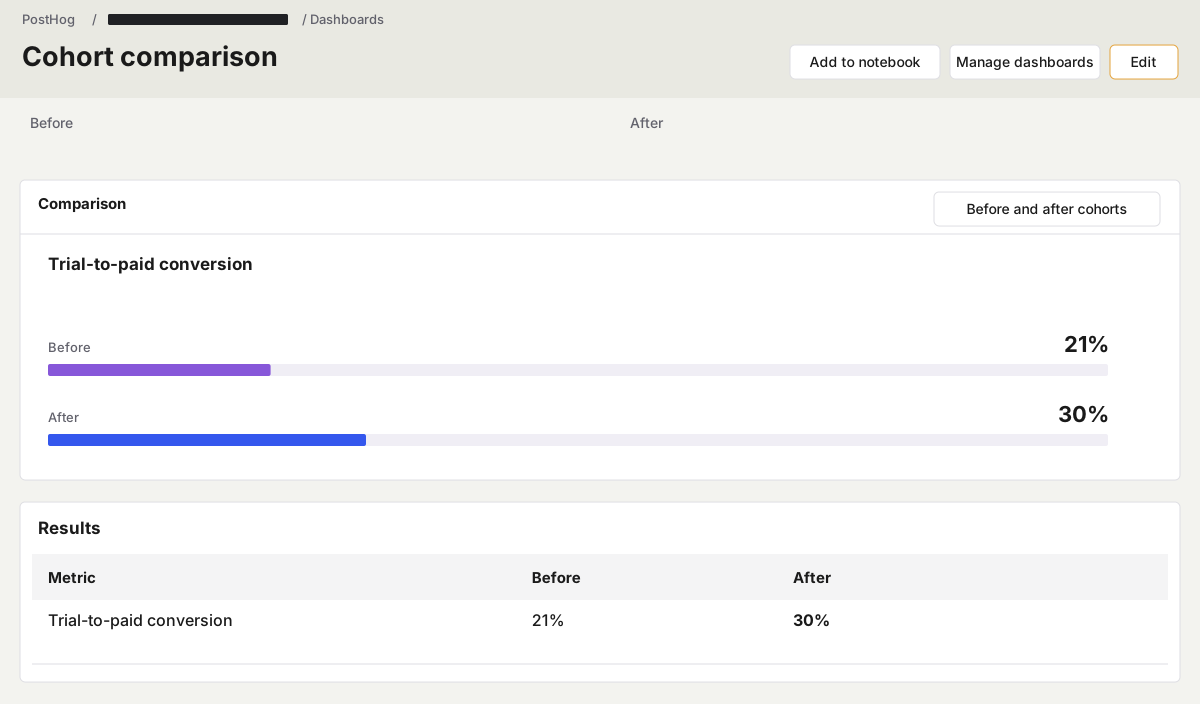
Paid volume showed where trials died: 71% wrote a first line of code, but only 26% finished a project in week one, and the paywall came before most of them did. We rebuilt the first session around a 15-minute project, a working web page the learner could share, added a mentor code review on day 3, and moved the paywall after the first project. Finished first projects in week one rose from 26% to 44%, and trial-to-paid rose from 21% to 30%.
How they fed each other
Creators proved the project hook before paid spent on it: the videos that built something converted best, so the ads promised a project too. Paid volume made the week-one drop obvious within a month. Once the first session delivered the project the ads promised, the promise and the product matched, trial-to-paid rose for every channel at once, and we could raise media to $65,000 a month while paid cost per learner kept falling.
What we changed
- Weeks 1–2: tie creator links and ad events to trial, first project and payment. Add an audience-age check to the creator rubric.
- Weeks 2–5: book the first 10 creators; first videos live in week 3.
- Weeks 3–8: test project hooks against career-switch hooks on YouTube, TikTok and Meta, each with $1,000 or 7 days.
- Weeks 6–12: find the week-one drop (71% write code, 26% finish a project), then A/B test the first-project onboarding and paywall; ship in week 12.
- Weeks 14–26 (sprint 2): creators to 20, mentor code review on day 3 shipped, media to $60,000 a month.
- Weeks 27–39 (sprint 3): final 6 creators, media at $65,000 a month on project hooks, win-back email for lapsed learners.
The results
| Pillar | Metric | Before | After | Change | How measured |
|---|---|---|---|---|---|
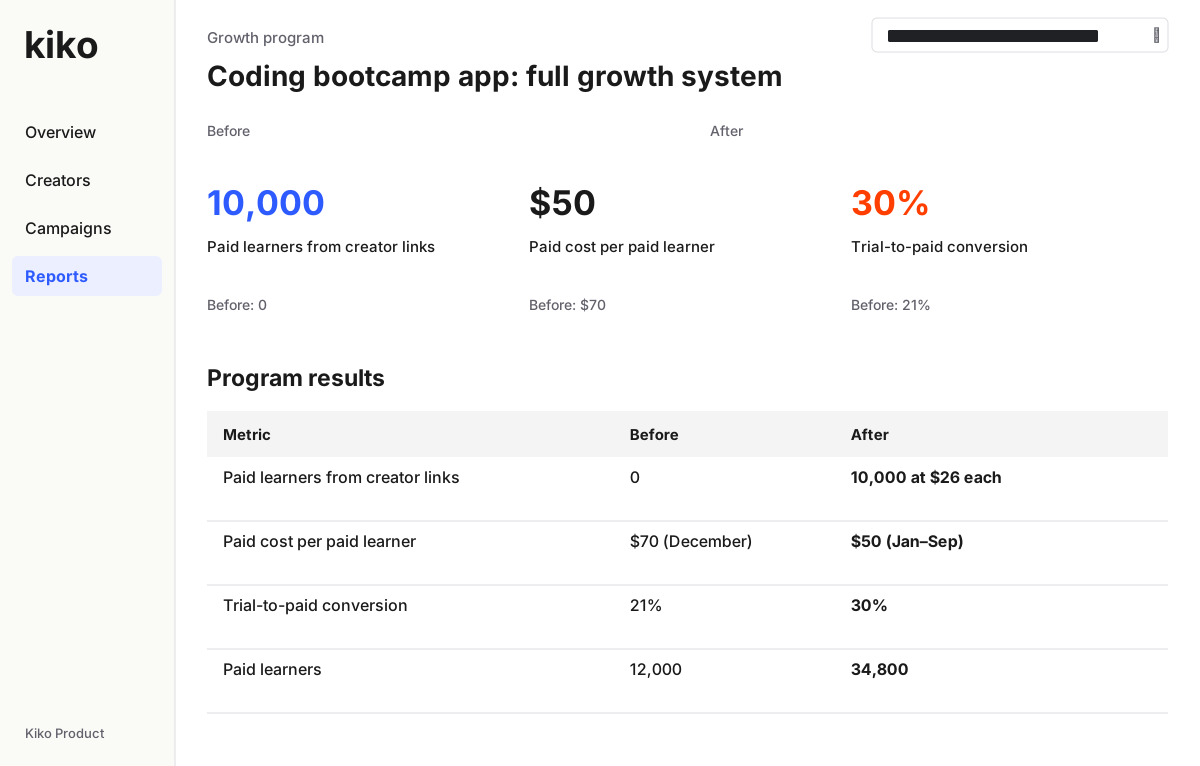
| Creator marketing | Paid learners from creator links | 0 | 10,000 at $26 each | +10,000 | Creator links joined to subscriptions |
| Paid ads | Paid cost per paid learner | $70 (December) | $50 (Jan–Sep) | −29% | YouTube, TikTok and Meta ads managers, joined to subscriptions |
| Product growth | Trial-to-paid conversion | 21% | 30% | +9 pts | A/B test, then full rollout; subscription data |
| Combined (headline) | Paid learners | 12,000 | 34,800 | 2.9x | Subscription system, month end |
What didn't work
- Study-with-me TikTok creators. Their audiences skewed under 18, so two were cut at the age check after booking talks, and the one who posted brought 120 paid learners at $75 each.
- Career-switch hooks. Outcome claims about jobs or salaries were banned by the claims checklist from day one, and the softer "switch careers" hook still lost to project hooks by 40%.
- Meta was the cheapest paid channel at $40 per paid learner, but those learners churned faster: 52% still paying at month 3, against 63% from YouTube.
What we learned
- Check audience age before outreach, not after; it saves weeks and keeps paid targeting clean.
- Make the ad's promise and the first session the same thing: a finished project.
- Judge channels on month-3 learners, not first payments, before moving budget.
Frequently asked questions
What does it cost to run creators, paid ads and product growth together for an education app?
Each new paid learner cost $21.11 blended, against $37.30 before the program; creators came in at $26 and paid at $50. Most Series A programs like this run $40,000–$100,000 a month in creator fees and media.
How long before paid learners grew?
First videos were live in week 3, the first-project onboarding shipped in week 12, and media reached $65,000 a month in sprint 3. Paid learners went from 12,000 to 34,800 over the 9 months.
Would this work for a seed-stage language-learning app?
The project-first onboarding and the paywall after the first win apply to any learning app. Paid here started at $30,000 a month, so a seed app should run creators first, copy the onboarding test, then add paid.
Related case studies and guides
Same industry, other angles:
- Creator marketing: Day-7 retention up from 18% to 31% for creator-sourced users
- Paid ads: Cost per paid learner down 44% in 10 weeks on TikTok and YouTube
- Product growth: Day-7 streak rate up from 22% to 39%
Guides and creators: