The company and program
| Client | A seed-stage link-in-bio and storefront tool for creators selling digital products. |
| Stage | Seed |
| Industry | Creator tools |
| Timeline | 10 weeks, 13 July – 20 September 2026. First posts in week 3, paid amplification from week 4 |
| Channels | TikTok and Instagram creator posts, YouTube integrations, TikTok Spark Ads, Meta partnership ads |
| Team | 1 dedicated Kiko growth lead, plus agents for creator scoring, earnings-claim checks and daily conversion reporting |
The approach
- Hypothesis: creators buy a storefront tool when a peer shows real money earned through it, not when they watch a tour of its features.
- Comparison: revenue-proof posts (the creator's own storefront dashboard on screen) against tool walkthroughs and setup tours, organic and as paid ads.
- Decision rule: 7 days of organic data per post before any spend. Each ad concept then got $500–$1,000 or 7 days. Pause above $25 per paid creator; scale below $20.
What we changed
- Weeks 1–2: score and sign. We scored 85 creators on Kiko's six-point rubric and signed 12, starting with creators who already sold presets, templates or guides from a bio link. Two were YouTube channels: a creator-business interview channel and a creator-tools review channel. Ten were TikTok and Instagram creator-coaches and small sellers at 8K–150K followers, and every contract included 90 days of paid usage.
- Week 2: brief. Set up a real storefront, list one product and show what it earned. Kiko checked every revenue figure on screen against the creator's own dashboard, and every script for FTC disclosure.
- Week 3: organic posts. The first 12 posts went live with tracked links.
- Week 4: paid test. The five strongest posts went into TikTok Spark Ads and Meta partnership ads: revenue proof, walkthrough and setup tour.
- Weeks 5–10: scale. Walkthrough and setup-tour ads paused, budget moved to revenue-proof ads, and 22 more posts briefed from the same creators so new earnings stories kept coming.
The results
| Metric | Before (prior 10 weeks, brand ads) | After (weeks 1–10) | Change |
|---|---|---|---|
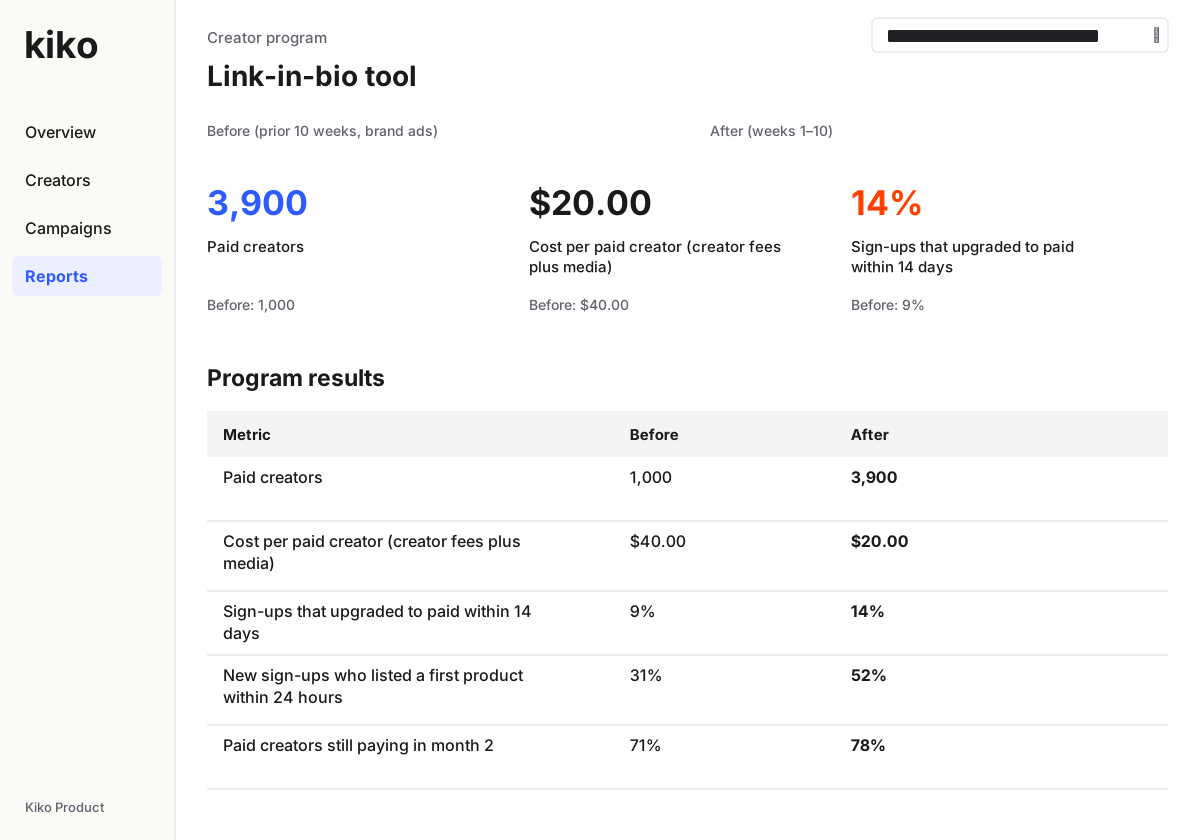
| Paid creators | 1,000 | 3,900 | 3.9x |
| Cost per paid creator (creator fees plus media) | $40.00 | $20.00 | −50% |
| Sign-ups that upgraded to paid within 14 days | 9% | 14% | +5 pts |
| New sign-ups who listed a first product within 24 hours | 31% | 52% | +21 pts |
| Paid creators still paying in month 2 | 71% | 78% | +7 pts |
What didn't work
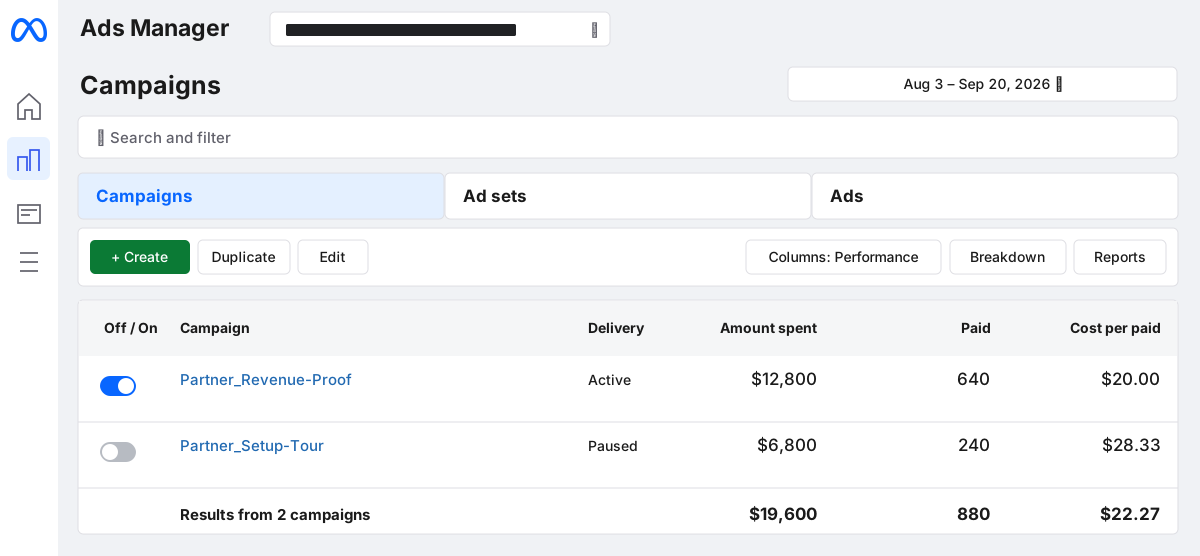
- Walkthroughs lost. The TikTok walkthrough ad ran at $28.00 per paid creator and was paused. Creators already know what a bio link does.
- Setup tours lost on Meta too. The setup-tour ad ran at $28.33 per paid creator. A good-looking page was not the reason to pay.
- The tools-review channel converted below the coaches. Its viewers compared tools carefully and often stayed on the free plan. Coaches with small-seller audiences drove most upgrades.
What we learned
- Lead with the creator's own earnings dashboard. Revenue-proof posts drove 920 of the 1,450 paid creators from organic links.
- Book small sellers over big names. Creators at 8K–150K followers looked like the buyer, and their viewers believed the numbers.
- Push the first product listing in onboarding. New users who listed a product on day one were the ones who paid.
Frequently asked questions
How much does a creator campaign for a creator tool cost?
Creator fees and media came to $20.00 per paid creator: $21.52 on fees for organic links and $19.10 on Spark and partnership ads. Most seed programs like this run $15,000–$35,000 a month in creator fees and media.
How quickly did paid creators come in?
First posts went live in week 3, after two weeks of scoring and briefing. Paid amplification started in week 4, once each post had 7 days of organic data, and weeks 5–10 scaled only the revenue-proof ads.
Would this work for a Series A creator CRM or analytics tool?
Only with a different brief. Revenue proof needs a product that makes creators money they can show on screen; a CRM has no earnings dashboard. Small-seller coaches at 8K–150K followers still fit, and the tools-review channel converted below them.
Related case studies and guides
Same industry, other angles:
- Paid ads: 4,700 paid creators in 12 weeks at $41 CAC
- Product growth: Creators making a first sale in week one up from 14% to 33%
- Full growth system: grew paying creators from 6,000 to 21,000 in 8 months