The company and program
| Client | A seed-stage storefront tool where creators sell digital products (guides, presets, templates) from their link in bio, on a free plan with a transaction fee and a $19-a-month plan without one. |
| Stage | Seed |
| Industry | Creator tools |
| Timeline | One 90-day sprint, May 4 to August 2, 2026 |
| Channels | Creator onboarding, the product editor, payout setup, lifecycle email and push |
| Team | A Kiko growth lead plus agents: an onboarding-funnel agent, a product-import agent that drafted a first product from a creator's existing post for them to edit, and an experiment write-up agent. The client's three engineers built the changes; its payments partner approved the held-funds flow. |
The approach
- Hypothesis: a creator who makes one sale in week one stays and upgrades. Three things stop it: an empty product editor, payout verification before the first sale, and never telling followers.
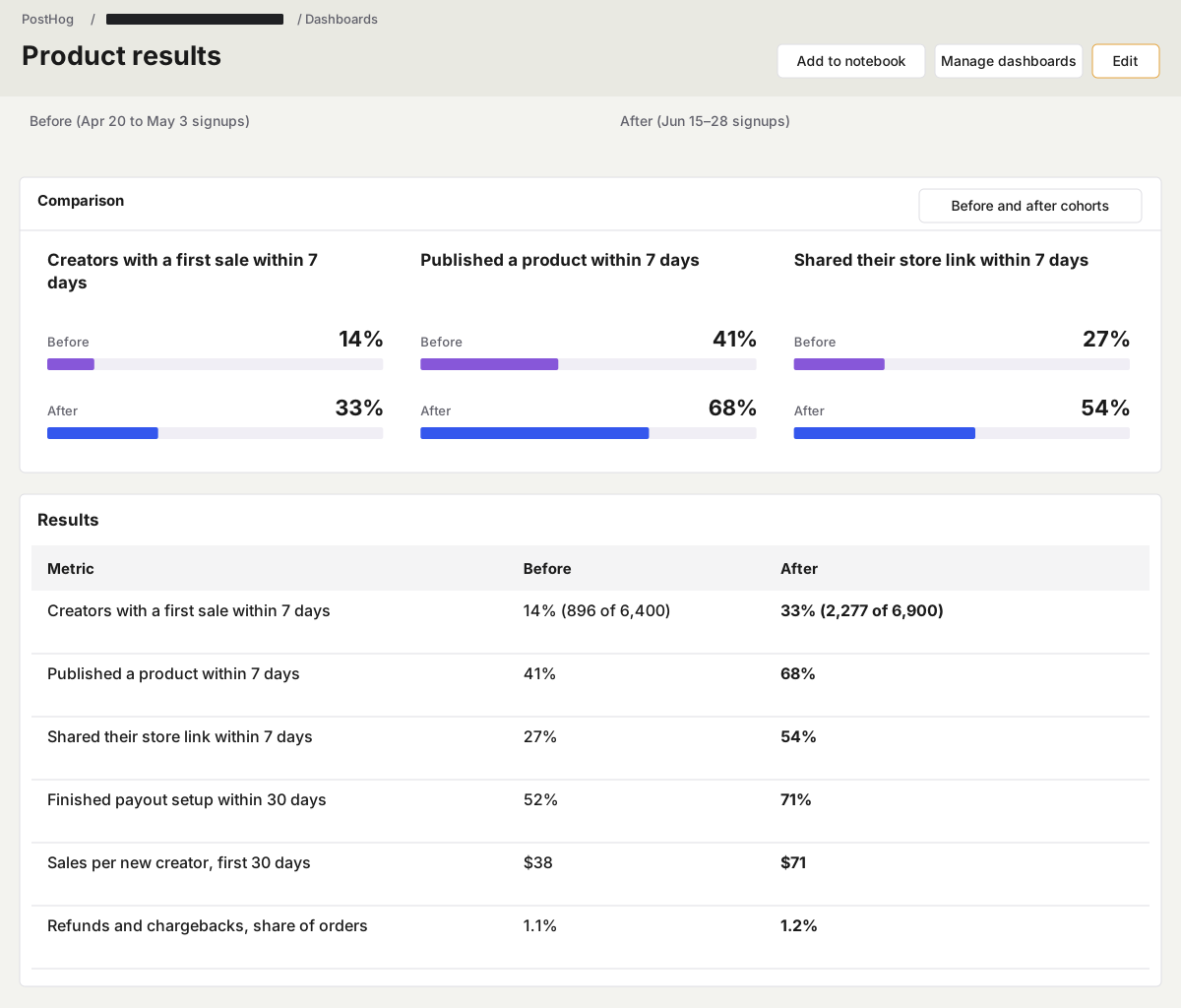
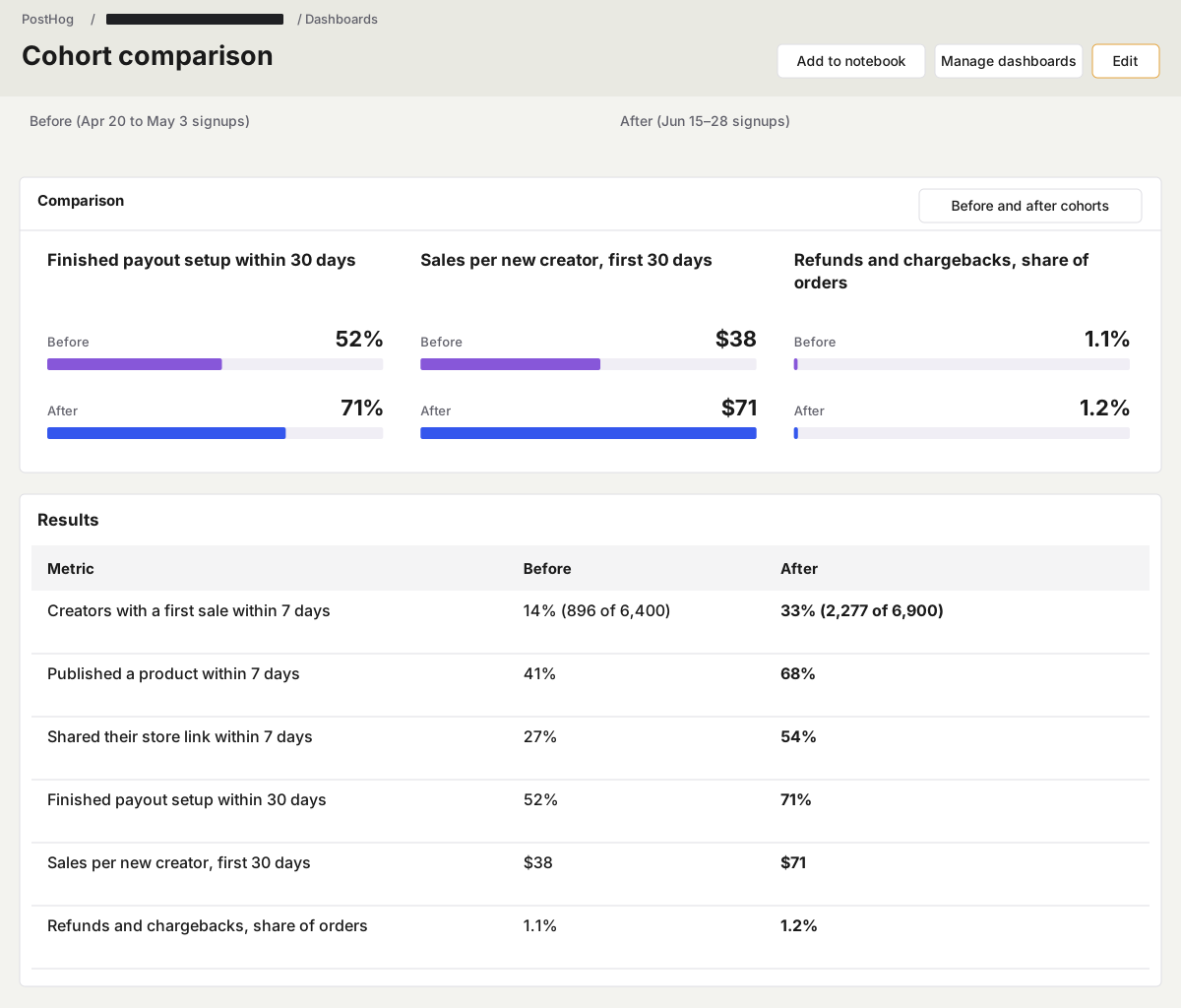
- Comparison: each change ran against a 50/50 split of new creator signups for at least 14 days. The final read compares creators who signed up from April 20 to May 3 with June 15–28, after every winner was live.
- Decision rule: ship if first sales in week one rise at least 2 points at 95% confidence, refunds and chargebacks stay under 2% of orders, and median product price doesn't fall. Kill it otherwise.
What we changed
- Weeks 1–2: the funnel and 25 creator interviews. Creators didn't know what to sell first, and 1 in 3 who published a product stopped at payout verification.
- Weeks 3–6: test A, a starter product from an existing post. An agent drafted a post the creator had already made as a $9–$15 guide for them to edit. Publishing within 7 days rose from 41.2% to 63.5%.
- Weeks 3–4: test E, a "start at $1" suggestion. Killed within two weeks: median price fell from $12 to $3.
- Weeks 4–6: tests C and D, sharing and descriptions. A share kit plus a day-2 "launch it" reminder lifted link sharing from 33.0% to 49.6%. AI-written product descriptions were killed.
- Weeks 5–6: test B, sell before payout setup. Funds were held until payout verification was done, with a banner showing the amount waiting. First sales in week one rose from 19.8% to 27.4%.
- Weeks 7–13: winners to 100%, the read and handover. Tests A, B and C went to all new creators on June 15. We read 30-day sales and payout setup for June 15–28 signups and handed over the dashboards.
The results
| Metric | Before (Apr 20 to May 3 signups) | After (Jun 15–28 signups) | Change |
|---|---|---|---|
| Creators with a first sale within 7 days | 14% (896 of 6,400) | 33% (2,277 of 6,900) | +19 pts |
| Published a product within 7 days | 41% | 68% | +27 pts |
| Shared their store link within 7 days | 27% | 54% | +27 pts |
| Finished payout setup within 30 days | 52% | 71% | +19 pts |
| Sales per new creator, first 30 days | $38 | $71 | +87% |
| Refunds and chargebacks, share of orders | 1.1% | 1.2% | +0.1 pts |
What didn't work
- AI-written product descriptions. Creators rewrote most of them, and publishing moved from 63.1% to 63.8%, which was not significant. The agent now drafts from the creator's own words only.
- Suggesting a $1 first product. It got more first sales, but median price fell from $12 to $3, and those creators rarely raised it. Killed within two weeks.
- The TikTok share asset. It drew a quarter of the link clicks of the Instagram story version, so the kit now leads with the story.
What we learned
- Start from something the creator has already made.
- Let creators sell before the paperwork, with funds held until it's done.
- Hand creators the launch post. Don't just tell them to share.
Frequently asked questions
What does an activation sprint for a creator tool cost?
There was no creator or media spend, so the only cost was Kiko's 90-day sprint, priced from $10,000 a month. The client's three engineers built the changes, and sales per new creator in their first 30 days rose from $38 to $71.
How long before first-sale rates moved?
Test A showed its lift within its first 14-day read in weeks 3–4. All three winners were live for every new creator by June 15, week 7, and the 30-day read on that cohort closed the sprint in week 13.
Would this work for a Series A creator CRM or a tool with no payments?
The starter-from-an-existing-post pattern and the share kit transfer to any creator tool with an empty first screen. Selling before payout setup only matters if you hold creator money; a CRM would need a different week-one win.
Related case studies and guides
Same industry, other angles:
- Creator marketing: 3,900 paid creators in 10 weeks
- Paid ads: 4,700 paid creators in 12 weeks at $41 CAC
- Full growth system: grew paying creators from 6,000 to 21,000 in 8 months