The company and program
| Client | A Series A creator monetization platform |
| Stage | Series A |
| Industry | Creator tools |
| Pillars | Creator marketing + Paid ads + Product growth |
| Timeline | 8 months, Feb 1 – Sep 30, 2026: two 90-day sprints and a 60-day third sprint |
| Channels | YouTube and Instagram creator partnerships, a customer affiliate program, Meta partnership ads, TikTok Spark Ads, onboarding and lifecycle email |
| Team | A dedicated Kiko growth lead plus agents for creator research, affiliate tracking, ad reporting and cohort pulls. The client's engineers built the onboarding changes Kiko specced |
| Headline result | Paying creators from 6,000 to 21,000 in 8 months |
| Measured in | Product analytics, Stripe, Meta and TikTok ads managers, affiliate links and a source question at sign-up |
The approach
- Hypothesis: creators upgrade once they have made their first sale. If creators show a real first sale, ads reuse those videos to reach creators who have an audience but nothing to sell yet, and onboarding gets a paid offer live within a week, every channel converts better and paying creators stay longer.
- Comparison: January 2026 was the baseline: Meta ads at $125 per paying creator from paid, 400 new paying creators, a blended CAC of $62.50 and 21% of sign-ups with a paid offer live within 7 days. Each later month was read against it, by source.
- Decision rule: a sponsored creator post got 7 days of organic data and went into paid only if its sign-ups put an offer live within 7 days at 35% or better. Ad concepts got $500–$1,000 or 7 days and were killed above $90 per paying creator. Onboarding changes shipped only after a 50/50 test lifted 7-day offer-live by 4 points or more.
How the three pillars connected
Creator marketing
We ran two tracks. First, 10 sponsored creator-economy educators in the first 30 days and 16 over the engagement: YouTube channels about the business of creating and Instagram creators who teach monetization. Second, the platform's own customers: we recruited 140 creators already selling on it as affiliates at a 20% recurring commission for 12 months. Every script avoided income promises; creators showed their own first sale and stated it was their result, not a typical one. Both tracks together brought 6,700 paying creators at $33 each.
Paid ads
The baseline ran feature-list ads at $125 per paying creator from paid. We rebuilt the account around creator videos, run as Meta partnership ads and TikTok Spark Ads, targeted to people who manage a creator or business page. Monthly media more than doubled from February to September, and paid brought 6,492 paying creators.
Product growth
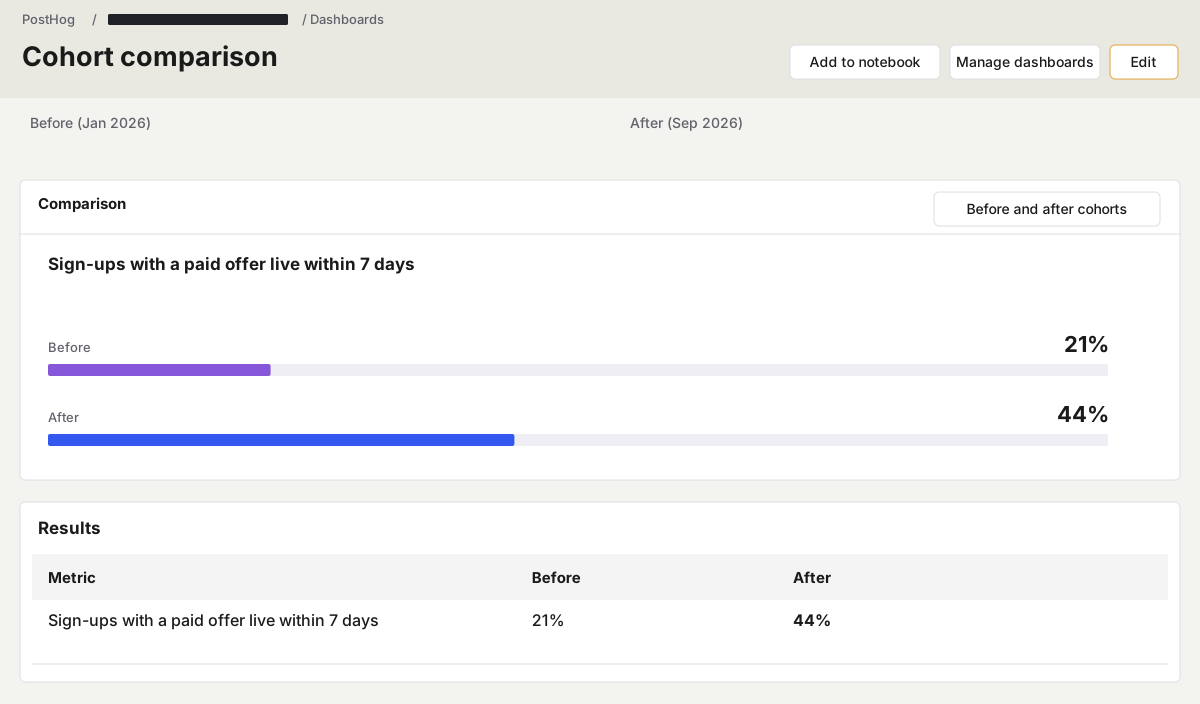
The funnel showed new creators stalling at payouts: identity verification for payouts came first, before they had built anything. We specced offer-first onboarding: three templates (paid community, digital download, booked call) prefilled from the creator's existing link-in-bio, payouts set up only when the first offer is ready to publish, a "share to Stories" kit with a link sticker, and an email the day after publishing with the first visitor count. Payouts connected rose from 48% to 70%, offer live within 7 days from 21% to 44%, and the paid-plan rate within 30 days from 9.5% to 16%.
How they fed each other
The creator videos that converted best showed a creator's first sale notification arriving on screen, so that moment became the hook for paid and the goal of onboarding. Paid volume exposed the payouts stall in the first month. Moving payouts later lifted creator and affiliate sign-ups as well, and cut paid CAC from $125 to $79. Every storefront carries a "made with" badge, so each newly live creator advertised the platform to their own audience; organic paying creators grew from 200 to about 1,300 a month.
What we changed
- Weeks 1–2: event audit, the offer-live definition, the January baseline by source, a creator shortlist scored on Kiko's six-point rubric, and an affiliate offer for existing customers.
- Weeks 3–6: first sponsored posts live in week 3 and 60 affiliates onboarded. Twelve ad concepts tested at $500–$1,000 each, and offer-first onboarding into a 50/50 test.
- Weeks 7–13: offer-first onboarding shipped to all users. Four creator videos passed the rule and ran as partnership ads and Spark Ads.
- Weeks 14–26 (sprint 2): six more sponsored creators and 80 more affiliates added, and the Stories kit and first-visitor email shipped. Media scaled on the winning videos.
- Weeks 27–35 (sprint 3): media reached its highest month, affiliate videos rotated into paid every two weeks, and the paid plan's lower transaction fee was surfaced at the first sale.
The results
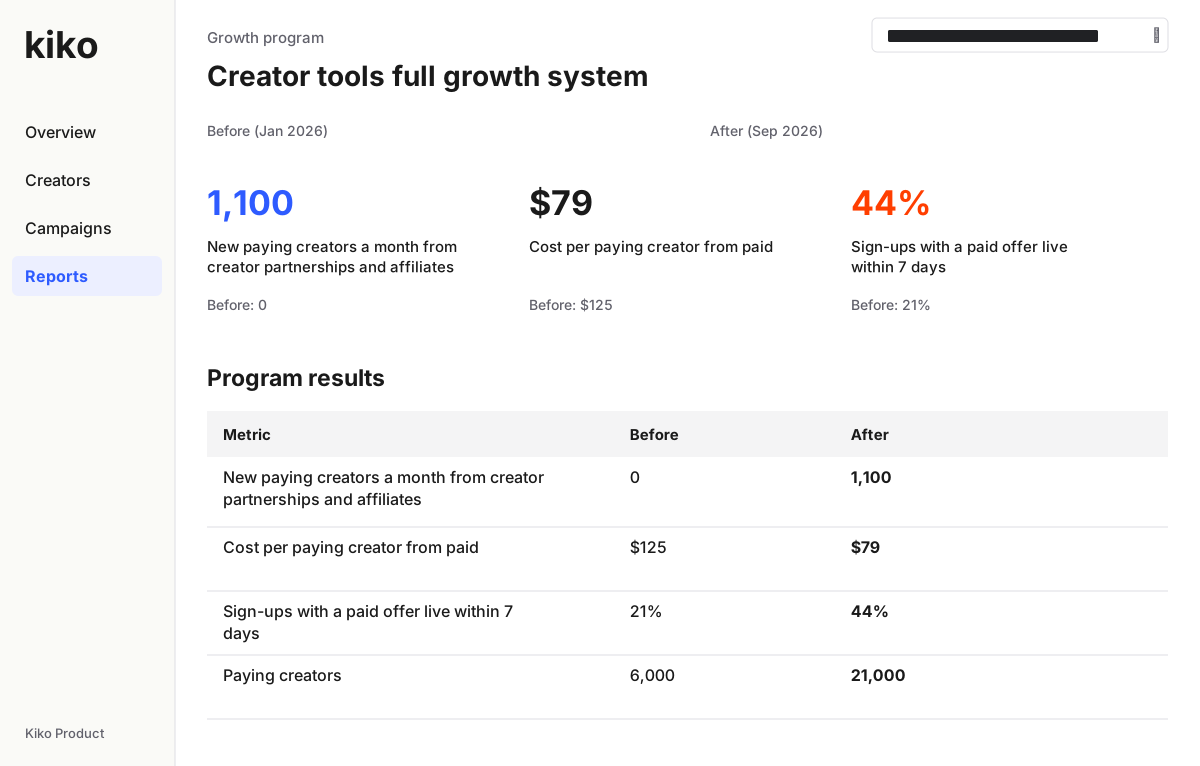
| Pillar | Metric | Before (Jan 2026) | After (Sep 2026) | Change |
|---|---|---|---|---|
| Creator marketing | New paying creators a month from creator partnerships and affiliates | 0 | 1,100 | +1,100 |
| Paid ads | Cost per paying creator from paid | $125 | $79 | −37% |
| Product growth | Sign-ups with a paid offer live within 7 days | 21% | 44% | +23 pts |
| Combined | Paying creators | 6,000 | 21,000 | 3.5x |
Blended CAC fell from $62.50 to $30, MRR grew from $204,000 to $756,000, and monthly churn fell from 6.7% to 4.8%.
What didn't work
- A mega-creator. One sponsored post by a lifestyle creator with more than 1M followers brought paying creators at about $125 each, nearly four times the creator average. The audience was fans, not creators with something to sell.
- Income-screenshot ads. Ads built around payout screenshots did not pass Kiko's compliance review: under the FTC Endorsement Guides, a featured creator's results imply typical results, and the client could not support that. We replaced them with first-sale moments.
- Very small TikTok creators. Creators under 10,000 followers attracted aspiring creators with no audience yet; only 4% of their sign-ups started a paid plan.
What we learned
- Recruit existing customers as affiliates in month 1; they were the cheapest and most credible creators in the program.
- Ask for the value moment (a first sale) before the paperwork (payouts verification).
- Show a real first sale instead of income claims, in creator scripts and in ads.
Frequently asked questions
How much does it cost to grow a creator tool with creators, affiliates and paid ads together?
Each new paying creator cost $35 across the 8 months and $30 by September: $72 from paid ads and $33 from creators and affiliates. Most Series A programs like this run $55,000–$100,000 a month in creator fees, commissions and media.
How quickly can a creator affiliate program start paying off?
Sixty existing customers were onboarded as affiliates in weeks 3 to 6 and 80 more in sprint 2. Together with 16 sponsored creators they brought 6,700 paying creators over 8 months, 1,100 of them in September alone.
Would this work for a seed-stage link-in-bio tool with a free plan?
Offer-first onboarding and the "made with" badge apply to any creator tool with a public storefront. The affiliate program needs paying customers to recruit; this platform had 6,000. A seed tool should start with sponsored educators and the onboarding fix.
Related case studies and guides
Same industry, other angles:
- Creator marketing: 3,900 paid creators in 10 weeks, a seed-stage link-in-bio and storefront tool for creators
- Paid ads: 4,700 paid creators in 12 weeks at $41 CAC, a Series A CRM for creators
- Product growth: Creators making a first sale in week one up from 14% to 33%, a seed-stage creator storefront tool
Playbooks and lists:
- Creator marketing for creator tools, the industry front door
- How creator-tool apps acquire creators with paid ads and creators as customers, the playbooks
- Creator lists by industry, the creators hub
- Fractional growth team, how Kiko runs all three pillars together