The company and program
| Client | A Series A options-education and investing app. |
| Stage | Series A |
| Industry | Investing apps |
| Pillars | Creator marketing + Paid ads + Product growth |
| Timeline | 9 months (three 90-day sprints), January–September 2026 |
| Channels | YouTube creators and investing newsletters; Meta, YouTube and Reddit ads; onboarding and lifecycle messages |
| Team | A dedicated Kiko growth lead plus agents for creator sourcing, claims pre-checks, ad variants, funnel pulls and weekly reporting; the client's product engineer and counsel |
| Headline result | Grew assets under custody from $40M to $165M in 9 months |
The approach
| Pillar | Hypothesis | Compared against | Decision rule |
|---|---|---|---|
| Creator marketing | Creators who paper-trade one defined-risk strategy step by step bring more funded accounts than market-commentary videos | Market-commentary and "what I'm buying" videos from creators of similar size | After 14 days, rebook creators under $90 per funded account; drop anyone over $150 |
| Paid ads | Creator walkthroughs cut into 30- and 60-second ads beat studio product ads on paid cost per funded account | The app's existing studio ads, same audiences and budget | Each concept gets $1,000 or 7 days; scale anything 20% below the account's cost per funded account |
| Product growth | Linking a bank during signup, while options approval runs, raises the share of approved accounts funded within 14 days | The old flow, which asked for a bank link only after approval | 50/50 split; ship if funding within 14 days rises 5 points or more at 95% confidence |
How the three pillars connected
Creator marketing
We booked 24 creators over 9 months: options-education YouTubers, markets explainers and two investing newsletters. The typical booking was a 100K–200K-subscriber options YouTuber who paper-trades a covered call or a cash-secured put on screen. The two largest were a markets-explainer channel and a personal-finance YouTuber for first-time investors. 61 videos and 14 newsletter placements went live. Kiko checked every script against the FTC Endorsement Guides and platform branded-content rules, the client's counsel signed off each one before filming, and every video read the options risk disclosure on camera. Creator links brought 3,600 funded accounts at $50 each.
Paid ads
Media scaled from $45,000 to $80,000 a month across Meta, YouTube and Reddit. Paid brought 5,000 funded accounts at $120 each, against $200 in Q4 2025. Creator footage won from the first round of tests. By month 4, 70% of paid spend ran on creator cuts as partnership ads, each one using claims counsel had already approved and run within each platform's financial-services ad rules.
Product growth
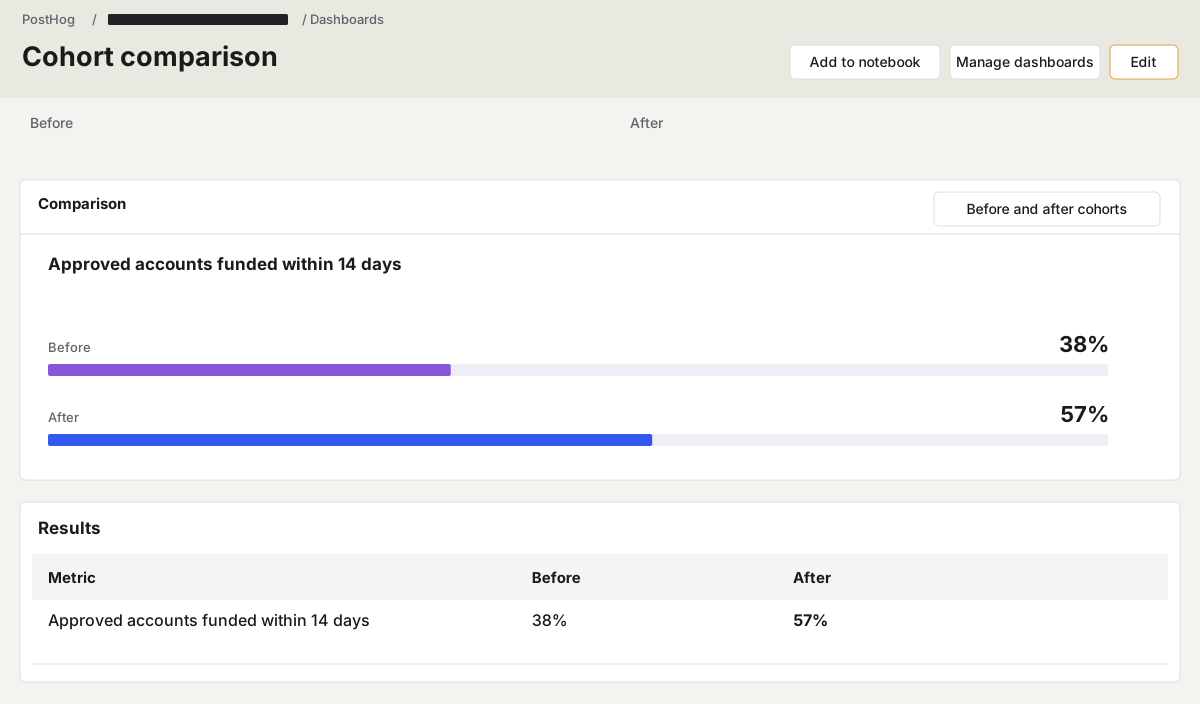
Paid volume showed the leak within six weeks. 62% of approved accounts that never funded stopped at the bank-link step, which the old flow only showed after an options approval that took up to two days. We moved the bank link into signup, opened a paper-trading sandbox on the strategy from the video the user came from, and sent a deposit reminder the moment approval cleared. The share of approved accounts funded within 14 days rose from 38% to 57%, and median time from approval to first deposit fell from 6 days to 2.
How they fed each other
The best creator walkthroughs became the paid ads, so the paid team started from hooks that had already earned funded accounts. Paid volume exposed the bank-link leak far sooner than creator traffic alone would have. Once the fix shipped, each click was worth 1.5 times as many funded accounts (57% ÷ 38%), which is most of why paid cost per funded account fell from $200 to $120 while monthly spend nearly doubled. Creator comments fed the product too: the three most-asked questions under the videos became the sandbox's first three screens.
What we changed
- Weeks 1–2: tie creator links, promo codes and ad events to approved, funded and first-trade events. Agree the claims checklist with counsel.
- Weeks 2–5: book and brief the first 10 creators; first videos live in week 3.
- Weeks 3–8: run 18 paid concepts on Meta and YouTube, creator cuts against studio ads, each with $1,000 or 7 days.
- Weeks 6–12: find the funding leak (62% of unfunded approved accounts stopped at the bank link), then A/B test the bank link at signup; ship to everyone in week 12.
- Weeks 14–26 (sprint 2): creators to 18 active, Reddit added at $15,000 a month, paper-trading sandbox launched.
- Weeks 27–39 (sprint 3): media to $80,000 a month, newsletter placements, deposit-reminder messages, final 6 creators booked.
The results
| Pillar | Metric | Before | After | Change | How measured |
|---|---|---|---|---|---|
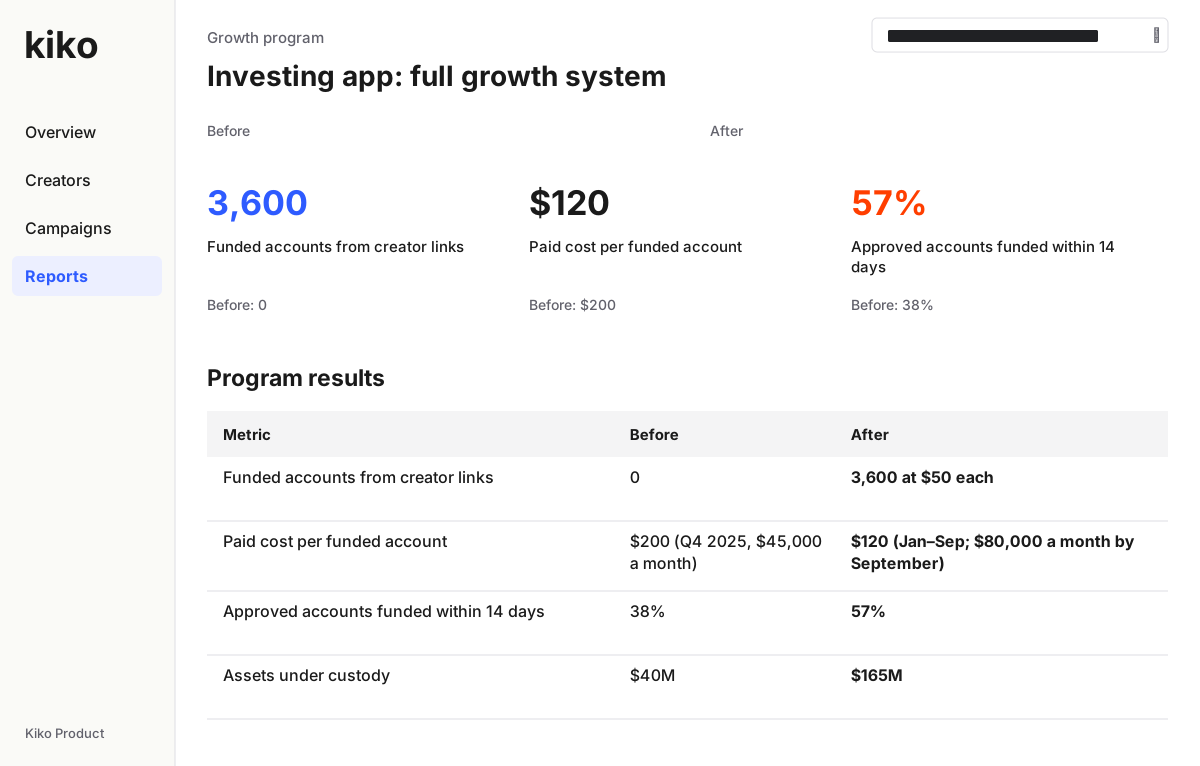
| Creator marketing | Funded accounts from creator links | 0 | 3,600 at $50 each | +3,600 | Unique links and promo codes joined to funded accounts |
| Paid ads | Paid cost per funded account | $200 (Q4 2025, $45,000 a month) | $120 (Jan–Sep; $80,000 a month by September) | −40% | Meta, YouTube and Reddit ads managers, joined to funded accounts |
| Product growth | Approved accounts funded within 14 days | 38% | 57% | +19 pts | A/B test, then full rollout; product analytics |
| Combined (headline) | Assets under custody | $40M | $165M | 4.1x | Custodian month-end statements; about $14M of the rise was market moves, the rest deposits |
What didn't work
- Short-form TikTok creators. Three creators brought 41 funded accounts, about $220 each. The options risk disclosure didn't fit a 30-second video, and counsel cut most of the hooks. We stopped after one round.
- A live "trade with me" stream drew 38,000 views but only 60 funded accounts. Viewers came to be entertained, not to follow a walkthrough.
- Reddit stayed the most expensive paid channel at $150 per funded account, so we held it at $15,000 a month from April and never scaled it.
What we learned
- Agree the claims checklist with counsel before the first creator brief, so paid can re-cut approved videos without a second review.
- Turn the best creator walkthroughs into ads within days of posting, once they have had 7 days of organic data.
- Send paid traffic early. Volume finds the onboarding leak, and fixing it lowers the cost of every channel at once.
Frequently asked questions
What did it cost per funded account?
Blended CAC was $55.71 per funded account over 9 months, 50% below the Q4 2025 baseline of $112.50. Creator accounts cost $50 and paid accounts $120. Most Series A programs like this run $40,000–$100,000 a month in creator fees and media.
How long did it take to find and fix the funding leak?
Paid volume exposed the bank-link drop within six weeks. The A/B test ran in weeks 6–12 and shipped to everyone in week 12. Funded accounts went from 9,000 to 23,000 by month 9.
Would this work for a seed-stage investing app without its own brokerage?
The creator walkthrough briefs, the counsel-approved claims list and the bank link at signup carry over. Paid here started at $45,000 a month and scaled on funded-account tracking, so a seed app should run creators and the onboarding fix first.
Related case studies and guides
Same industry, other angles:
- Creator marketing: 5,600 funded accounts in 12 weeks at $96 each
- Paid ads: Cost per funded account down 29% while spend tripled to $300K a month
- Product growth: First deposit within 7 days up from 31% to 49%
Guides and creators: