The company and program
| Client | A Series B investing app |
| Stage | Series B |
| Industry | Investing apps |
| Timeline | 16 weeks: one 90-day sprint plus the first month of the second, measured against the month before kickoff |
| Channels | Meta in the "Financial products and services" special ad category; TikTok in-feed ads from the brand's account; YouTube Shorts and in-stream ads |
| Team | A Kiko growth lead and two paid media buyers, plus agents for claim-library checks, spend pacing and the daily funded-account report. The client's chief compliance officer approved every ad |
The approach
- Hypothesis: ads that explain how the product works fund more accounts than ads built on market news, and a pre-approved claim library lets us test enough of them to scale.
- Comparison: "how it works" explainers, made by personal-finance creators and by the brand, against the client's existing ads built on market-news hooks, at matched budgets in month 1.
- Decision rule: each concept got 7 days or $1,000, whichever came first, judged on cost per account opened, then on cost per funded account at 30 days. Kill anything more than 30% above the best concept on its platform. Raise the monthly budget only if the previous month's cost per funded account was flat or down.
What we changed
- Weeks 1–3: claim library. With the client's chief compliance officer, we wrote 42 approved lines, the required risk disclosure for every ad, and a banned list: no returns, no "guaranteed", no market predictions, no single stocks. The client's compliance team reviewed against FINRA Rule 2210; Kiko checked every script against the FTC Endorsement Guides and platform rules.
- Weeks 2–4: creators. Six personal-finance creators at 50K–300K followers, plain-English explainer creators, made videos from library scripts on flat fees, never per funded account. Their videos ran from the brand's own accounts with 90 days of paid usage, which keeps TikTok inside its Branded Content Policy for investment services.
- Weeks 4–8: tests. Twenty-four concepts ran across Meta, TikTok and YouTube, all targeted 18+, with Meta in its special ad category on broad delivery. Market-news ads were retired in week 6.
- Weeks 9–16: scale. Spend rose month by month to $300K, only after the previous month held. Approval stayed at 3 days and every approved ad was archived with its approval date.
The results
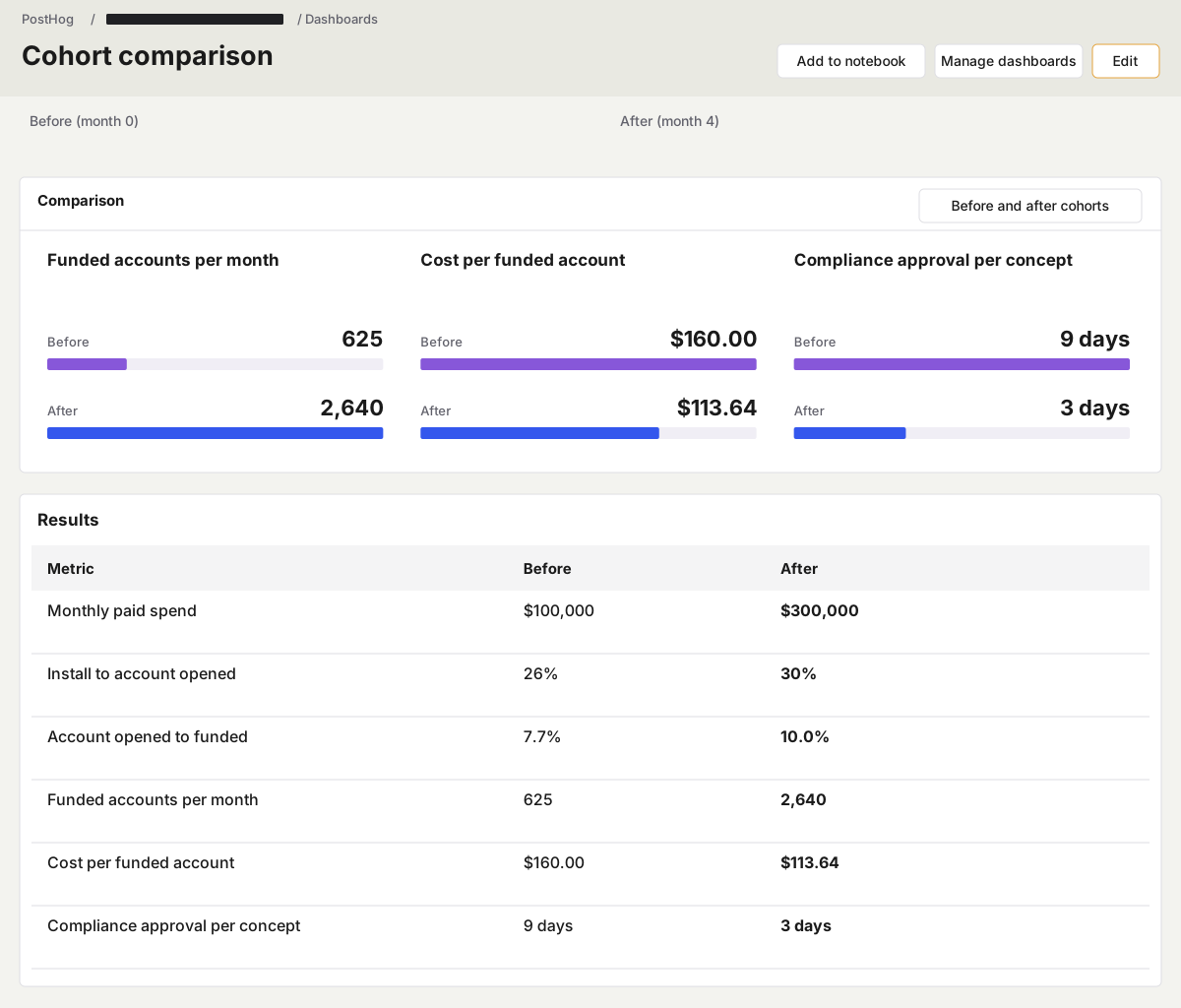
| Metric | Before (month 0) | After (month 4) | Change |
|---|---|---|---|
| Monthly paid spend | $100,000 | $300,000 | 3x |
| Install to account opened | 26% | 30% | +4 pts |
| Account opened to funded | 7.7% | 10.0% | +2.3 pts |
| Funded accounts per month | 625 | 2,640 | 4.2x |
| Cost per funded account | $160.00 | $113.64 | −29% |
| Compliance approval per concept | 9 days | 3 days | −6 days |
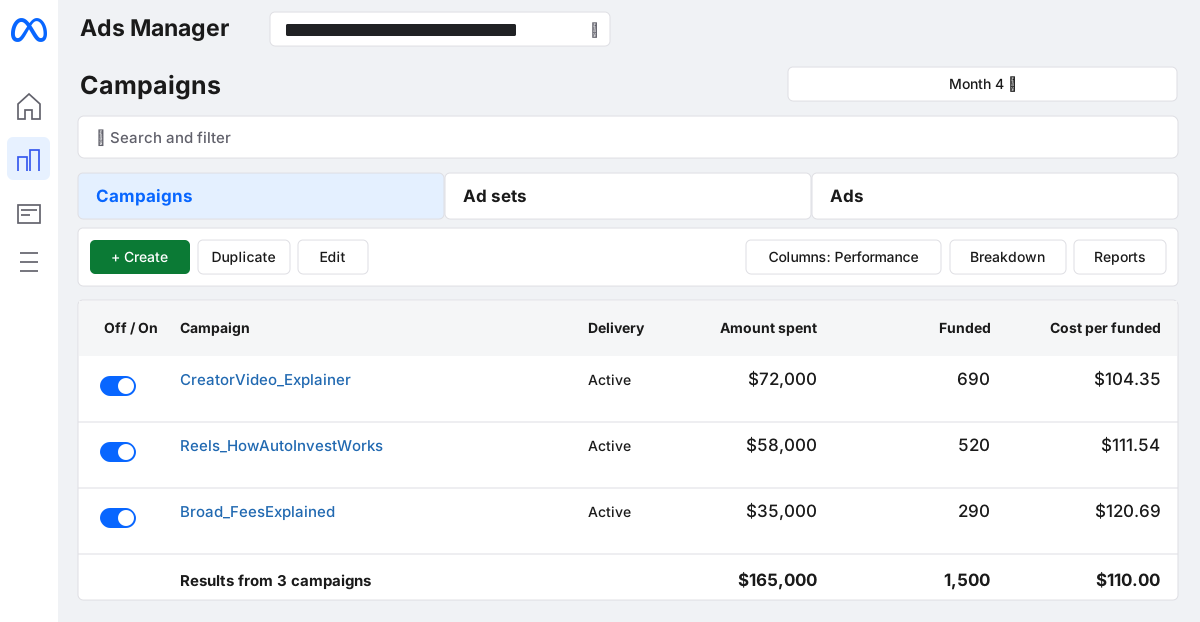
Cost per funded account fell every month: $150.99, $138.04, $124.03, then $113.64. Meta ran at $110.00 in month 4; TikTok and YouTube at $118.42 each.
What didn't work
- Market-news hooks. They drew the most clicks and funded the fewest accounts, and each one needed a fresh compliance review. They were retired in week 6.
- A slow first month. Before the claim library, only 9 concepts cleared review in month 1, and cost per funded account fell just 6%.
- The round-ups explainer on TikTok. It never left the learning phase and ran at $126.67 per funded account, 12% above the best TikTok concept.
What we learned
- Build the claim library with compliance before writing the first brief.
- Pay creators flat fees, never per funded account, and run their videos from the brand's accounts.
- Lead with how the product works: where the money goes, what it costs and how to withdraw.
Frequently asked questions
What does it cost to scale paid social for an investing app to $300K a month?
Judge it by unit cost: each funded account cost $113.64 in month 4, down from $160.00, and cost fell every month as spend rose. Most Series B programs like this run $130,000–$300,000 a month in creator fees and media.
How long does compliance review take once a claim library exists?
Three days per concept by month 4, down from 9. Building the library took the first 3 weeks, and month 1 only cleared 9 concepts, so cost per funded account fell just 6% that month.
Would this work for a seed-stage investing app spending $20K a month?
The claim library and flat creator fees apply at any size. The monthly budget step-ups do not: this plan needed six-figure monthly media from month 1 to run 24 concepts across three platforms. At $20,000, run one platform and fewer concepts.
Related case studies and guides
Same industry, other angles:
- Creator marketing: a Series B investing app, 5,600 funded accounts in 12 weeks at $96 each
- Product growth: a Series A investing app, First deposit within 7 days up from 31% to 49%
- Full growth system: a Series A options-education and investing app grew assets under custody from $40M to $165M in 9 months