The company and program
| Client | A Series A self-directed investing app for US stocks and ETFs with fractional shares, run through its own broker-dealer. |
| Stage | Series A |
| Industry | Investing apps |
| Timeline | One 90-day sprint, June 8 to September 6, 2026 |
| Channels | Post-approval onboarding, the funding flow, the home screen, push and email |
| Team | A Kiko growth lead plus agents: a funnel agent, a compliance-log agent that recorded every screen and message version with its approval date, and an experiment write-up agent. The client's two engineers built the changes; its chief compliance officer approved each one. |
The approach
- Hypothesis: approved users mean to fund, and stall on friction: where the funding step sits, the minimum, and the wait before money can be used. Removing that friction lifts first deposits without changing what the app says about investing.
- Comparison: each change ran against a 50/50 split of newly approved accounts for at least 14 days. The final read compares accounts approved from May 25 to June 7 with July 20 to August 2, after every winner was live.
- Decision rule: ship if first deposits within 7 days rise at least 2 points at 95% confidence and the ACH return rate stays under 1.5%. No variant ran without written compliance approval.
What we changed
- Weeks 1–2: the funding path and the approval log. We instrumented every step from approval to first deposit and set up the compliance log. The client's compliance team reviewed the test plan before any copy was written.
- Weeks 3–5: test A, funding right after approval. The approval screen led straight into bank linking and a first deposit instead of the home screen. Bank linking within 24 hours rose from 53.1% to 66.8%.
- Weeks 4–6: test B, a $10 minimum. The first-deposit minimum fell from $100 to $10. First deposits within 7 days rose from 38.2% to 44.0%.
- Weeks 5–6: test C, instant buying power. Up to $500 of a pending deposit was available to invest at once, with the limit set by the client's risk team. First deposits within 7 days rose from 44.3% to 48.1%.
- Weeks 5–6: test D, a day-1 SMS reminder. Killed.
- Weeks 7–13: winners to 100%, the read and handover. Tests A, B and C went to all newly approved accounts on July 20. We read 7-day deposits and 30-day recurring deposits for July 20 to August 2 approvals and handed over the dashboard and the compliance log.
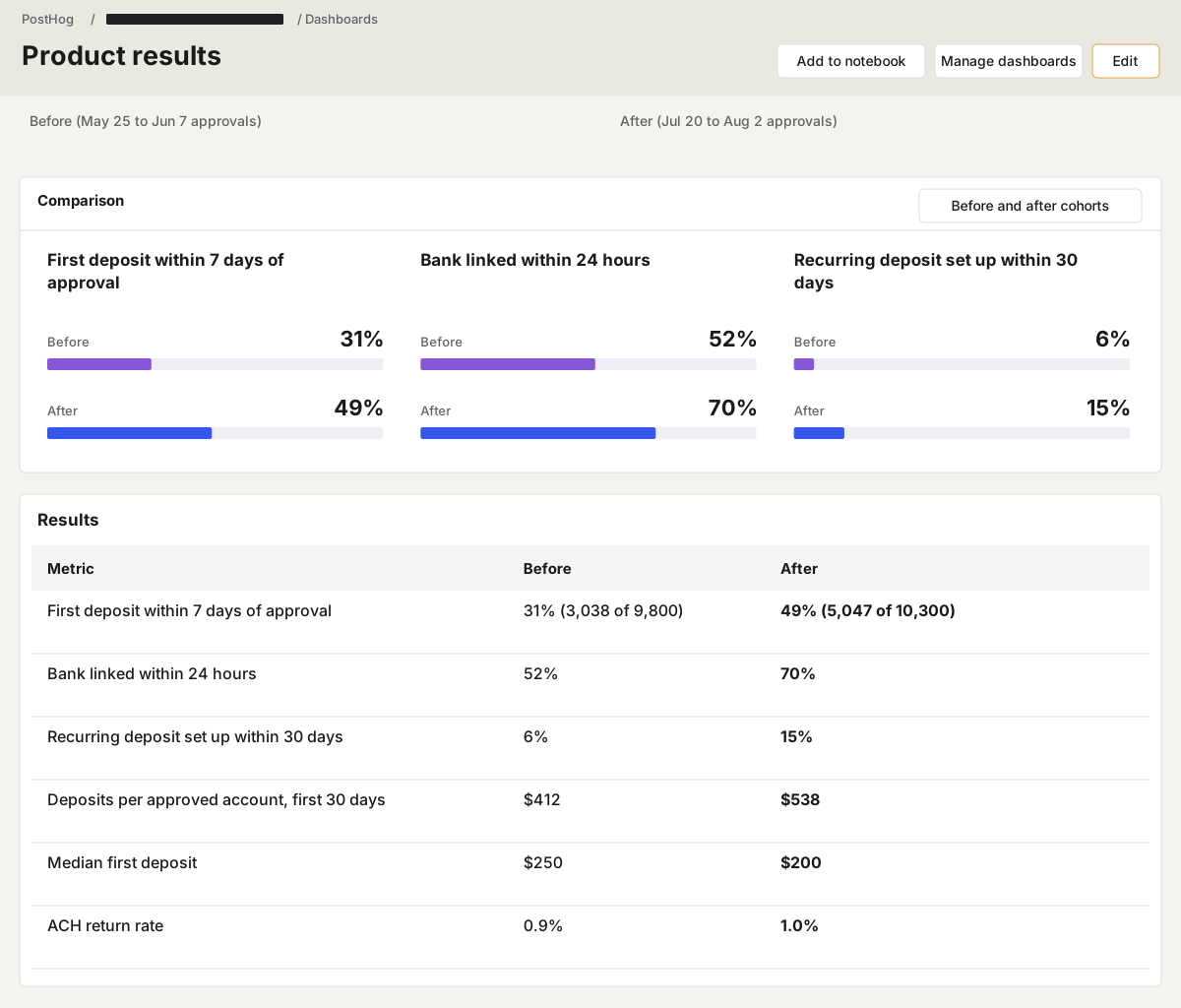
The results
| Metric | Before (May 25 to Jun 7 approvals) | After (Jul 20 to Aug 2 approvals) | Change |
|---|---|---|---|
| First deposit within 7 days of approval | 31% (3,038 of 9,800) | 49% (5,047 of 10,300) | +18 pts |
| Bank linked within 24 hours | 52% | 70% | +18 pts |
| Recurring deposit set up within 30 days | 6% | 15% | +9 pts |
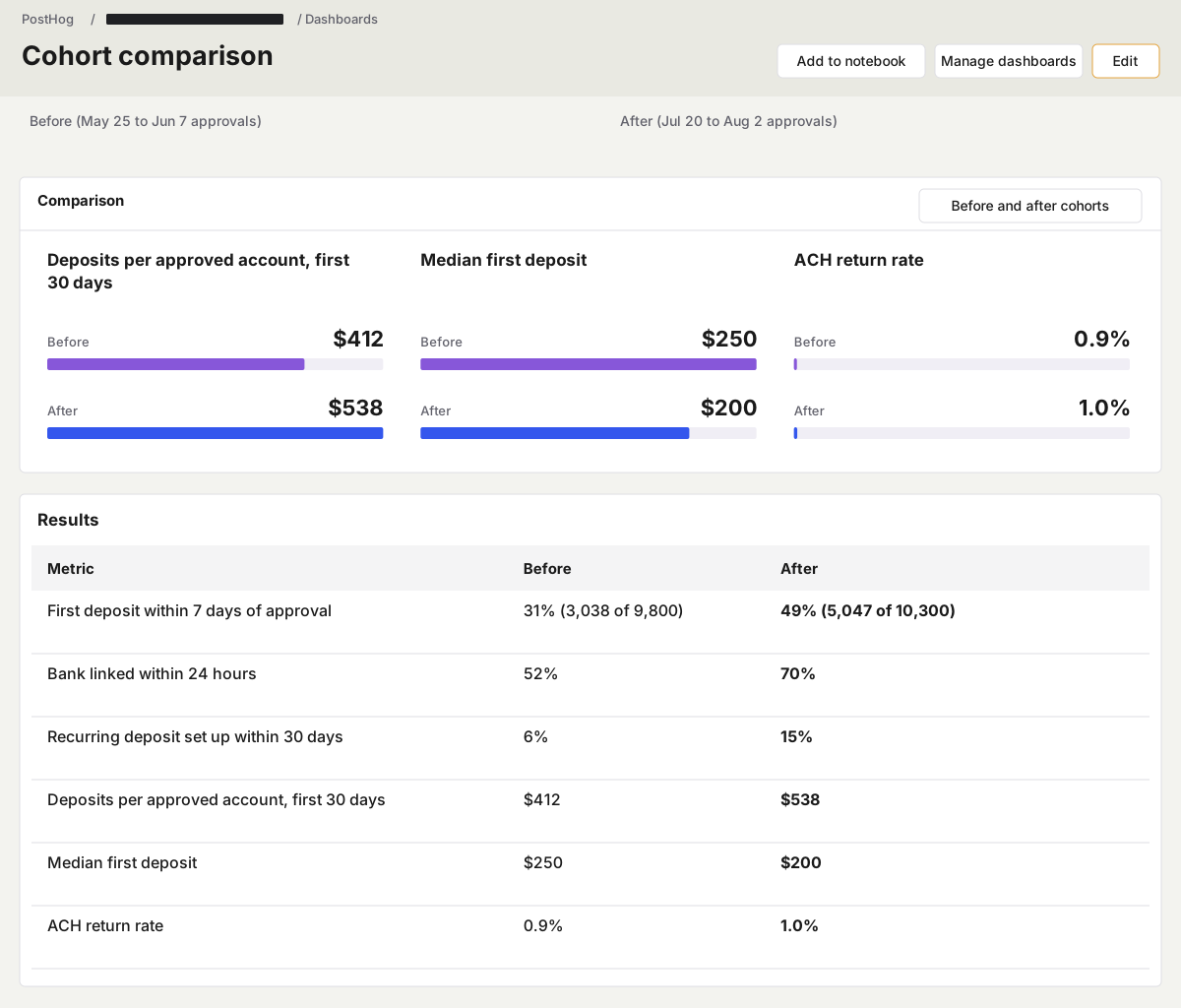
| Deposits per approved account, first 30 days | $412 | $538 | +31% |
| Median first deposit | $250 | $200 | −20% |
| ACH return rate | 0.9% | 1.0% | +0.1 pts |
What didn't work
- The SMS reminder. First deposits within 7 days went from 47.6% to 47.9%, which was not significant. The push reminder already reached the same people.
- A starter-portfolio screen. We planned a screen offering a few ready-made portfolios at first deposit. The client's compliance team ruled that choosing for a new investor read as a recommendation, so we dropped it before testing.
- Smaller first deposits. The median first deposit fell from $250 to $200, as expected with a $10 minimum. Deposits per approved account in the first 30 days still rose from $412 to $538.
What we learned
- Put funding straight after approval, while intent is highest.
- Bring compliance in during week one, and log an approval for every version.
- Change the friction, not the pitch.
Frequently asked questions
How much does a first-deposit sprint for an investing app cost?
There was no creator or media spend, so the only cost was Kiko's 90-day sprint, priced from $10,000 a month. The client's two engineers built the changes, and deposits per approved account in the first 30 days rose from $412 to $538.
How long does it take to lift first deposits when compliance reviews every screen?
Still 90 days. Compliance reviewed the test plan in weeks 1–2, before any copy was written, then approved each variant. Three winners were live for all approved accounts by July 20, week 7, and the read closed in week 13.
Would this work for a neobank or a seed-stage investing app without its own broker-dealer?
Funding straight after approval and a lower minimum apply to any account that needs a first deposit. Instant buying power needs a risk team to set a limit, here $500. Without it, expect only the test A and B gains.
Related case studies and guides
Same industry, other angles:
- Creator marketing: 5,600 funded accounts in 12 weeks at $96 each
- Paid ads: Cost per funded account down 29% while spend tripled to $300K a month
- Full growth system: grew assets under custody from $40M to $165M in 9 months