The company and program
| Fact | Detail |
|---|---|
| Client | A Series B investing app for stocks, ETFs and recurring investing. |
| Stage | Series B |
| Industry | Investing apps |
| Timeline | 12 weeks, June 1 – August 23, 2026 |
| Channels | YouTube integrations, podcast host-reads, short-form TikTok and Instagram posts, creator-handle partnership ads on Meta and YouTube |
| Team | 1 dedicated Kiko growth lead, plus agents for creator sourcing, script and claims checks, and daily reporting |
The approach
- Hypothesis: Long-form hosts who already explain retirement accounts and index investing produce funded accounts more cheaply than short-form finfluencer clips, because their viewers arrive ready to deposit.
- Comparison: 14 long-form creators (8 YouTube channels, 6 podcasts) against 8 short-form creators on TikTok and Instagram, with the same offer and the same counsel-approved claims. On paid, creator-handle partnership ads against the app's existing brand ads at $141 per funded account.
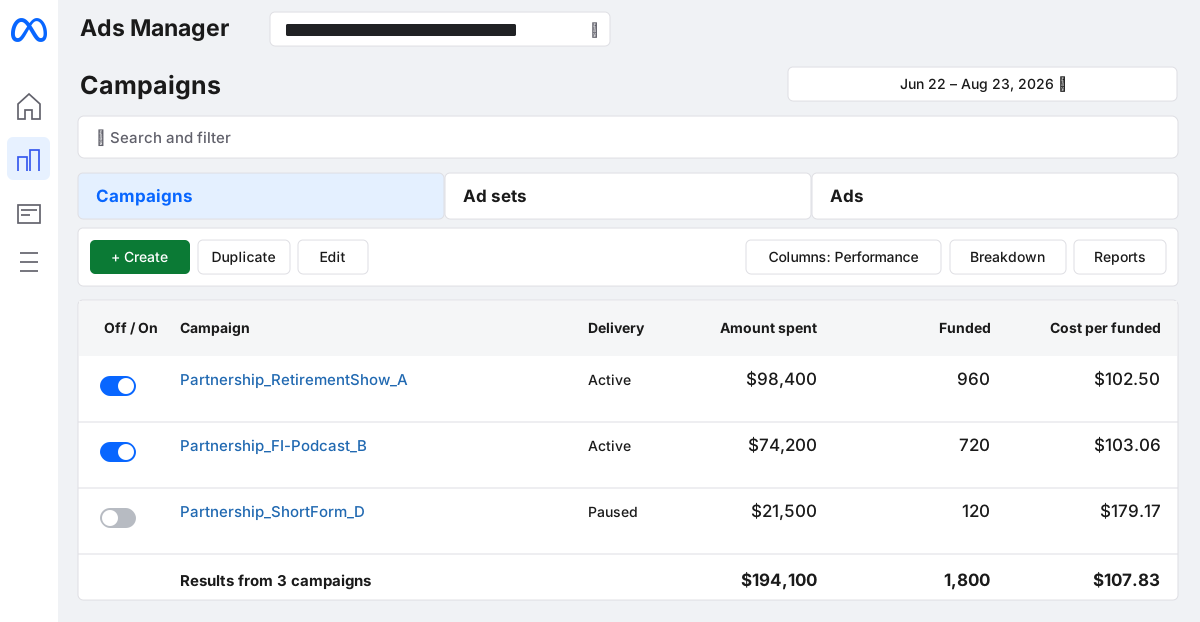
- Decision rule: Every creator post got 7 days of organic data. Posts under $120 per funded account on their own link got paid spend behind them. Each ad concept got $500–$1,000 or 7 days, whichever came first; any ad above $160 per funded account was cut.
What we changed
- Weeks 1–2: claims list and shortlist. Counsel agreed a claims list: no return figures, no "best app" claims, a risk line on screen. We scored 140 creators, contacted 34 and signed 22. The long-form bookings included an advisor-hosted retirement-planning show, a financial-independence podcast and a personal-finance YouTuber who runs regular app sponsorships.
- Week 3: first 10 creators post. Six YouTube integrations and four podcast host-reads went live, each with its own link and code.
- Weeks 4–6: read, amplify and test short-form. The four best long-form posts ran as partnership ads after 7 days of organic data, with 90 days of paid usage in each base fee. The 8 short-form creators posted in weeks 5 and 6.
- Weeks 7–10: second wave. Four more long-form creators posted (2 YouTube, 2 podcasts). The short-form ad set was paused in week 8, and spend shifted to the ads under $120 per funded account.
- Weeks 11–12: rebook and scale. The six best long-form creators were rebooked for Q4, with spend held on the top four partnership ads.
The results
| Metric | Before (prior quarter, brand ads) | After (12 weeks with Kiko) | Change |
|---|---|---|---|
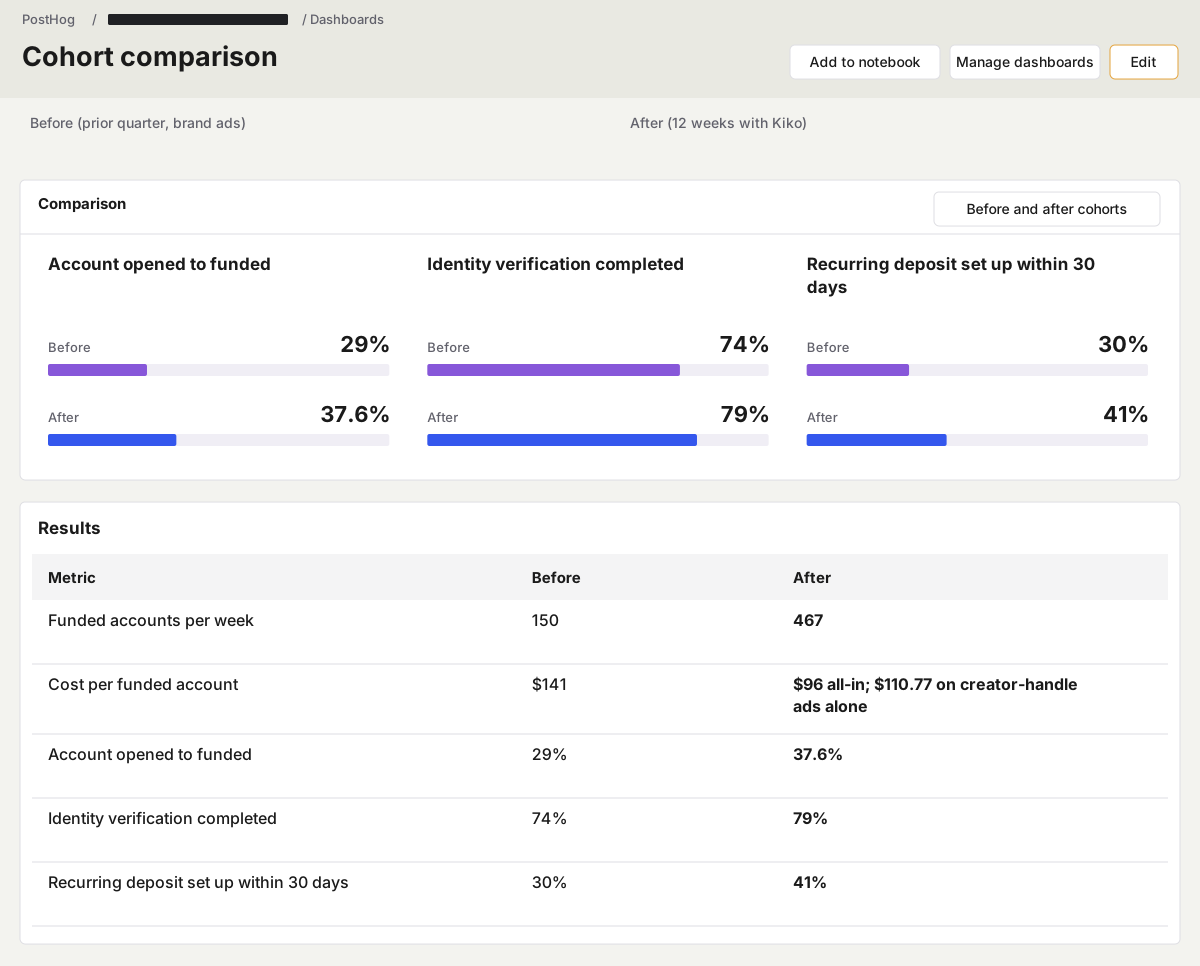
| Funded accounts per week | 150 | 467 | 3.1x |
| Cost per funded account | $141 | $96 all-in; $110.77 on creator-handle ads alone | −32% |
| Account opened to funded | 29% | 37.6% | +8.6 pts |
| Identity verification completed | 74% | 79% | +5 pts |
| Recurring deposit set up within 30 days | 30% | 41% | +11 pts |
What didn't work
- Short-form finfluencer clips. The 8 TikTok and Instagram creators drew the most views and the weakest deposits. Their partnership ad set ran at $179.17 per funded account, above the $160 cut line, and we paused it in week 8.
- Advisor-hosted shows took longer to clear. Hosts who are registered advisors needed their own firm's compliance review on top of the client's counsel. Two first-wave posts slipped from week 3 to week 5.
- Codes undercounted podcasts. In the post-sign-up survey, 31% of funded users who named a podcast never entered its code. We credited podcasts on links and codes only, so their true cost per funded account is lower than reported.
What we learned
- Agree the claims list with counsel before outreach, so most scripts clear in one round.
- Book long-form hosts who already teach the account types the app sells.
- Put paid spend only behind posts that beat the cost-per-funded bar on 7 days of organic data.
Frequently asked questions
How much does a creator program for an investing app cost?
Creator fees and media came to $96 per funded account, against $141 on the app's brand ads. Creator links and codes ran at $75.57 per funded account on fees, and creator-handle ads at $110.77 on media.
How long until creator posts produced funded accounts?
First posts went live in week 3, after two weeks of claims review and sourcing. Paid spend started in week 4 on posts with 7 days of organic data. The app averaged 467 funded accounts a week, up from 150.
Would this work for a seed-stage trading or crypto app?
The structure transfers: a counsel-approved claims list, long-form hosts, and spend behind posts under a cost bar. The $96 depended on enough media to scale the winning posts and on hosts who teach what you sell. Short-form clips ran at $179.17 and got paused.
Related case studies and guides
Same industry, other angles:
- Paid ads: Cost per funded account down 29% while spend tripled to $300K a month
- Product growth: First deposit within 7 days up from 31% to 49%
- Full growth system: grew assets under custody from $40M to $165M in 9 months