The company and program
| Fact | Detail |
|---|---|
| Client | A seed-stage strength-training app |
| Stage | Seed |
| Industry | Health and fitness apps |
| Timeline | 8 weeks of trial starts, May 4 – June 28, 2026; day-30 training read through July 28 |
| Channels | YouTube, TikTok and Instagram creators; podcast host-reads; TikTok Spark Ads and Meta partnership ads |
| Team | 1 dedicated Kiko growth lead, plus agents for creator sourcing, claims checks and daily retention reporting |
The approach
- Hypothesis: A creator who follows the app's program for 4 weeks and shows their own logs builds a training habit in viewers that a one-off review does not.
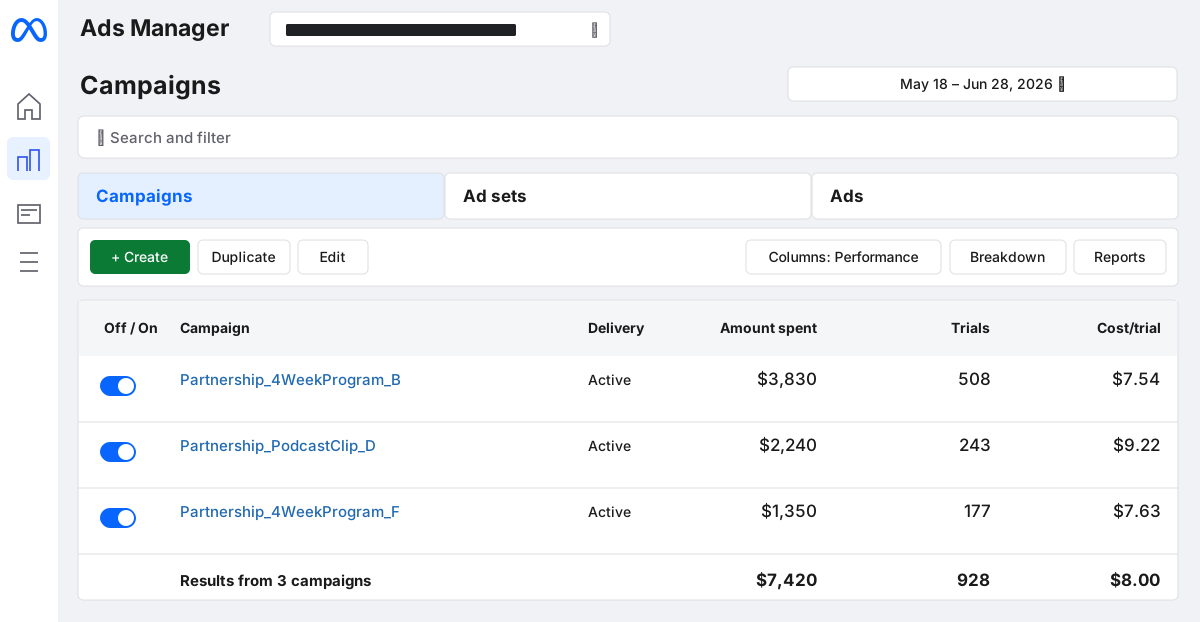
- Comparison: 4-week program series (8 creators) against one-off reviews and gym vlogs (5) and podcast host-reads (3). The whole program against the prior quarter's paid social: $14.80 per trial and 21% still training at day 30.
- Decision rule: After 7 days of organic data, ads went only behind posts whose trials logged a median of 3 or more workouts in week 1. Each ad concept got $500–$1,000 or 7 days. Creators were rebooked at 35% or more still training at day 30.
What we changed
- Weeks 1–2: claims and shortlist. Agreed a claims list with the client's counsel: no weight-loss, injury or medical claims, and results shown only as the creator's own logs. Reviewed 150 creators against Kiko's creator-fit rubric, contacted 40 and signed 16: lifting podcasts that run coded host-reads, evidence-led coaches and mid-size lifting YouTubers and TikTok coaches for the program series.
- End of week 2: first 10 creators post. Every script and edit had cleared counsel; program-series creators posted their week-1 check-in.
- Week 3: read and amplify. Trials from program-series posts logged a median 3.4 workouts in week 1, against 2.2 for reviews. Spark Ads and partnership ads started behind those posts, with 90 days of paid usage in each base fee.
- Weeks 4–6: check-ins and second wave. Program creators posted weekly check-ins, and 6 more creators joined.
- Weeks 7–8: cut and rebook. Paused the review ad at $11.82 per trial and rebooked 6 program-series creators for a second 4-week block.
The results
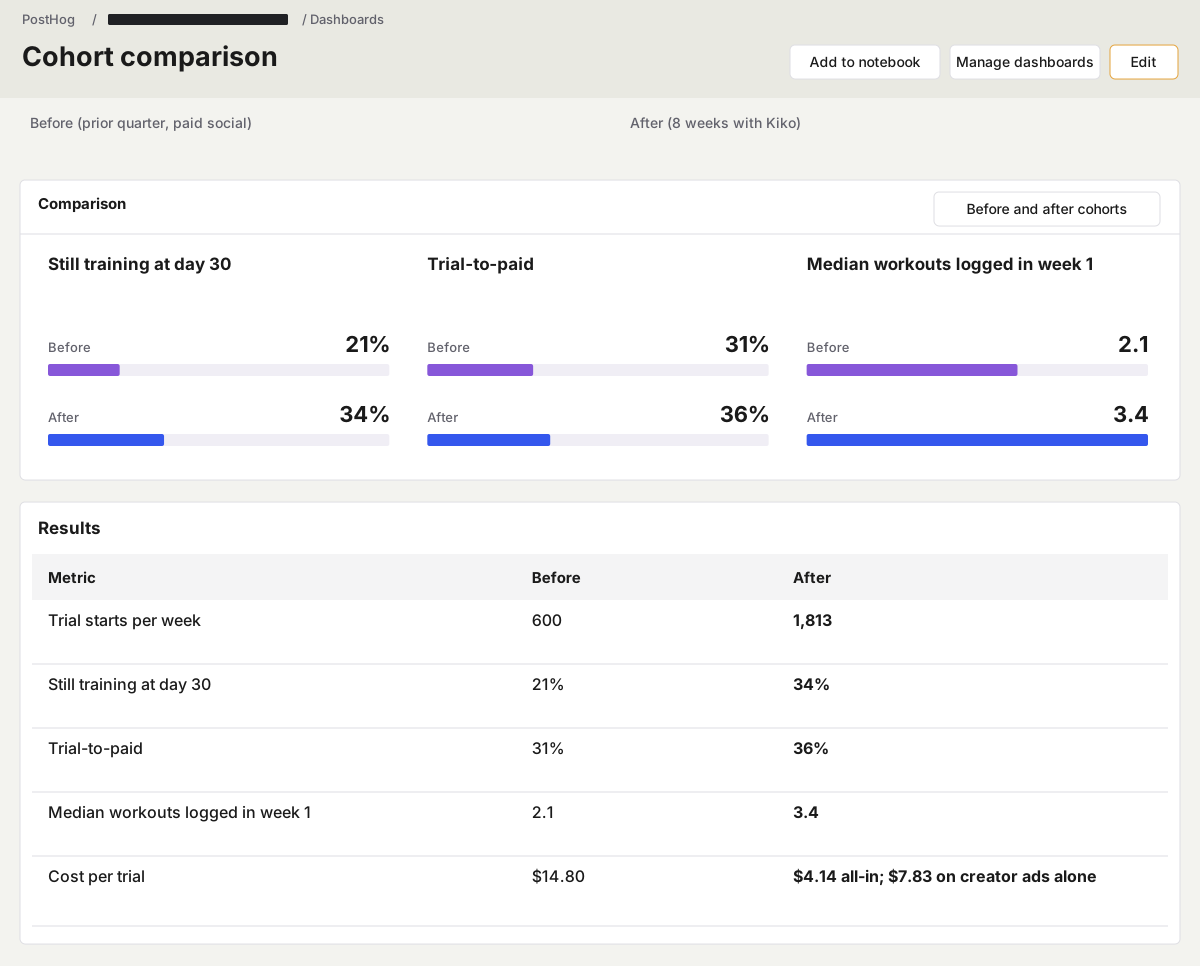
| Metric | Before (prior quarter, paid social) | After (8 weeks with Kiko) | Change |
|---|---|---|---|
| Trial starts per week | 600 | 1,813 | 3.0x |
| Still training at day 30 | 21% | 34% | +13 pts |
| Trial-to-paid | 31% | 36% | +5 pts |
| Median workouts logged in week 1 | 2.1 | 3.4 | +1.3 |
| Cost per trial | $14.80 | $4.14 all-in; $7.83 on creator ads alone | −72% |
What didn't work
- One-off reviews. Review and gym-vlog posts brought plenty of trials, but only 28% of those users were training at day 30. The review ad set ran at $11.82 per trial and 21% at day 30, so we paused it.
- Podcast host-reads. The three podcasts brought 2,600 trials, but listeners rarely started the program in the first 48 hours, and 27.7% were training at day 30.
- Before-and-after footage. Counsel cut transformation shots from two creators' edits because they read as a body-composition claim. Both posts were reshot and went live a week late.
What we learned
- Have creators follow the program for 4 weeks and post their real logs.
- Make ad decisions on week-1 workouts and rebooking decisions on day-30 training.
- Agree the claims list with counsel before the first brief.
Frequently asked questions
How much does a creator program for a fitness app cost?
Judge it by unit cost: each trial cost $4.14 all-in, $7.83 on creator ads alone, and each user still training at day 30 cost $12.17. Most seed programs like this run $15,000–$35,000 a month in creator fees and media.
How long until you know which creators to keep?
Ad decisions came at day 7 of each post, on whether trials logged 3 or more workouts in week 1. Rebooking waited for day-30 training data, so the first rebook of 6 creators happened in weeks 7–8.
Would this work for a Series A running or yoga app?
The program-series format needs a structured plan a creator can follow for 4 weeks and log publicly. A running plan fits; a drop-in yoga library has nothing to check in on. One-off reviews here held 28% at day 30.
Related case studies and guides
Same industry, other angles:
- Paid ads: a Series A sleep-coaching app, Trial-to-paid CAC down from $96 to $58 in 12 weeks
- Product growth: a seed-stage home workout app, Trial-to-paid conversion up from 34% to 47% after a paywall and onboarding rebuild
- Full growth system: a Series B nutrition-coaching app grew subscribers from 40,000 to 155,000 in 9 months