The company and program
| Fact | Detail |
|---|---|
| Client | A Series A sleep-coaching app |
| Stage | Series A |
| Industry | Health and fitness apps |
| Timeline | 12 weeks, Aug 3 – Oct 25, 2026. Results compare weeks 9–12 (Sep 28 – Oct 25) with the 4 weeks before Kiko started (Jul 6 – Aug 2) |
| Channels | Meta (Facebook and Instagram) and TikTok, US, ages 25–64 |
| Team | A dedicated Kiko growth lead plus agents for event checks, creative tagging and daily CAC alerts. The client's medical advisor and counsel approved every claim |
The approach
| Test | Hypothesis | Compared against | Decision rule |
|---|---|---|---|
| Optimization event | Trial users who log their sleep on night 3 are the ones who pay, so optimizing to that event finds more of them | Optimizing to trial start | Run both for 4 weeks at equal budget. Keep the event with the lower trial-to-paid CAC |
| Coach-led creative | A real coach reading a viewer-style sleep diary beats calm nightscape footage | Nightscape stock video with a voiceover | Each ad gets $500–$1,000 or 7 days. Kill it at 30% above the best cost per trial |
| Program claims | Describing what the user does each night converts as well as promising an outcome, and needs no new evidence | The client's existing "fall asleep faster" ads | Counsel signs off every line first. Then the lower cost per trial wins |
Trial-to-paid CAC is media spend divided by trials that converted to a paid subscription. It leaves out creator fees and Kiko's fee. We read conversions on November 1, after every trial in the window had ended.
What we changed
- Weeks 1–2. Sent a server-side night-3 sleep-log event to Meta's Conversions API and TikTok's Events API, and agreed an approved claims list with the medical advisor and counsel. Signed 4 UGC creators with 90 days of paid usage in the base fee.
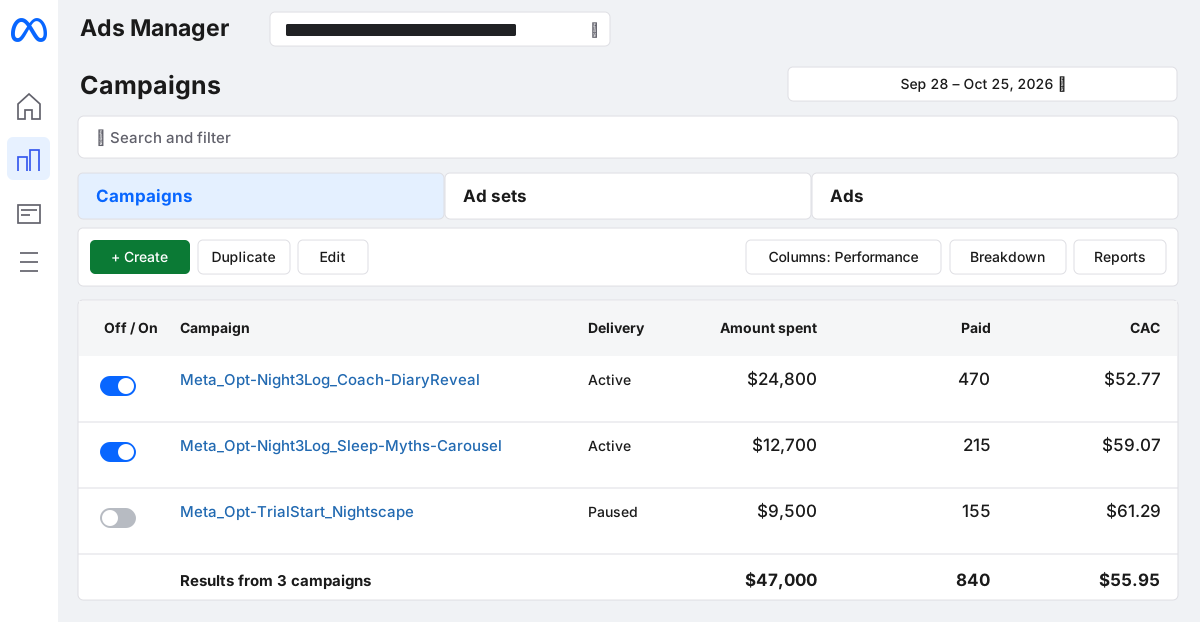
- Weeks 3–6. Split budget evenly between night-3 and trial-start optimization on Meta, and ran coach-led diary videos against nightscape footage.
- Weeks 7–8. Moved every new campaign to night-3 optimization. Scaled the coach-led diary reveal and ran coach videos as TikTok Spark Ads.
- Weeks 9–12. Raised weekly budgets by about a fifth and paused the last trial-start campaign in week 10.
The results
| Metric | Before (4 weeks) | After (weeks 9–12) | Change |
|---|---|---|---|
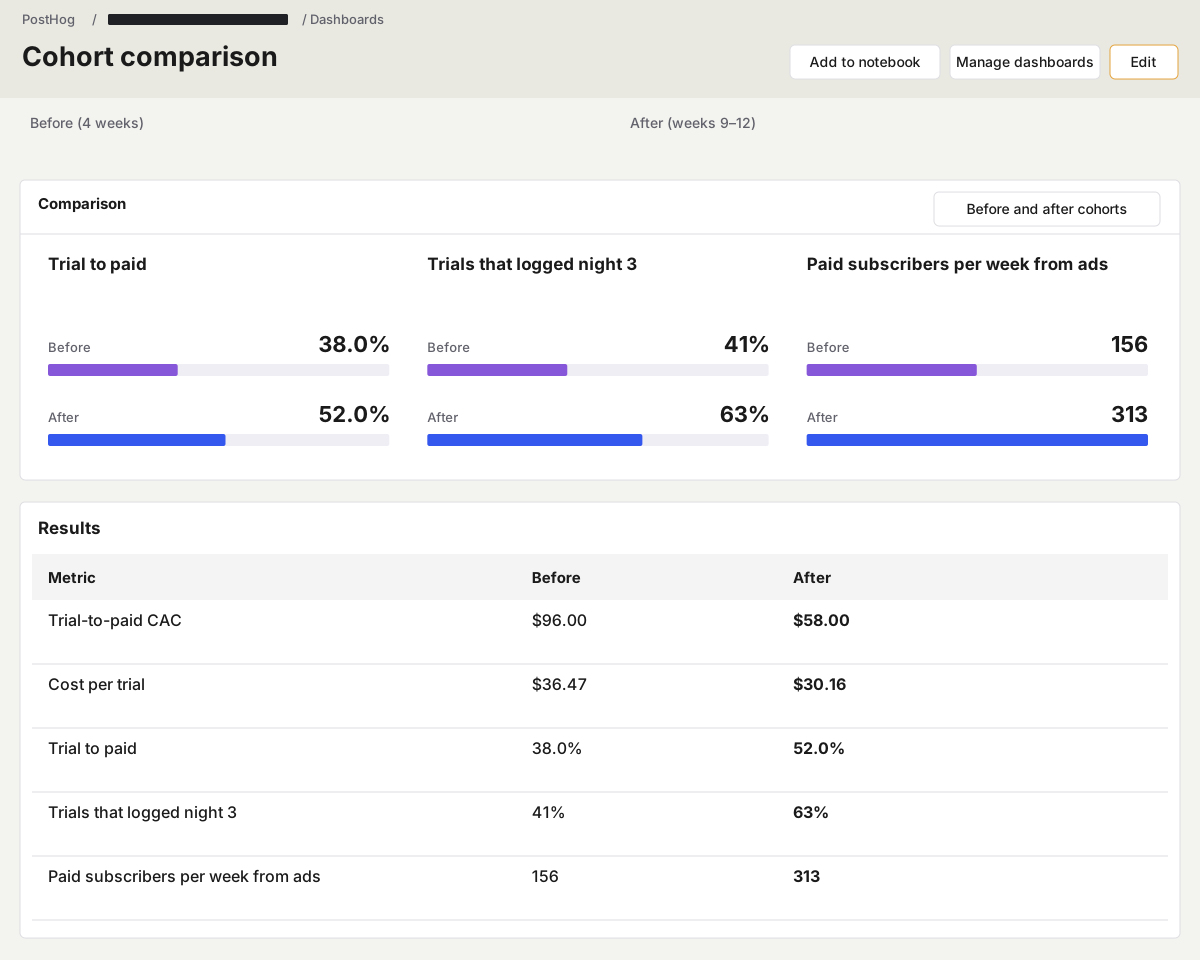
| Trial-to-paid CAC | $96.00 | $58.00 | −40% |
| Cost per trial | $36.47 | $30.16 | −17% |
| Trial to paid | 38.0% | 52.0% | +14 pts |
| Trials that logged night 3 | 41% | 63% | +22 pts |
| Paid subscribers per week from ads | 156 | 313 | 2.0x |
Across all 12 weeks, the program brought 2,940 paid subscribers at a CAC of $67.52.
What didn't work
- A slow start. The night-3 event takes three days to fire, so Meta campaigns took about 11 days to leave the learning phase. CAC in week 1 was $93.75, barely better than the baseline.
- The "awake at 3am" hook on TikTok. It had a strong hook rate but cost $66.43 per paid subscriber. Viewers watched; fewer stayed through the trial.
- Annual plans slipped. The share of new subscribers choosing the annual plan fell from 58% to 51%, so revenue per subscriber fell too. CAC fell faster, but payback improved by less than the CAC headline suggests.
What we learned
- Optimize to the first habit that predicts payment, not the trial start.
- Put the client's real coaches on camera, reading a sleep diary.
- Agree the claims list with counsel before the first script.
Frequently asked questions
How much does it cost to run Meta and TikTok ads for a sleep app?
Judge it by unit cost: each paid subscriber cost $67.52 across all 12 weeks and $58.00 by weeks 9–12, against $96.00 before. Most Series A programs like this run $50,000–$80,000 a month in creator fees and media.
How long before trial-to-paid CAC actually dropped?
Week 1 came in at $93.75, barely under the $96.00 baseline, because the night-3 event takes three days to fire and Meta needed about 11 days to leave learning. Weeks 1–4 averaged $82.19; weeks 9–12 hit $58.00.
Would this work for a seed-stage meditation app with no free trial?
Not as run. Everything here hinges on a 7-day trial with a logged nightly habit and enough media for the ad platforms to learn on a three-day-delayed event. A meditation app would need its own first-habit event before copying the plan.
Related case studies and guides
Same industry, other angles:
- Creator marketing: a seed-stage strength-training app, 14,500 trial starts in 8 weeks; 34% still training at day 30
- Product growth: a seed-stage home workout app, Trial-to-paid conversion up from 34% to 47% after a paywall and onboarding rebuild
- Full growth system: a Series B nutrition-coaching app grew subscribers from 40,000 to 155,000 in 9 months
- Creator marketing for health and fitness apps
- How to keep health claims compliant in creator and ad content, plus Meta ads and TikTok ads
- Health and fitness app creators
- All case studies
Want a program like this? Book a call.