The company and program
| Client | A Series A field-service software company. |
| Stage | Series A |
| Industry | SMB vertical SaaS |
| Pillars | Creator marketing + Paid ads + Product growth |
| Timeline | 9 months (three 90-day sprints), January–September 2026 |
| Channels | Trade YouTubers and owner-operator creators; Meta partnership ads and YouTube placements on trade channels; trial onboarding and lifecycle texts |
| Team | A dedicated Kiko growth lead plus agents for creator sourcing, claims pre-checks, ad variants, funnel pulls and weekly reporting; the client's onboarding lead and a product engineer |
| Headline result | Grew paying contractors from 1,100 to 4,300 in 9 months |
The approach
| Pillar | Hypothesis | Compared against | Decision rule |
|---|---|---|---|
| Creator marketing | Owner-operators who show the software running a real day (dispatch, job, invoice) bring more paying contractors than business-coach endorsements | Home-service business coaches with similar reach | After 14 days, rebook creators under $250 per paying contractor; drop anyone over $450 |
| Paid ads | Creator footage run as Meta partnership ads to trade audiences beats the client's product-screen ads | Product-screen ads, same audiences and budget | Each concept gets $1,000 or 7 days; scale anything under $400 per paying contractor |
| Product growth | Importing customers and a trade price book at signup gets trials to a first invoice faster, and the first invoice predicts payment | The old empty-account start | 50/50 split; ship if first-invoice-within-7-days rises 8 points or more at 95% confidence |
How the three pillars connected
Creator marketing
We built a bench of 20 creators, trade by trade: HVAC service-tech channels, plumbing educators with 100K–700K subscribers, and owner-operators who post about running a five-to-twenty-truck business. Each one filmed a real day: a call booked, a tech dispatched, an invoice paid from the truck. Creator links and codes brought 1,050 paying contractors at $200 each.
Paid ads
Media scaled from $25,000 to $70,000 a month: Meta at $340 per paying contractor and YouTube placements on trade channels at $400. That is $355.56 per paying contractor across paid, against $600 on the client's own Meta ads in December. Owner-operator footage beat product screens in every round; by month 3 it carried 80% of Meta spend.
Product growth
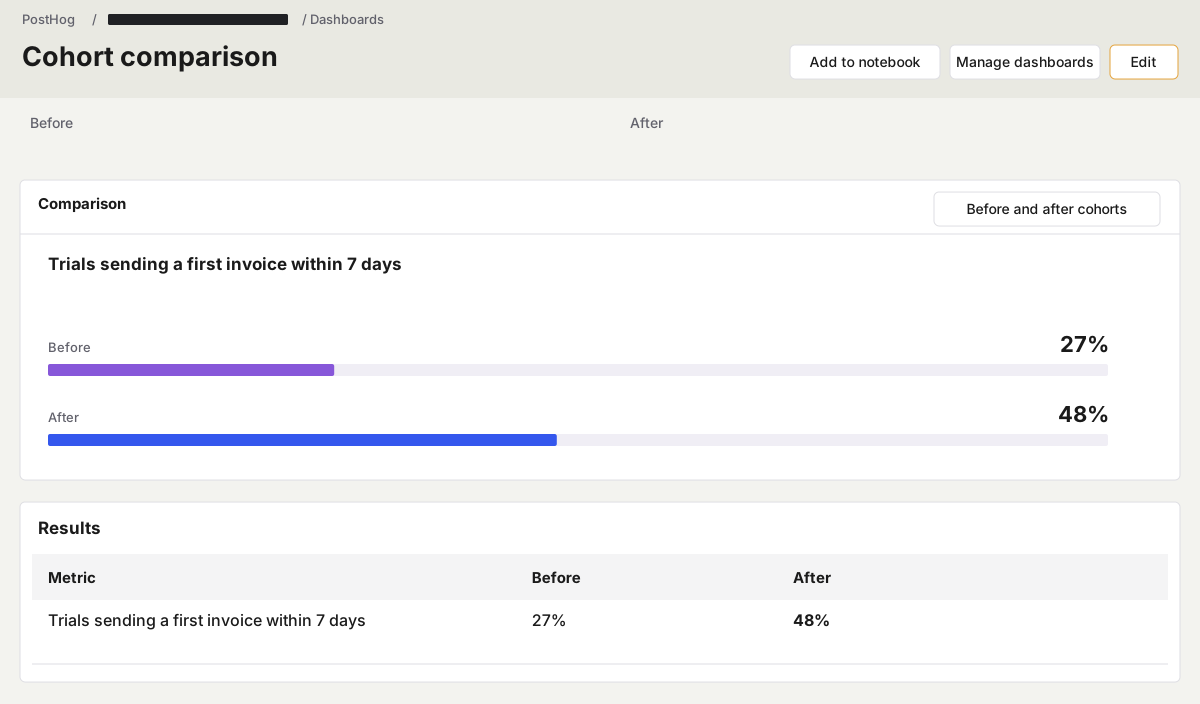
Paid volume showed where trials stalled: contractors signed up, saw an empty account and left. Only 27% sent a first invoice within 7 days, and those who did were four times as likely to pay. We added customer import from an accounting tool or a spreadsheet at signup, price-book templates per trade, and text-to-pay invoices. Trials sending a first invoice within 7 days rose from 27% to 48%, and trial-to-paid rose from 19% to 31%.
How they fed each other
Creators showed which moment sold the software: getting paid from the truck. That became the paid hook and the onboarding goal. Paid volume across three trades exposed the empty-account problem in weeks, and the onboarding fix raised trial-to-paid for every source, which is why paid cost per contractor kept falling as spend nearly tripled. Contractors who joined through creators also referred other contractors at twice the rate of paid signups, feeding the organic and referral line.
What we changed
- Weeks 1–2: tie creator codes, ad events and trial events to first invoice and payment.
- Weeks 2–5: book the first 8 trade creators, HVAC first; first videos live in week 3.
- Weeks 3–8: test owner footage against product screens on Meta, each concept with $1,000 or 7 days.
- Weeks 6–12: find the trial stall (27% send an invoice in 7 days), then A/B test customer import and trade price books; ship in week 12.
- Weeks 14–26 (sprint 2): plumbing creators added, YouTube placements on trade channels, text-to-pay invoices shipped.
- Weeks 27–39 (sprint 3): electrical creators added, media at $70,000 a month, referral prompt after the tenth paid invoice.
The results
| Pillar | Metric | Before | After | Change | How measured |
|---|---|---|---|---|---|
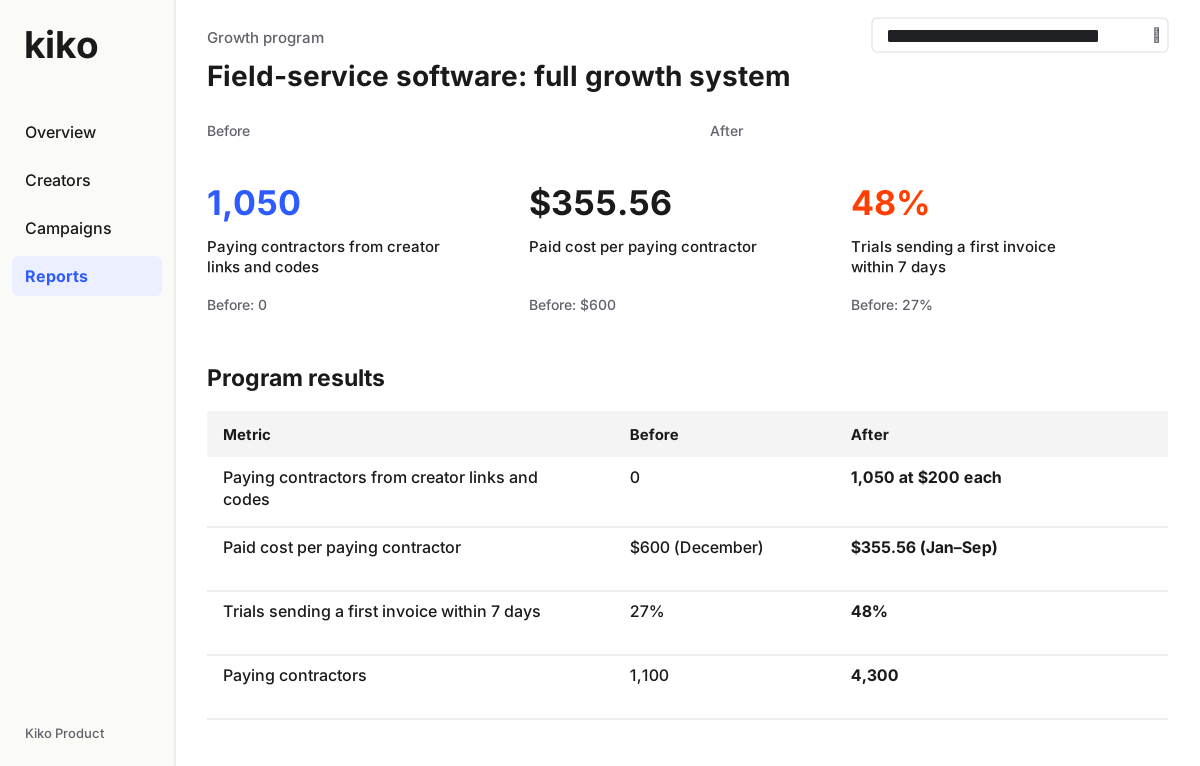
| Creator marketing | Paying contractors from creator links and codes | 0 | 1,050 at $200 each | +1,050 | Creator links and codes joined to billing |
| Paid ads | Paid cost per paying contractor | $600 (December) | $355.56 (Jan–Sep) | −41% | Meta and YouTube ads managers, joined to billing |
| Product growth | Trials sending a first invoice within 7 days | 27% | 48% | +21 pts | A/B test, then full rollout; product analytics |
| Combined (headline) | Paying contractors | 1,100 | 4,300 | 3.9x | Billing system, month end |
What didn't work
- Home-service business coaches on Instagram. Their followers were mostly agency owners and aspiring founders, not contractors; we cut two of five after the first round.
- YouTube ads to broad home-improvement interests reached homeowners, not contractors, at $1,100 per paying contractor in the first test. Placements on trade channels fixed it.
- Electrical lagged: thin price-book templates meant electricians were 9% of new accounts against the 18% we planned.
What we learned
- Book creators trade by trade, and only owners who run a real business.
- Make the creator's best moment, here getting paid from the truck, both the ad hook and the onboarding goal.
- Fix the empty-account start before adding a new trade.
Frequently asked questions
What does it cost to acquire a paying contractor for field-service software?
Blended CAC was $192.74 per paying contractor over 9 months: creators at $200, paid at $355.56, down from $600 on the client's own Meta ads. Most Series A programs like this run $40,000–$100,000 a month in creator fees and media.
How long did it take to go from 1,100 to 4,300 contractors?
Nine months, January to September 2026. First trade videos were live in week 3, the onboarding rebuild shipped in week 12, and plumbing and electrical creators were added in sprints 2 and 3.
Would this work for a seed-stage vertical SaaS for salons or restaurants?
The pattern carries to any vertical: owner-operator creators, their footage as ads, and a first-value fix like the first invoice in 7 days. Media here started at $25,000 a month across three trades; a seed company should pick one vertical.
Related case studies and guides
Same industry, other angles:
- Creator marketing: 640 paid accounts in 12 weeks from trade YouTubers
- Paid ads: Cost per paid account down from $410 to $236 on Meta in 10 weeks
- Product growth: Go-live within 14 days up from 41% to 78%
Guides and creators: