The company and program
| Fact | Detail |
|---|---|
| Client | A New York restaurant reservations app that releases hard-to-get tables at partner restaurants. |
| Stage | Pre-seed |
| Industry | New York consumer launch |
| Timeline | 6 weeks, September 7 – October 18, 2026 |
| Channels | TikTok, Instagram Reels and YouTube creator posts; no paid media |
| Team | 1 dedicated Kiko growth lead, plus agents for creator sourcing, brief review and daily reporting |
The approach
- Hypothesis: A creator who releases real tables that viewers can claim only in the app converts viewers to sign-ups at least 3 times better than a standard restaurant review that mentions the app.
- Comparison: 13 table-drop posts against 18 review and list posts from the same creators, with the same link setup, in the same weeks.
- Decision rule: Each post got 7 days of organic data. Creators above 8 sign-ups per 1,000 views were rebooked, and every later post moved to whichever format won.
What we changed
- Weeks 1–2: creators and restaurants. We reviewed 90 New York food creators, contacted 30 and signed 14, while the client lined up 12 partner restaurants to hold 4–8 tables per drop. The formats booked were restaurant visits where the creator orders in the language of the neighborhood and quick street interviews with New Yorkers about where and how the city eats.
- Week 3: first 10 creators post. Nine restaurant reviewers and one street-interview food creator went live, each with their own tracked link.
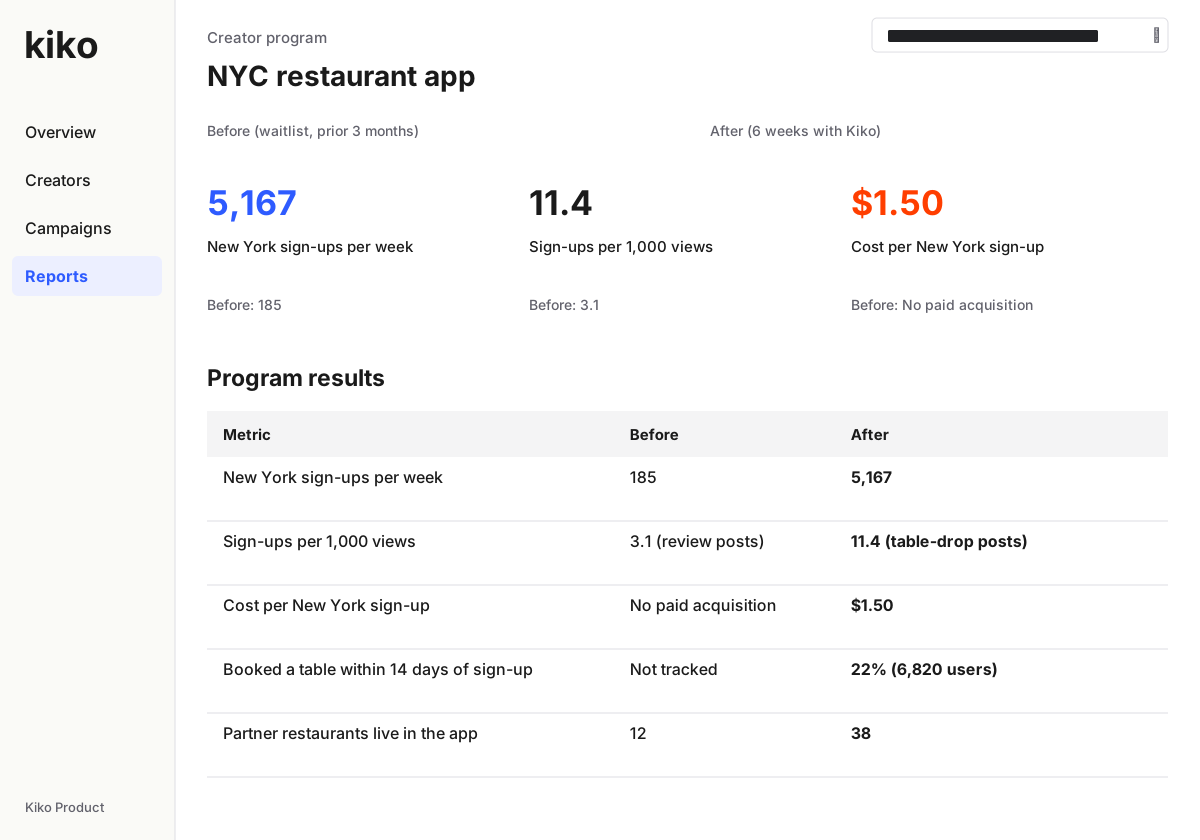
- Week 4: read the first week. Table drops converted at 11.4 sign-ups per 1,000 views and reviews at 3.1. Every remaining post moved to a table drop wherever a restaurant could hold tables.
- Weeks 5–6: scale. Four more creators posted (2 street-interview food creators and 2 neighborhood food vloggers), and the 5 best restaurant reviewers posted a second drop. Partner restaurants grew to 38.
The results
| Metric | Before (waitlist, prior 3 months) | After (6 weeks with Kiko) | Change |
|---|---|---|---|
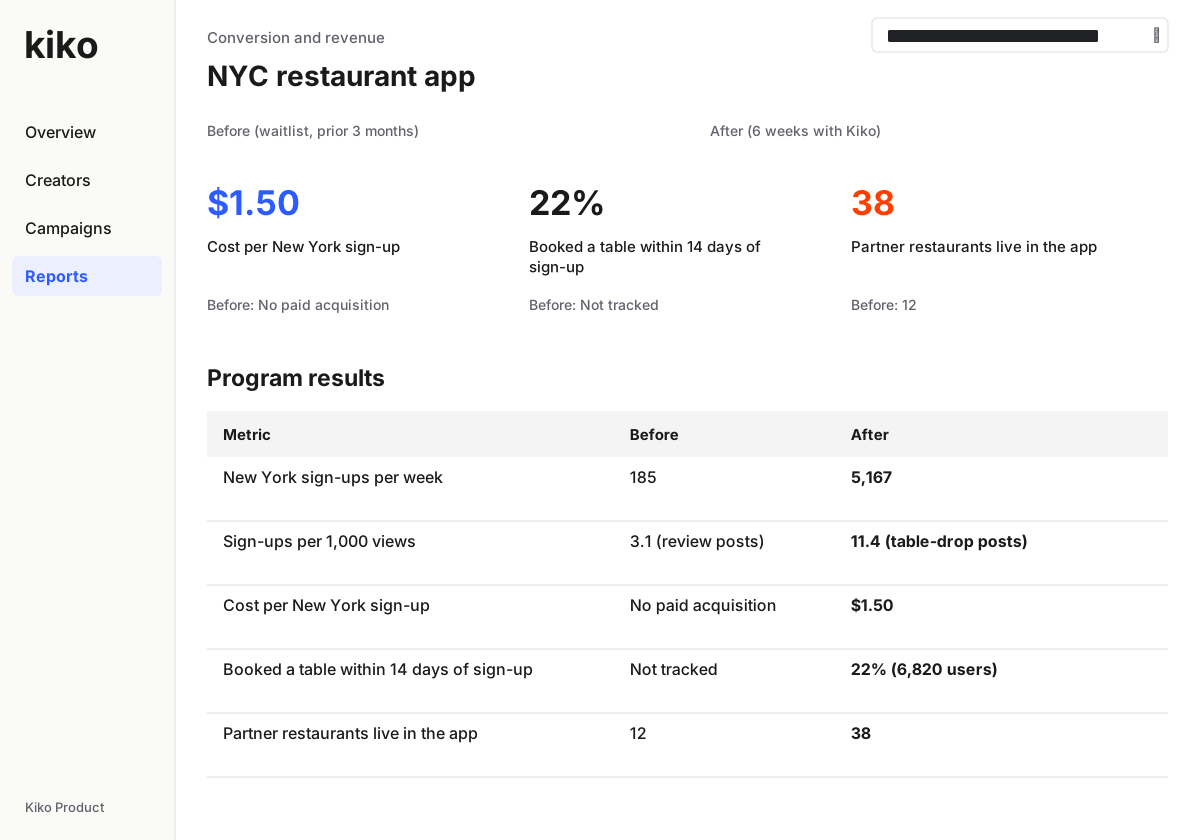
| New York sign-ups per week | 185 | 5,167 | 28x |
| Sign-ups per 1,000 views | 3.1 (review posts) | 11.4 (table-drop posts) | 3.7x |
| Cost per New York sign-up | No paid acquisition | $1.50 | New metric |
| Booked a table within 14 days of sign-up | Not tracked | 22% (6,820 users) | New metric |
| Partner restaurants live in the app | 12 | 38 | 3.2x |
What didn't work
- Sell-outs wasted reach. The biggest West Village drop sold out in 40 minutes. About 2,100 people signed up and found no table, and only 9% of them booked anything within 14 days.
- Instagram cross-posts lagged. Reels reposts of TikTok posts drove about a quarter of the sign-ups per view, because the link sat in the bio instead of on the post.
- List posts underperformed. A "best brunch spots" list got 480K views and only 700 sign-ups. Lists gave viewers nothing they needed the app for.
What we learned
- Give viewers something they can only get inside the app.
- Read 7 days of data, then move every remaining post to the winning format.
- Line up restaurant inventory before booking creators, so a viral post never lands on a sold-out drop.
Frequently asked questions
How much does a creator launch in New York cost without paid ads?
With no paid media, creator fees for 14 NYC food creators and 31 posts came to $1.50 per New York sign-up. Most pre-seed launches like this run $15,000–$35,000 a month in creator fees.
How fast can a pre-seed app get its first 30,000 users in one city?
Six weeks here. Two weeks to sign 14 creators and line up 12 restaurants, first posts in week 3, then an average of 5,167 sign-ups a week against 185 a week on the waitlist before.
Would this work for a seed-stage fitness or events app in another city?
Only if you have something viewers can get nowhere else, like scarce tables; a review that just mentions the app converted at 3.1 per 1,000 views. You also need inventory: 2,100 people hit a sold-out drop and only 9% booked.
Related case studies and guides
Same industry, other angles: