The company and program
| Fact | Detail |
|---|---|
| Client | A Series A New York fitness class booking app |
| Stage | Series A |
| Industry | New York, consumer fitness app |
| Timeline | 10 weeks, Aug 18 – Oct 26, 2026, against the 4 weeks before (Jul 21 – Aug 17) |
| Channels | Meta (Facebook and Instagram) and TikTok, geo-targeted to New York City ZIP clusters |
| Team | A dedicated Kiko growth lead plus agents for creative tagging, budget pacing and daily reporting. The client's head of growth approved budgets |
The approach
| Test | Hypothesis | Compared against | Decision rule |
|---|---|---|---|
| Walking-distance geo | New Yorkers book a class they can walk to, so ads aimed at ZIP codes within 15 minutes of a partner studio convert better than city-wide ads | NYC-wide broad targeting at the same daily budget | After $1,000 or 7 days per ad set, whichever comes first, keep the lower cost per first booking and cut the other |
| Instructor-filmed creative | A real instructor filming a class from the floor beats studio stock footage | Studio stock video and static schedule ads | Each concept gets $500–$1,000 or 7 days. Scale winners 20% every 3 days while cost per first booking stays under $16 |
| $5 first class | A $5 first class lowers cost per booking enough to pay for the discount | Full-price first class | Judge on cost per first booking and second booking within 30 days, not bookings alone |
What we changed
- Weeks 1–2. Moved the optimization event from install to first class booked, sent server-side through Meta's Conversions API and TikTok's Events API, and grouped the 140 partner studios into four ZIP clusters: Williamsburg and Greenpoint, Flatiron and Union Square, the Upper West and Upper East Side, and Astoria and Long Island City. Signed 9 New York instructors with 90 days of paid usage, on written contracts as the city's Freelance Isn't Free Act requires for work of $800 or more.
- Weeks 3–4. Ran the three tests side by side on both platforms.
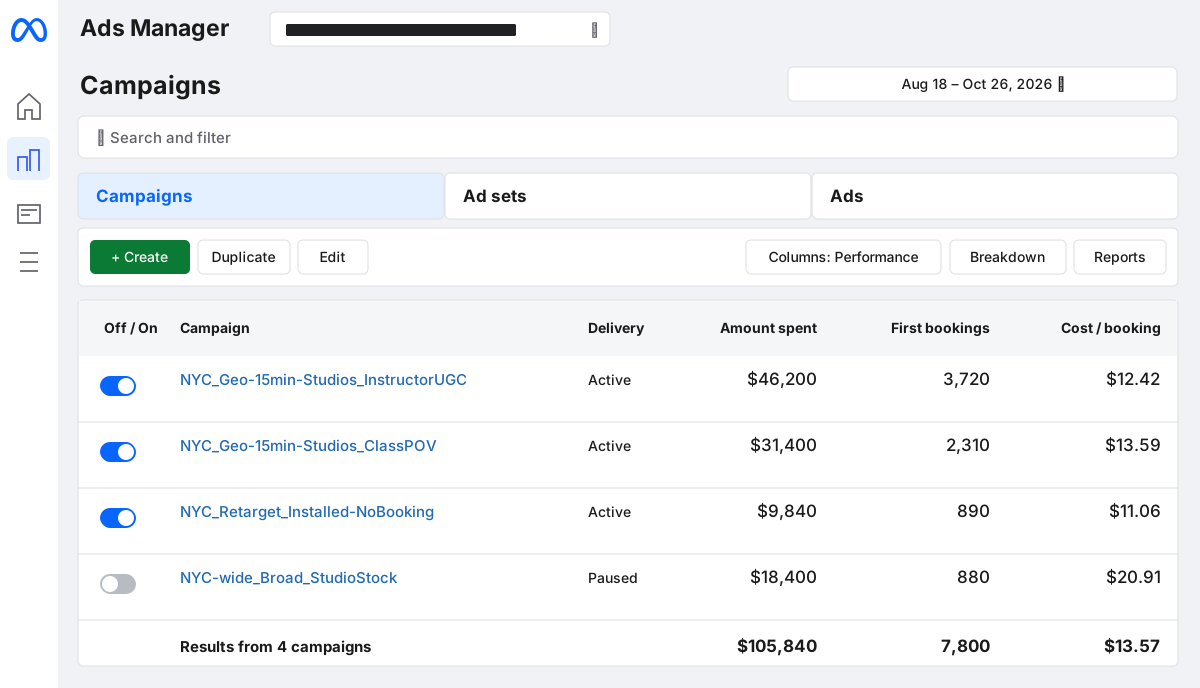
- Weeks 5–6. Paused NYC-wide broad targeting on both platforms, moved its budget into the four clusters, and added Meta retargeting for people who installed but had not booked.
- Weeks 7–10. Raised budgets 20% every 3 days while cost per first booking held under $16, added 4 new instructor videos a week, and paused the $5 offer in week 7.
The results
| Metric | Before (Jul 21 – Aug 17) | After (Aug 18 – Oct 26) | Change |
|---|---|---|---|
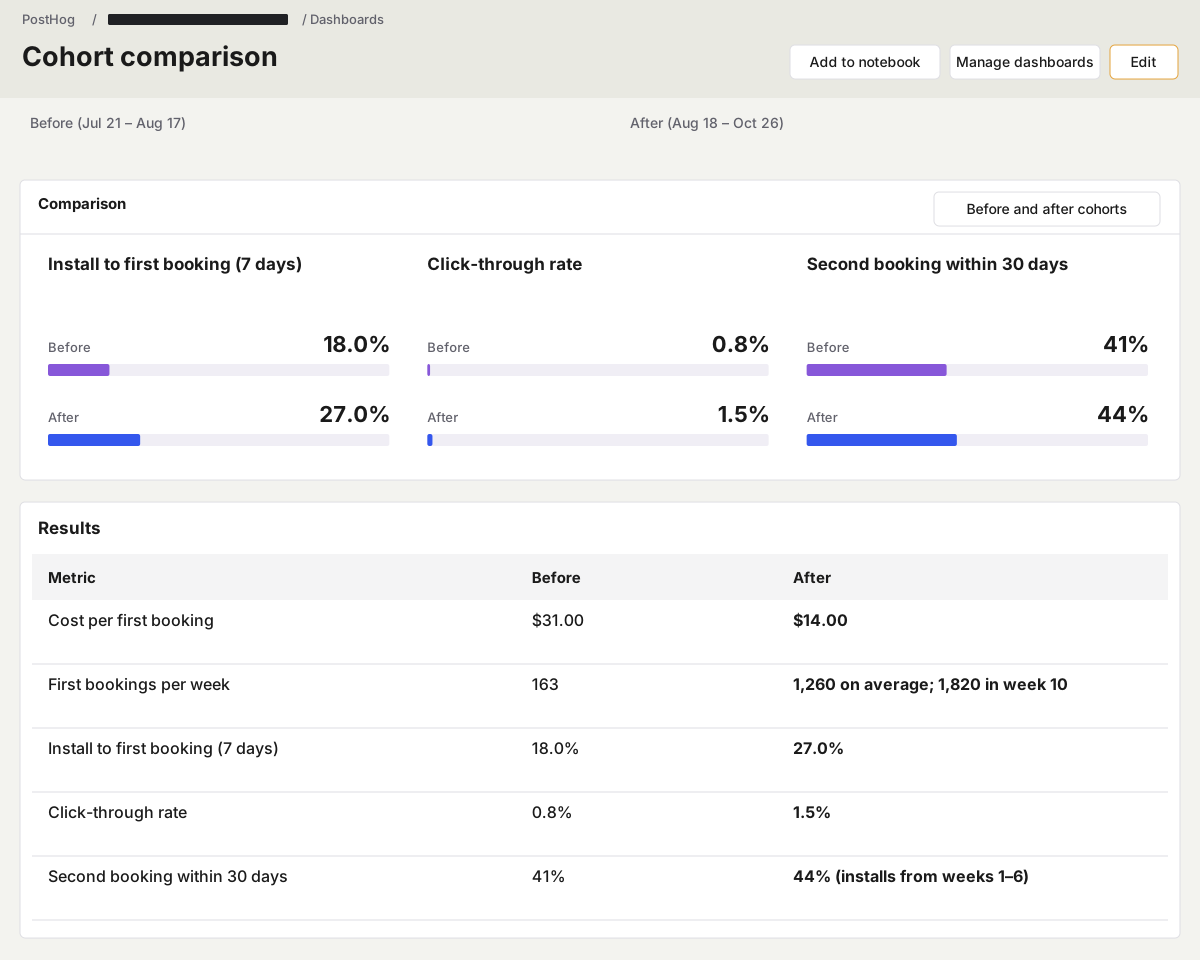
| Cost per first booking | $31.00 | $14.00 | −55% |
| First bookings per week | 163 | 1,260 on average; 1,820 in week 10 | 7.7x |
| Install to first booking (7 days) | 18.0% | 27.0% | +9 pts |
| Click-through rate | 0.8% | 1.5% | +0.7 pts |
| Second booking within 30 days | 41% | 44% (installs from weeks 1–6) | +3 pts |
Cost per first booking is media spend divided by first bookings. It leaves out creator fees and Kiko's fee.
What didn't work
- The $5 first class. It cost $14.01 per booking on TikTok, no cheaper than the full-price instructor ads at $13.70, and only 31% of those users booked a second class within 30 days, against 46% at full price. We paused it in week 7.
- City-wide targeting. Broad NYC ads cost $20.91 per first booking on Meta and $23.55 on TikTok, and only 19.8% of those installs booked. We paused both in week 5.
- Scaling past week 9. In week 10, after another budget raise, cost per first booking rose to $13.41 from $12.92 the week before. The four clusters were close to saturated. The next step is new neighborhoods, not more budget in the same ones.
What we learned
- Target the walk, not the city: ZIP codes within 15 minutes of a partner studio.
- Put real instructors on the studio floor with their own phones.
- Optimize to the first booking from day one, not to installs.
Frequently asked questions
How much does it cost to get a first class booking in New York with paid ads?
$14.00 in media per first booking here, $13.57 on Meta and $14.70 on TikTok, against $31.00 before. Creator fees for the instructors and Kiko's fee sit on top of that.
How fast can a local app scale spend before cost per booking rises?
Weekly spend roughly tripled over 10 weeks, raised 20% every 3 days. Costs started climbing in week 10, when the four ZIP clusters were close to saturated.
Would this work for a fitness app that sells nationally, not in one city?
Not this version. The 15-minute-walk targeting and instructor videos only pay off where partner studios are dense; the city-wide control cost $21.79 per booking. A national app would need a different geo plan.
Related case studies and guides
Same industry, other angles:
- Creator marketing: a pre-seed New York restaurant reservations app, 31,000 New York sign-ups in 6 weeks from 14 NYC food creators
- Product growth: a seed-stage New York grocery delivery app, Second order within 30 days up from 38% to 57%
- Full growth system: a seed-stage New York experiences marketplace became the top-grossing app in its category in New York in 6 months
- Creator marketing and paid social in New York
- Meta ads and TikTok ads
- Creator lists by industry
- All case studies
Want a program like this? Book a call.