The company and program
| Client | A Series A notes app with AI meeting summaries. |
| Stage | Series A |
| Industry | Productivity apps |
| Timeline | One 90-day growth sprint, June 22 – September 20, 2026. Upgrade windows read through October 13 |
| Channels | Web and desktop app, in-app prompts, invite and summary emails |
| Team | A dedicated Kiko growth lead plus agents for event audits, funnel pulls, experiment write-ups and first drafts of invite copy. Client side: two product engineers and a designer |
The approach
A workspace counts when a second person accepts an invite and joins within 14 days of the workspace being created. Every test ran as a 50/50 split on new workspaces.
| Test | Hypothesis | Comparison | Decision rule |
|---|---|---|---|
| Send summary to attendees | People invite colleagues when they have something worth sending, not when an onboarding screen asks | After an AI meeting summary, a one-click "send to attendees" from the calendar invite, vs. no prompt | Ship if second member within 14 days rises at least 2 points at 95% confidence, with first-note rate and creator day-30 retention flat or up |
| Guest comment, one-click join | Recipients join more often if they can read and comment before making an account | Shared notes open for guest comments with a one-click join, vs. a sign-up wall | Same rule |
| Second seat free for 30 days | The upgrade prompt on the first invite stops people from inviting | Second seat free for 30 days, vs. an upgrade prompt on invite | Same rule, plus Team plan upgrades within 30 days must not fall |
| Same-domain discovery | Colleagues on the same company domain will join a workspace they can find | New sign-ups see their company's existing workspace, vs. a fresh empty one | Same rule |
What we changed
- Weeks 1–2: audit and baseline. Fixed the invite events, defined the metric and pulled the April–May funnel: 34% of workspaces sent an invite, 19% got a second member.
- Weeks 3–4: send summary to attendees. The biggest single lift, +8.5 points. Shipped to all workspaces in week 5.
- Weeks 5–6: guest comments with one-click join. +4.2 points. The "invite step before first note" test ran alongside in week 5 and was reverted.
- Weeks 6–7: second seat free for 30 days. +3.7 points, with more Team upgrades, not fewer.
- Weeks 7–8: same-domain discovery. +2.1 points. The "AI credits for each invite" test ran in week 8 and was reverted.
- Weeks 9–12: hold and measure. No new changes. 14-day invites and 30-day upgrades read for each weekly cohort, then the sprint review.
The results
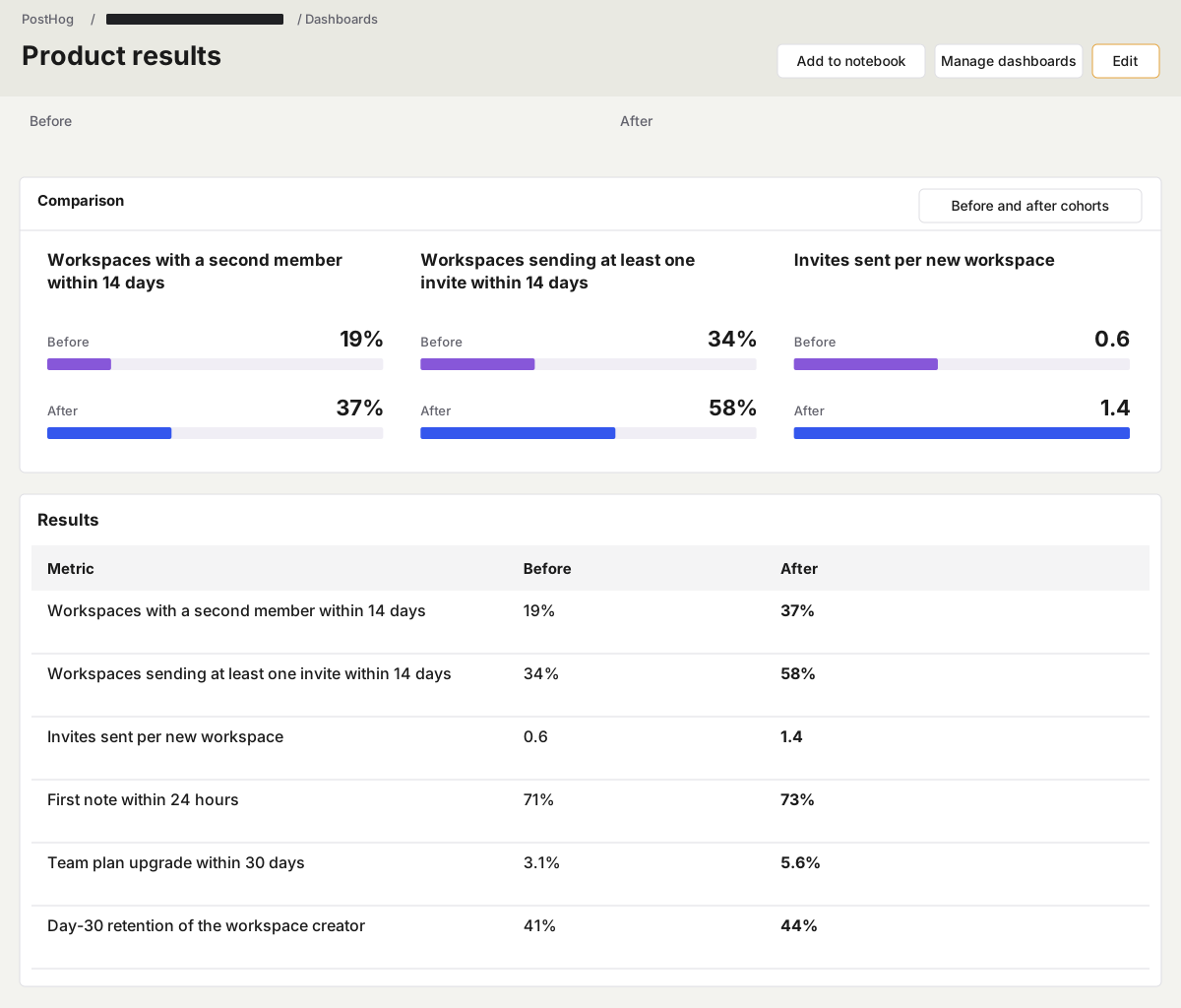
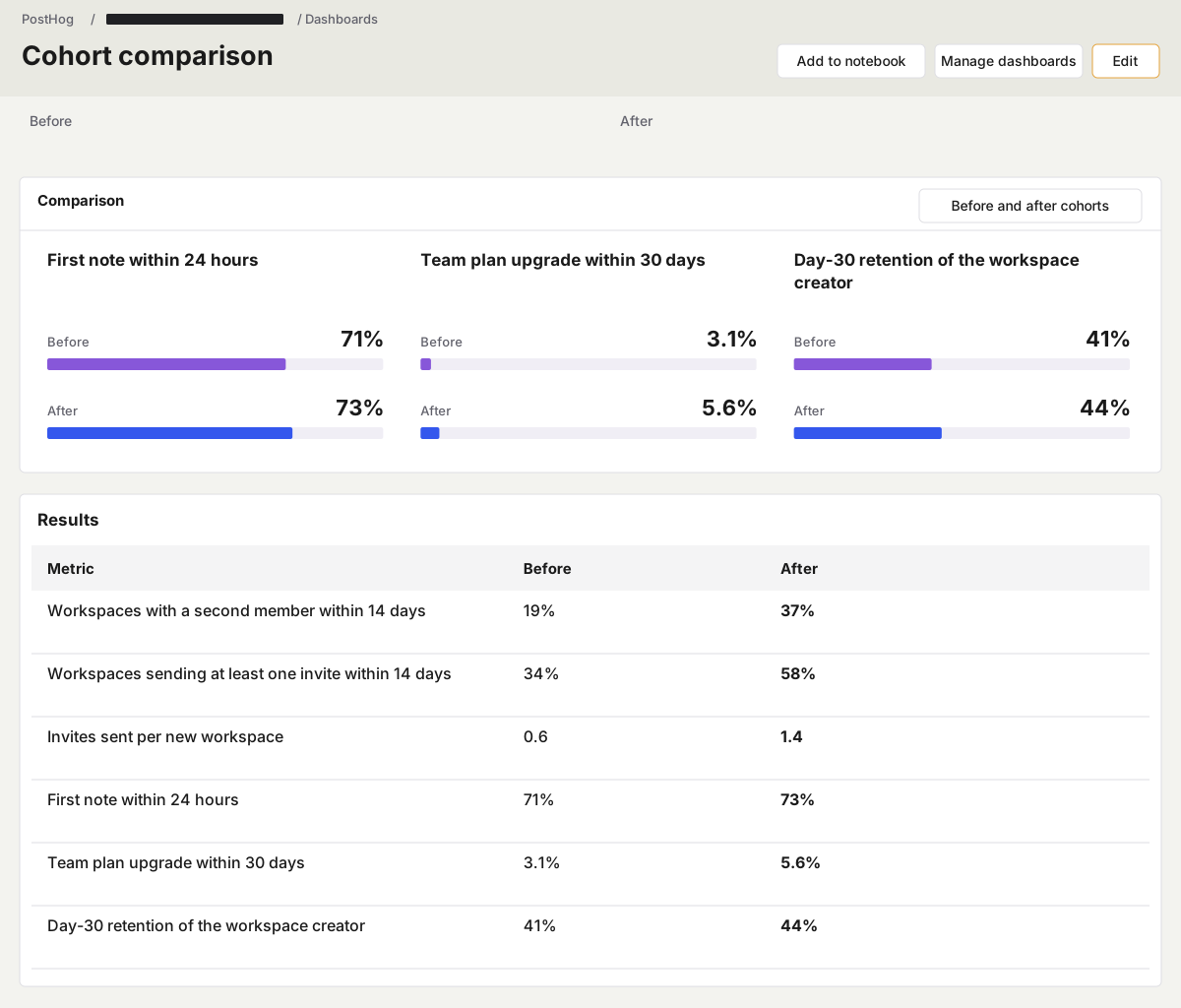
Before: 18,400 workspaces created in April–May 2026. After: 9,850 workspaces created in sprint weeks 9–12 (August 17 – September 13).
| Metric | Before | After | Change |
|---|---|---|---|
| Workspaces with a second member within 14 days | 19% | 37% | +18 pts |
| Workspaces sending at least one invite within 14 days | 34% | 58% | +24 pts |
| Invites sent per new workspace | 0.6 | 1.4 | +0.8 (2.3x) |
| First note within 24 hours | 71% | 73% | +2 pts |
| Team plan upgrade within 30 days | 3.1% | 5.6% | +2.5 pts |
| Day-30 retention of the workspace creator | 41% | 44% | +3 pts |
What didn't work
- An "invite teammates" step before the first note. Invites barely moved (31.2% to 31.9%), and first notes within 24 hours fell 9 points. Reverted after one week.
- AI credits for each invite. Invites went up, joins didn't, and spam reports tripled. Reverted.
- Same-domain discovery on personal email. About 40% of new workspaces sign up with a personal email domain, and discovery does nothing for them.
What we learned
- Attach the invite to something the user already wants to send. The meeting summary did more than every other change.
- Let recipients see the work before they make an account.
- Remove the price from the moment of inviting. Charging at the second seat cost more in invites than it earned in upgrades.
Frequently asked questions
What does a 90-day product growth sprint on team expansion cost?
Kiko's 90-day sprints start at $10,000 a month, and this one used no media. The client supplied two product engineers and a designer to build the four changes. The return showed in Team upgrades within 30 days, up from 3.1% to 5.6%.
How fast did the invite rate move?
The first test, "send summary to attendees", ran in weeks 3–4 and added 8.5 points. All four winners were live by week 8, and weeks 9–12 read 37% with no new changes.
Would this work for a seed-stage notes app with no team plan?
Partly. Sending the summary and guest comments work for any shared document. The second-seat test needs a per-seat price to remove, and same-domain discovery did nothing for the 40% of sign-ups on personal email.
Related case studies and guides
Same industry, other angles:
- Creator marketing: 9,400 trial starts in 8 weeks; 27% converted to paid
- Paid ads: Paid subscriptions up 3.2x in 4 months at a flat $52 CAC
- Full growth system: grew paid seats from 9,000 to 34,000 in 8 months