The company and program
| Fact | Detail |
|---|---|
| Client | A Series A AI email app |
| Stage | Series A |
| Industry | Productivity apps |
| Timeline | 4 months, Jul 1 – Oct 31, 2026, against June 2026 as the baseline month |
| Channels | Meta, YouTube and TikTok |
| Team | A dedicated Kiko growth lead and a Kiko creative producer, plus agents for creative tagging, budget pacing and CAC alerts |
The approach
| Test | Hypothesis | Compared against | Decision rule |
|---|---|---|---|
| Creative volume | Spend can triple at the same CAC only if new concepts arrive faster than old ones tire | Raising budgets on the 6 existing concepts | Raise a campaign 20% every 3 days only while its 7-day CAC is $56 or less. New concepts get $500–$1,000 or 7 days before a kill or scale call |
| Optimization event | Optimizing to "first AI draft sent" finds trial users who go on to pay | Optimizing to trial start | Compare 14-day trial-to-paid and keep the event with the lower CAC |
| YouTube as a third channel | 90-second workflow demos reach knowledge workers Meta can't reach at the same price | Meta-only scaling | YouTube stays if its CAC is within 10% of Meta's after $15,000 |
CAC here is media spend divided by new paid subscriptions: trials that converted within 14 days, attributed to an ad on a 7-day click. It leaves out creator fees and Kiko's fee.
What we changed
- Weeks 1–2 (July). Moved optimization from trial start to first AI draft sent, through server-side events on all three platforms. Briefed 7 UGC creators, with 90 days of paid usage in the base fee.
- Weeks 3–6 (July–August). Shipped 3–4 new concepts a week on Meta and launched YouTube in-stream ads with a 90-second workflow demo.
- Weeks 7–12 (August–September). Ran creator inbox tours as TikTok Spark Ads and raised budgets inside the $56 CAC rule.
- Weeks 13–18 (September–October). Reached 6 new concepts a week. Retired any concept whose CAC sat 15% above the account average for 7 days.
The results
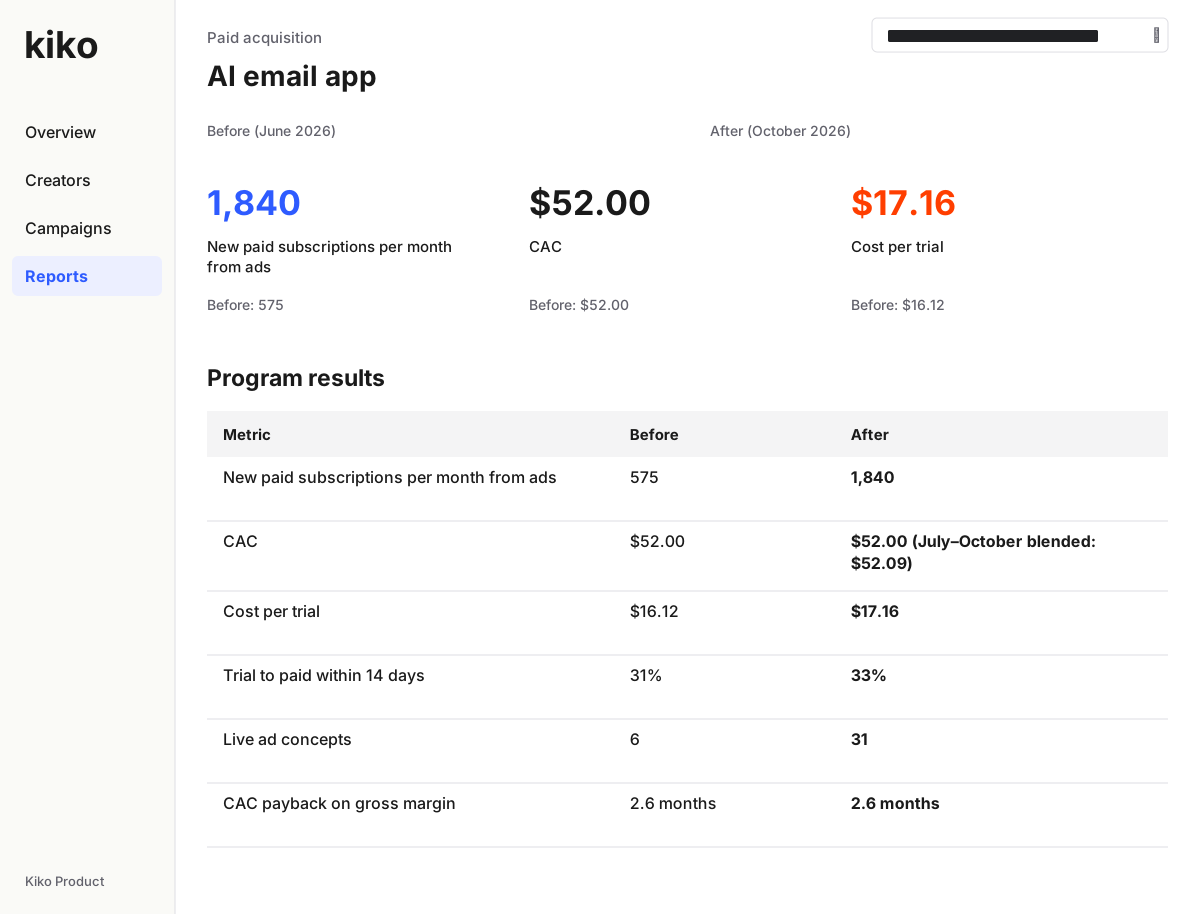
| Metric | Before (June 2026) | After (October 2026) | Change |
|---|---|---|---|
| New paid subscriptions per month from ads | 575 | 1,840 | 3.2x |
| CAC | $52.00 | $52.00 (July–October blended: $52.09) | Flat |
| Cost per trial | $16.12 | $17.16 | +6% |
| Trial to paid within 14 days | 31% | 33% | +2 pts |
| Live ad concepts | 6 | 31 | +25 |
| CAC payback on gross margin | 2.6 months | 2.6 months | Flat |
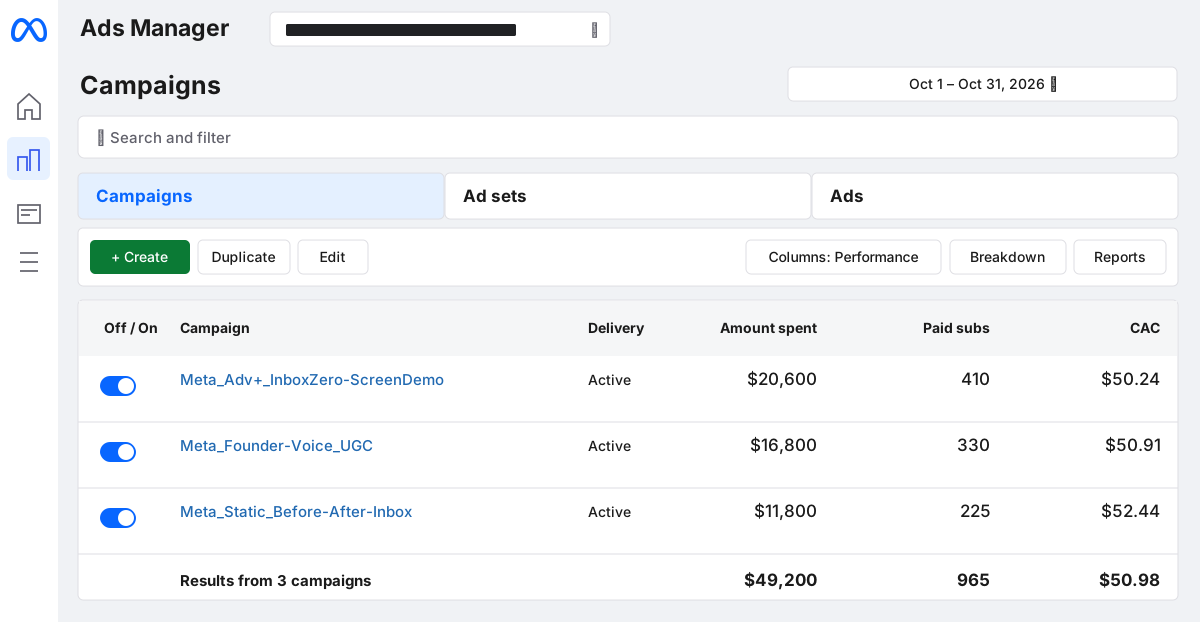
YouTube cost $54.42 per subscription in October against $50.98 on Meta, 7% higher and inside the 10% rule, so it stayed.
What didn't work
- Cost per trial rose. It went from $16.12 to $17.16 as spend tripled. The better trial-to-paid rate is what held CAC flat: at June's 31%, October's CAC would have been $55.35.
- Short-form hooks on YouTube and TikTok. YouTube Shorts ran at $56.25 per subscription and the TikTok "reply race" at $57.50, both above the $56 rule. Neither got more budget in October.
- Lookalike audiences. 1% lookalikes of paying users cost $61 per subscription in July against broad targeting on Meta. We paused them in August and let the creative find the audience.
What we learned
- Treat creative as the scaling lever: budget followed new concepts, never the other way round.
- Optimize to the action that predicts payment, here the first AI draft sent.
- Write the CAC rule down before the first budget increase and let it decide.
Frequently asked questions
How much does it cost to triple paid ad spend for a productivity app?
Judge it by unit cost: each new paid subscriber cost $52.09 in media on average, and the $25 Pro plan paid that back in 2.6 months. Most Series A programs like this run $40,000–$100,000 a month in creator fees and media.
How long did it take to triple spend without CAC rising?
Four months. Spend stepped up every month, at 20% every 3 days while 7-day CAC stayed at $56 or less. Monthly CAC never left the $51.38 to $52.56 range.
Would this work for a seed-stage note-taking app spending $15K a month?
The rules transfer: optimize to the first real action, write the CAC ceiling down, retire tired concepts. The pace does not. Six new concepts a week needs a creative producer and 7 UGC creators, which a $15,000 budget rarely covers.
Related case studies and guides
Same industry, other angles:
- Creator marketing: a Series A AI calendar app, 9,400 trial starts in 8 weeks; 27% converted to paid
- Product growth: a Series A notes app, Workspaces inviting a second member up from 19% to 37%
- Full growth system: a Series A AI meeting assistant grew paid seats from 9,000 to 34,000 in 8 months
- Creator marketing for productivity apps
- How to run tutorial campaigns for a productivity app and scaling creative in paid ads
- Creator lists by industry
- All case studies
Want a program like this? Book a call.