The company and program
| Fact | Detail |
|---|---|
| Client | A Series A AI calendar app that schedules tasks and focus time around meetings. |
| Stage | Series A |
| Industry | Productivity apps |
| Timeline | 8 weeks of trial starts, July 6 – August 30, 2026; paid conversion read at day 14 of each trial |
| Channels | YouTube integrations and dedicated videos; creator-handle ads on YouTube and Meta |
| Team | 1 dedicated Kiko growth lead, plus agents for creator sourcing, brief review and daily reporting |
The approach
- Hypothesis: A creator who connects their real calendar and lets the AI plan their week on camera drives more paid conversions than a feature walkthrough.
- Comparison: 5 "my real week" videos against 4 feature-tour videos in the first wave, each with its own tracked link. On paid, creator-handle ads against the app's earlier Meta brand ads at $118 per paying customer.
- Decision rule: Paid conversion takes 14 days, so ad decisions used a leading signal. After 7 days of organic data, ads went behind videos whose trials connected a calendar in the first session at 70% or more. Each ad concept got $500–$1,000 or 7 days. Rebooking waited for day-14 trial-to-paid, with a bar of 25%.
What we changed
- Weeks 1–2: shortlist and real accounts. We reviewed 110 channels, contacted 28 and signed 9 for the first wave: workplace productivity tutorial channels, note-system teachers and step-by-step software tutorial channels. Each creator got an account a week before filming and connected their real work calendar.
- Week 3: 9 videos go live. Five "my real week" videos and four feature tours, each with its own link.
- Weeks 4–5: read and amplify. "My real week" trials connected a calendar in the first session 78% of the time, against 66% for feature tours. The top 3 videos ran as creator-handle ads, with 90 days of paid usage in each base fee.
- Weeks 6–8: second wave. Four "my real week" creators posted a "30 days later" follow-up, and 2 new creators joined, for 11 creators in total.
- Weeks 9–10: close the cohorts. The last trials reached day 14, and we read paid conversion by creator before rebooking for Q4.
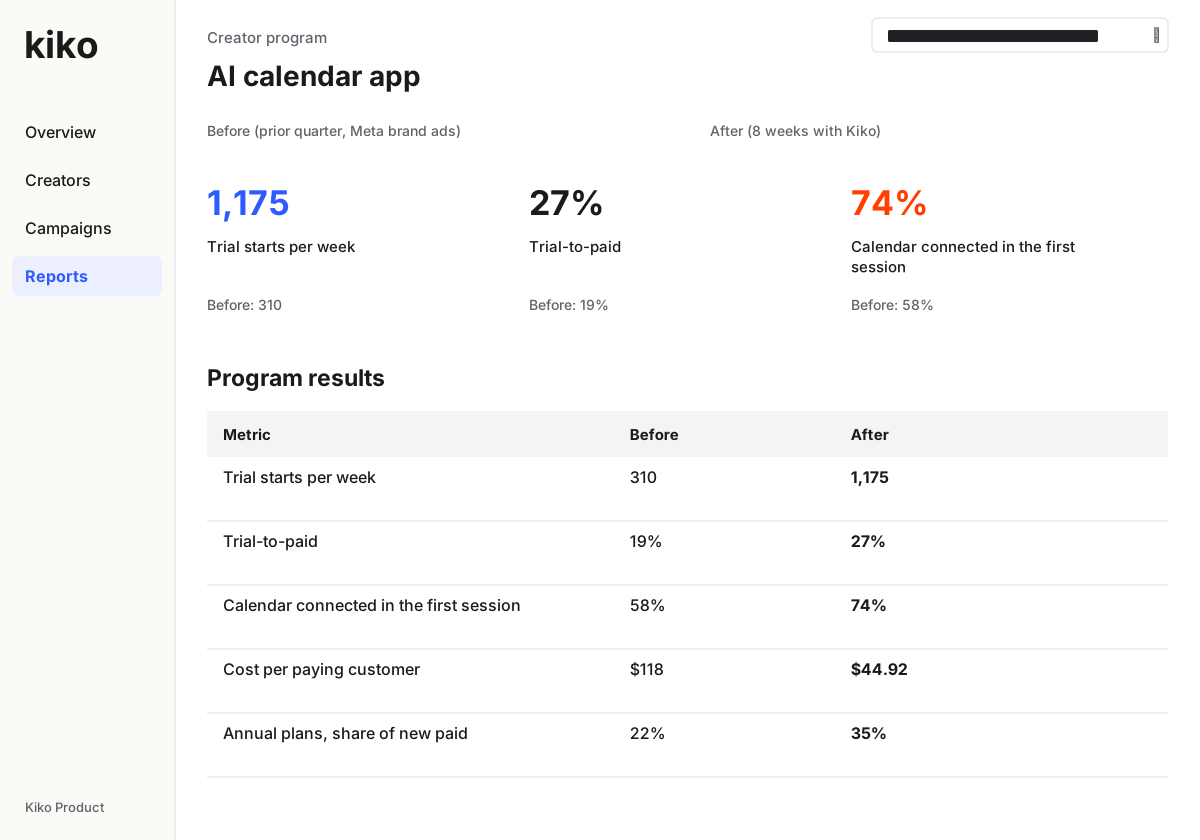
The results
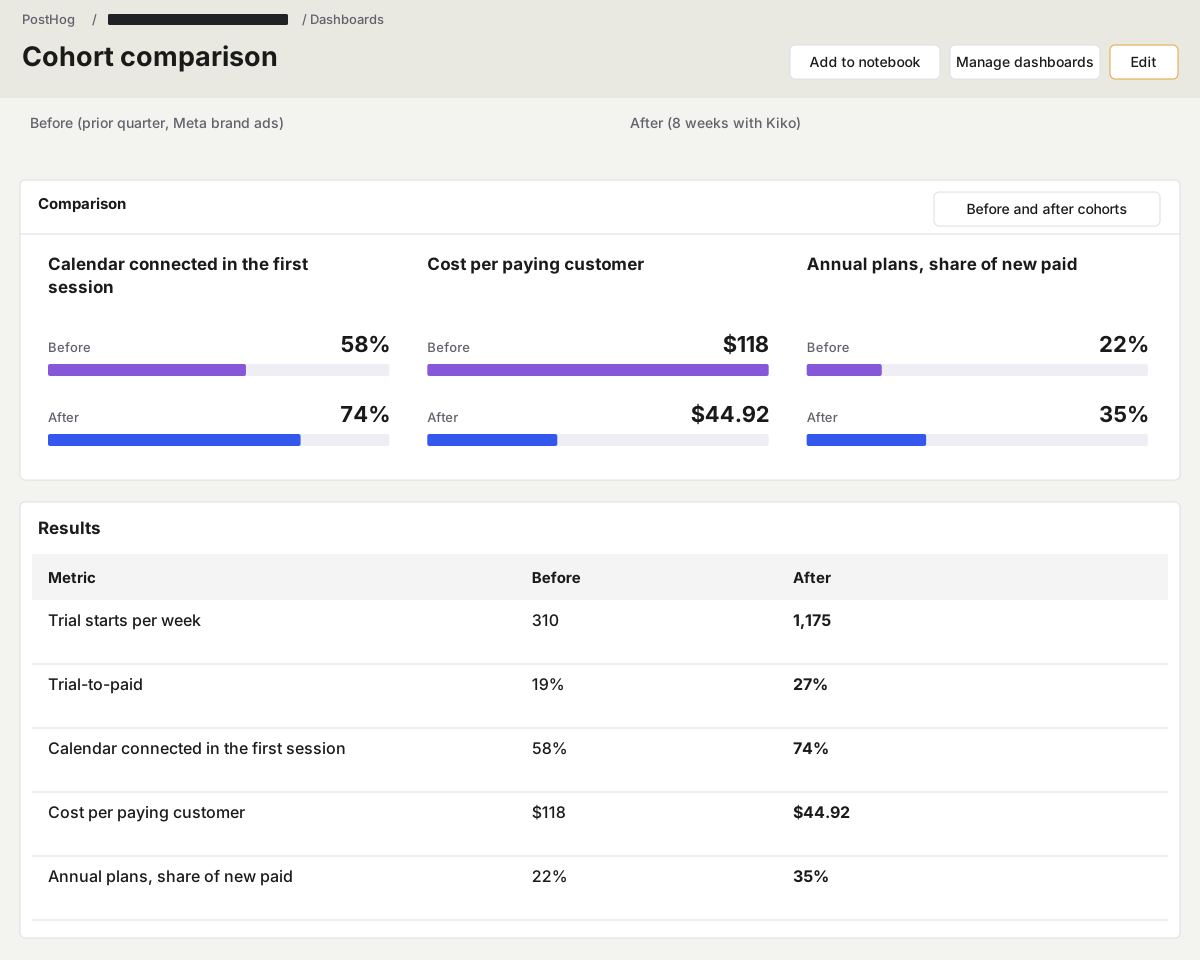
| Metric | Before (prior quarter, Meta brand ads) | After (8 weeks with Kiko) | Change |
|---|---|---|---|
| Trial starts per week | 310 | 1,175 | 3.8x |
| Trial-to-paid | 19% | 27% | +8 pts |
| Calendar connected in the first session | 58% | 74% | +16 pts |
| Cost per paying customer | $118 | $44.92 | −62% |
| Annual plans, share of new paid | 22% | 35% | +13 pts |
What didn't work
- Feature tours. The 4 feature-tour videos converted trials to paid at 17%, under the 25% bar. None was rebooked.
- Broad reach without a workday audience. Our largest booking, a self-improvement channel with over 1M subscribers, brought 1,050 trials but only 16% paid. Its viewers were students more than people with full calendars.
- Android lagged. Calendar sync on Android was slower, and Android trials converted at 15%, against 29% on iOS and Mac. We asked creators to film on iPhone and Mac and pointed Android viewers to the waitlist until sync improved.
What we learned
- Have every creator use their real calendar, not a demo account.
- Make ad decisions on a fast leading signal, and rebooking decisions on paid conversion.
- Book "30 days later" follow-ups with the creators who converted best.
Frequently asked questions
How much did 9,400 trials from YouTube creators cost?
Each trial cost $12.13 and each paying customer $44.92, against $118 on the app's earlier Meta brand ads. Trials from creator links cost $53.35 per paying customer; trials from creator-handle ads cost $25.77.
How long before creator videos turn into paid subscribers?
Videos went live in week 3. The leading signal, calendar connected in the first session, read at 7 days. Paid conversion waits for the 14-day trial to end, so the full 27% read closed in weeks 9–10.
Would this work for a Series B productivity app, or an Android-first one?
A Series B app with a 14-day trial and a workday audience, yes: the real-calendar format and the 70% leading signal carry over. Android-first, not yet. Android trials here converted at 15% against 29% on iOS and Mac, so fix sync first.
Related case studies and guides
Same industry, other angles: