The company and program
| Client | A Series A neobank offering a checking account and debit card through a partner bank. |
| Stage | Series A |
| Industry | Consumer fintech |
| Timeline | 10 weeks, July to September 2026 |
| Channels | In-app onboarding, KYC vendor configuration, lifecycle email and push |
| Team | A Kiko growth lead plus agents: an event-audit agent, a reason-code agent that grouped vendor outcomes daily, and an experiment write-up agent. The client's engineers built the screens; the partner bank and compliance team approved every change |
The approach
- Hypothesis: most lost applicants fail at screens the app controls, not at the bank's policy, so field order, validation, resume flows and step-up design can raise completion with no policy change.
- Comparison: each change against a 50/50 split of new applicants, at least 200 per arm and 14 days. The bank's required fields stayed fixed in both arms.
- Decision rule: ship if completion rises at least 2 points and approved-to-funded and fraud flags hold. Kill otherwise.
What we changed
- Weeks 1–2: stage instrumentation. Added
kyc_started,kyc_field_completed,kyc_decision,stepup_submitted,review_resolved,kyc_resumedandaccount_funded, with vendor reason codes and no PII in analytics. - Weeks 3–5: field order. Name and email first, address with autocomplete next, SSN last with a one-line reason. Start-to-submit rose from 69% to 79%.
- Weeks 4–6: resume links. Every step resumable by deep link, with reminders at 1 hour and 24 hours. Start-to-submit reached 85%; resumed applications went from 6% to 18%.
- Weeks 5–7: inline checks. Name, date of birth and address checked for format and typos before the identity check ran. Auto-approval rose from 62% to 68%.
- Weeks 6–8: step-up on the phone. Desktop users got a QR handoff to the phone camera, capture guidance and a list of accepted IDs up front. Step-up approvals rose from 45% to 62%.
- Weeks 6–8: review status. Applicants in manual review saw the expected wait and got a notification on every status change. Review approvals within 7 days rose from 60% to 70%.
The results
| Metric | Before (baseline cohorts) | After (weeks 7–10) | Change |
|---|---|---|---|
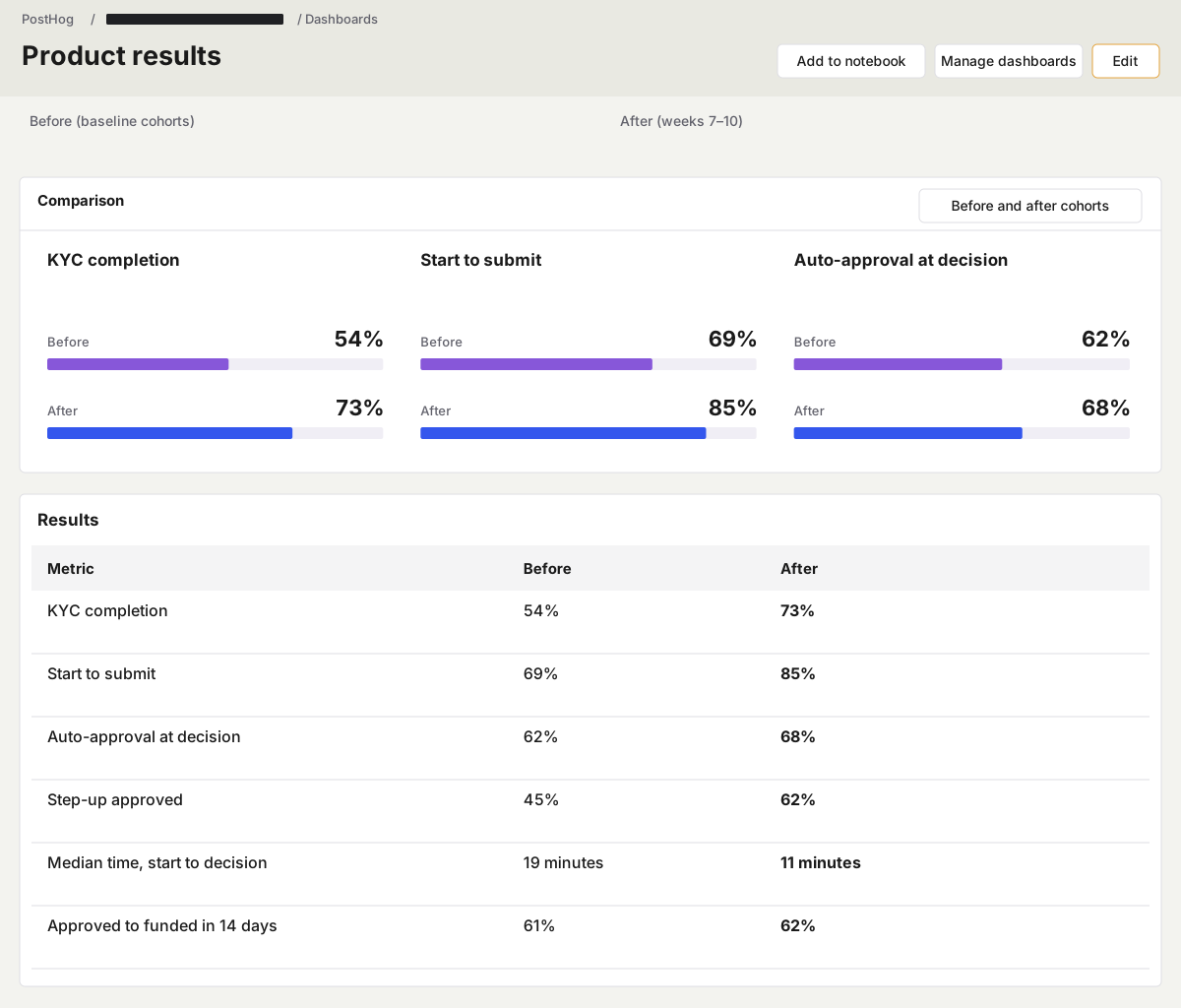
| KYC completion | 54% | 73% | +19 pts |
| Start to submit | 69% | 85% | +16 pts |
| Auto-approval at decision | 62% | 68% | +6 pts |
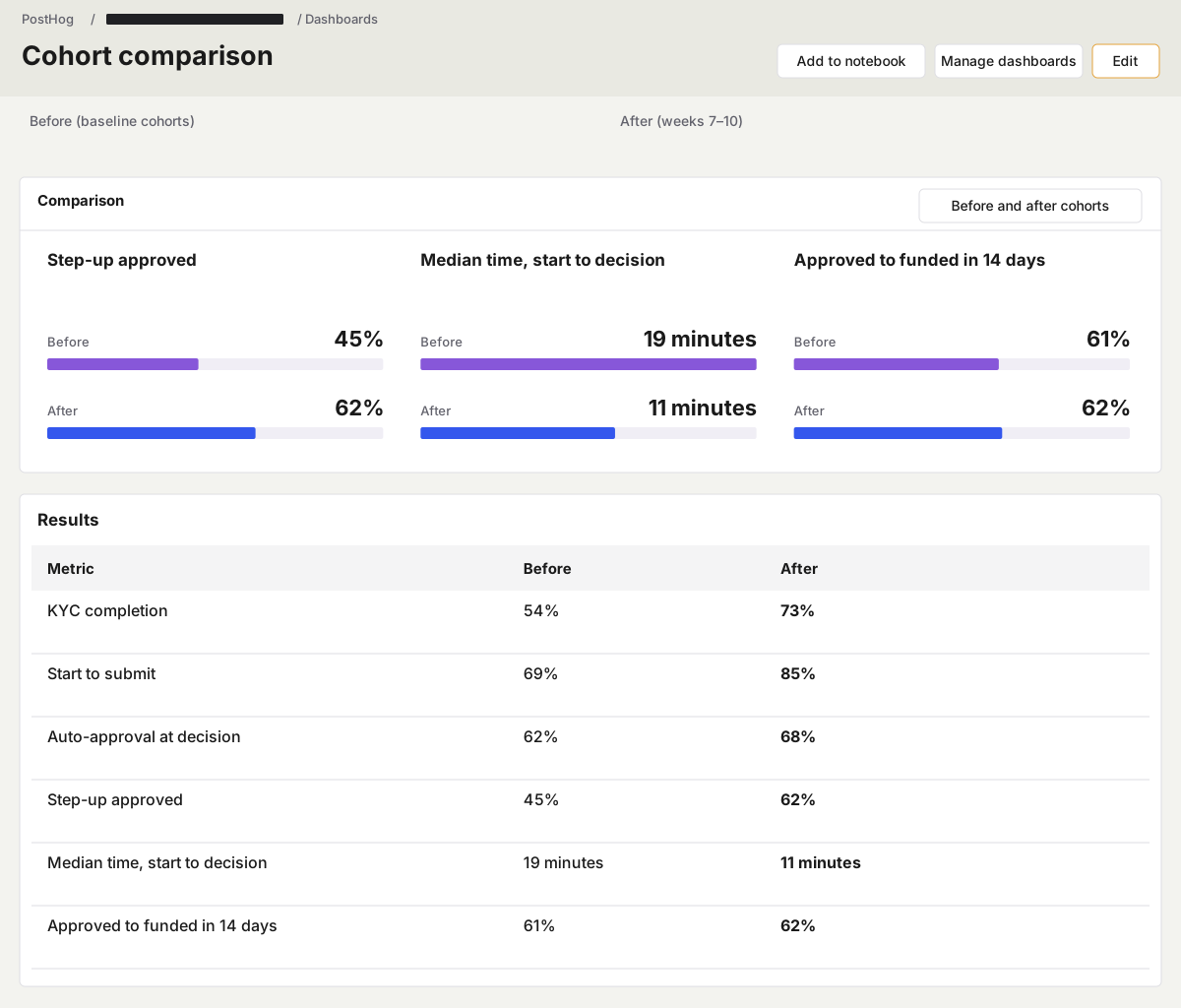
| Step-up approved | 45% | 62% | +17 pts |
| Median time, start to decision | 19 minutes | 11 minutes | −8 minutes (−42%) |
| Approved to funded in 14 days | 61% | 62% | +1 pt |
What didn't work
- Asking for less. The bank kept the expected-monthly-deposits question and declined to collect the SSN from a third party. Both were policy calls, not design ones.
- Value before identity. A tiered-access preview was ruled out: the product is an account, so the program requires identity at application.
- Funding barely moved. A redesigned first-deposit screen lifted approved-to-funded by 1 point. Funding needs its own sprint.
What we learned
- Instrument every KYC stage separately before changing a screen.
- Make every step resumable; people leave to find an ID.
- Hand desktop step-up to the phone camera.
Frequently asked questions
What does a KYC onboarding sprint cost?
There was no media spend, and the client's own engineers built the screens; Kiko's sprints start at $10,000 a month. Approved applicants rose 42%, from 9,730 to 13,863 per four weeks, on 6% more starts.
How long does it take to lift KYC completion?
Two weeks of instrumentation, then overlapping tests from week 3. Field order alone took start-to-submit from 69% to 79% in weeks 3–5. Weeks 7–10 read 73%, with every test having run at least 14 days.
Would this work for a seed-stage lending or crypto app with a different KYC vendor?
Yes, if your losses sit on screens you control. Field order, resume links, inline checks and phone handoff for documents don't depend on the vendor. Fields your bank requires won't move, and neither will tiered access before identity.
Related case studies and guides
Same industry, other angles:
- Creator marketing: Cost per funded account down 41% in 12 weeks
- Paid ads: Monthly paid spend scaled from $60K to $240K with cost per funded account flat at $38
- Full growth system: grew funded accounts 3.4x in 9 months at a 22% lower blended CAC