The company and program
| Client | A Series B budgeting app with a spending and savings account through a partner bank. |
| Stage | Series B |
| Industry | Consumer fintech |
| Timeline | 16 weeks, May to August 2026, measured against an April baseline |
| Channels | Meta (Facebook and Instagram) in the "Financial products and services" special ad category; TikTok in-feed ads from the brand's own account |
| Team | A Kiko growth lead plus agents: a creative-tagging agent, a daily pacing and cohort agent, and a claim-check agent that flags new claims for the client's counsel |
The approach
- Hypothesis: spend can grow 4x without cost per funded account rising more than 10%, if campaigns optimize to a post-KYC event, concept supply stays ahead of fatigue, and TikTok adds a second pool of broad reach.
- Comparison: each budget step against the previous 7 days; each new concept against the current control at $500–$1,000 or 7 days, whichever came first; TikTok against Meta on cost per funded account with a 14-day lag for late deposits.
- Decision rule: raise 20% when 7-day cost per funded account sits within 10% of the $38 target. Hold when it runs 10–30% above. Cut back when it runs 30% above for 5 straight days. Refresh creative when 7-day frequency passes 3.0 or cost per funded rises 25% on a stable budget.
What we changed
- Weeks 1–2: events. We sent
kyc_submitted,kyc_approvedandaccount_fundedserver-side to Meta and TikTok, with no personal financial data in the payloads. Meta campaigns moved from install optimization to KYC approved. - Weeks 1–3: TikTok clearance. The client got its TikTok representative's classification of the product in writing and filed the sponsor-bank documents. Creator-made video ran from the brand's account, not as Spark Ads.
- Weeks 2–6: concept pipeline. Twelve personal-finance creators at 50K–400K followers who do budget breakdowns on camera made 46 videos, with 90 days of paid usage in the base fee. Every concept fit one of four families, product proof, story, creator or comparison, and counsel signed off every claim before launch.
- Weeks 3–12: budget steps. Spend rose 20% a week when the rule allowed. It held three times, in weeks 6, 9 and 12, while new concepts went in.
- Week 6: deeper event. Once each campaign cleared 50 funded accounts a week, Meta optimization switched to
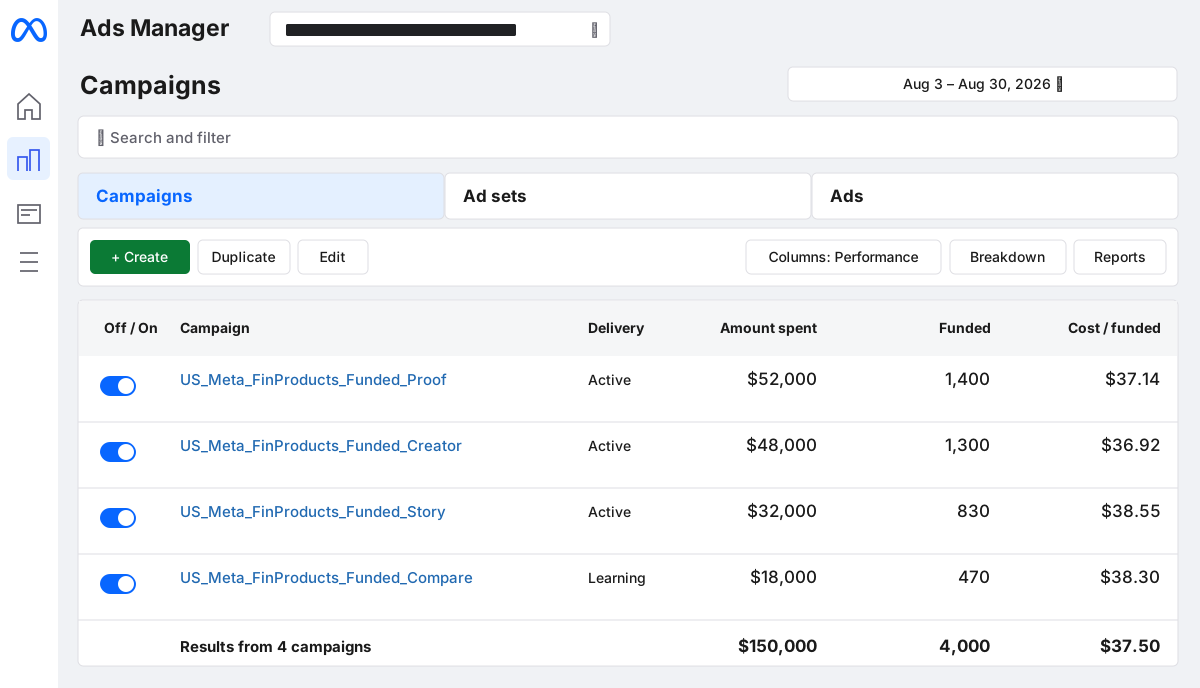
account_funded. Nine Meta campaigns became four. - Weeks 13–16: hold at $60K a week. Three new concepts went live every week and the weakest three came out.
The results
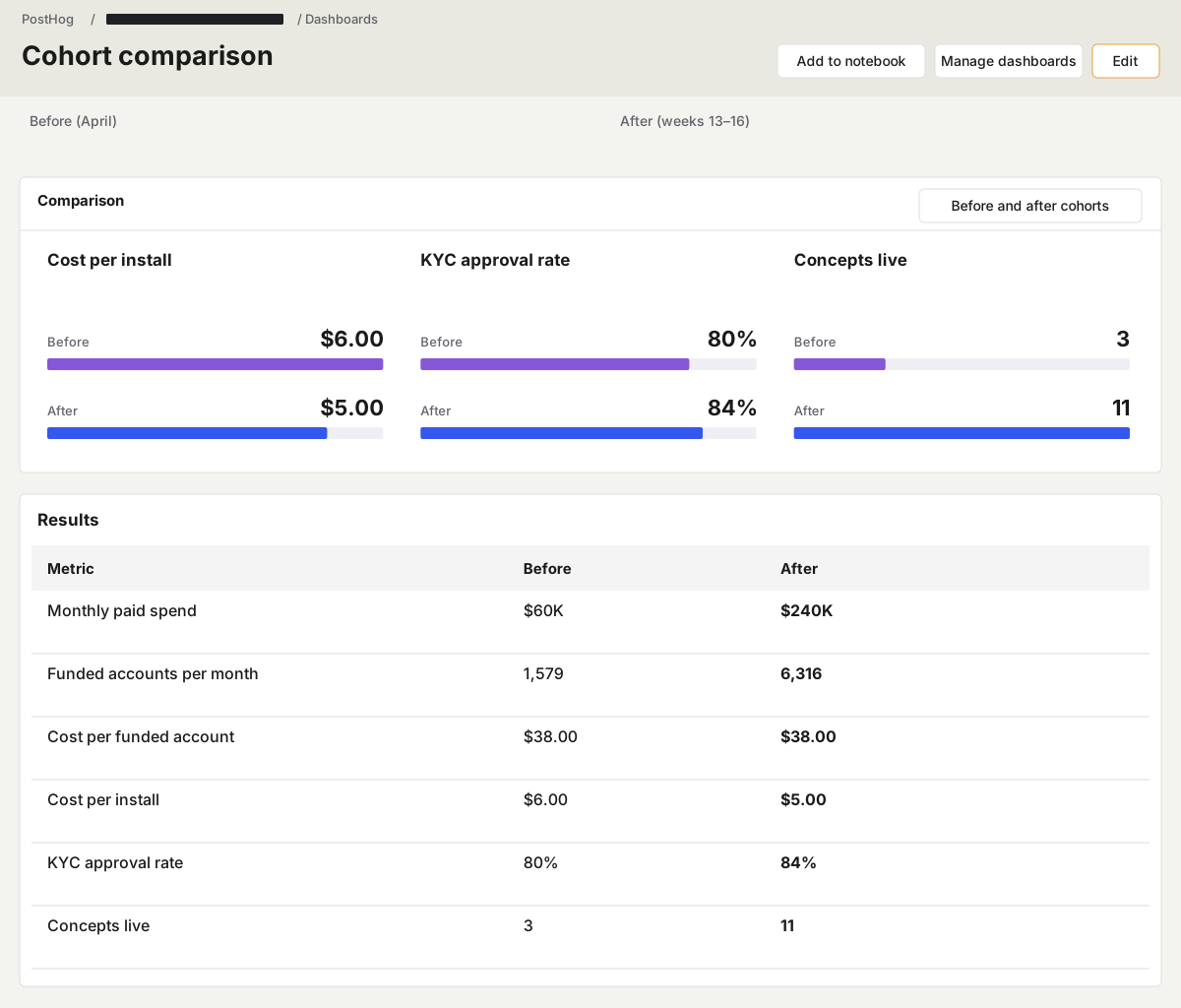
| Metric | Before (April) | After (weeks 13–16) | Change |
|---|---|---|---|
| Monthly paid spend | $60K | $240K | 4.0x |
| Funded accounts per month | 1,579 | 6,316 | 4.0x |
| Cost per funded account | $38.00 | $38.00 | 0% |
| Cost per install | $6.00 | $5.00 | −17% |
| KYC approval rate | 80% | 84% | +4 pts |
| Concepts live | 3 | 11 | +8 |
What didn't work
- Funded rate fell as reach widened. Approved-to-funded dropped from 47% to 39%. Cheaper installs and a higher approval rate made up for it, but broad delivery brought in more people who opened an account and never moved money.
- Months 2 and 3 ran above target. Cost per funded reached $39.80 in month 3, when budget outpaced new concepts. The three holds were the price of that.
- The comparison concept never scaled. "Us vs. your bank" ads drew clicks but the weakest funded rate of the four families, and they needed the longest claim review.
What we learned
- Optimize to KYC approved from day one and switch to funded as soon as volume allows.
- Treat concept supply as the budget limit: no step without a new concept ready to go live.
- Get TikTok's classification in writing before building any TikTok-specific creative.
Frequently asked questions
What does it cost to scale fintech ad spend 4x without CAC rising?
Cost per funded account stayed at $38.00 while monthly spend went from $60K to $240K over 16 weeks; the worst month, month 3, ran at $39.80. Creator fees for 46 videos came on top and averaged a few hundred dollars a video.
How long does it take to go from $60K to $240K a month?
16 weeks. Two weeks of event work, then 20% steps a week from week 3. The budget held three times, in weeks 6, 9 and 12, when concepts ran short. Weeks 13–16 held at $60K a week.
Would this work for a seed-stage fintech app spending $15K a month?
The rules carry over: optimize to KYC approved, raise 20% only when the last step holds, keep concepts ahead of spend. The switch to account_funded needs 50 funded accounts a week per campaign, so at $38 and $15K a month you get one or two campaigns, not nine.
Related case studies and guides
Same industry, other angles:
- Creator marketing: Cost per funded account down 41% in 12 weeks
- Product growth: KYC completion up from 54% to 73% in 10 weeks
- Full growth system: A Series B savings app grew funded accounts 3.4x in 9 months at a 22% lower blended CAC