The company and program
| Client | A Series A credit-building app with a credit-builder account and a secured card. |
| Stage | Series A |
| Industry | Consumer fintech |
| Timeline | 3 weeks of setup from 13 April 2026, then 12 weeks live, 4 May – 26 July 2026 |
| Channels | YouTube and podcast integrations, TikTok creator posts, TikTok Spark Ads, Meta partnership ads |
| Team | 1 dedicated Kiko growth lead, plus agents for creator scoring, claim checks against the approved-claims list and daily funnel reporting |
The approach
- Hypothesis: people rebuilding credit trust a creator who shows their own score history and deposits more than a brand ad with a score graph.
- Comparison: creator-led Spark and partnership ads against the brand's static score-graph ad, at matched daily budgets. The whole program against the prior 12 weeks of brand-only ads.
- Decision rule: each ad concept got $500–$1,000 or 7 days. Pause above $100 per funded account; scale below $90.
What we changed
- Setup weeks 1–2: score, sign and approve claims. We scored 70 creators on Kiko's six-point rubric, with disclosure history weighted most, and signed 12. Six were YouTube and podcast hosts: debt-and-spending audit shows, Gen Z money explainers, a couples-money show and a student-debt podcast. Six were TikTok creators at 15K–180K followers who post their own credit rebuild. In parallel, the client's counsel approved a claims list: no score-increase promises, fees stated plainly.
- Setup week 3: scripts and first posts. Every script went through Kiko's FTC check and then counsel. First posts went live at the end of the week with tracked links, and every contract included 90 days of paid usage in the base fee.
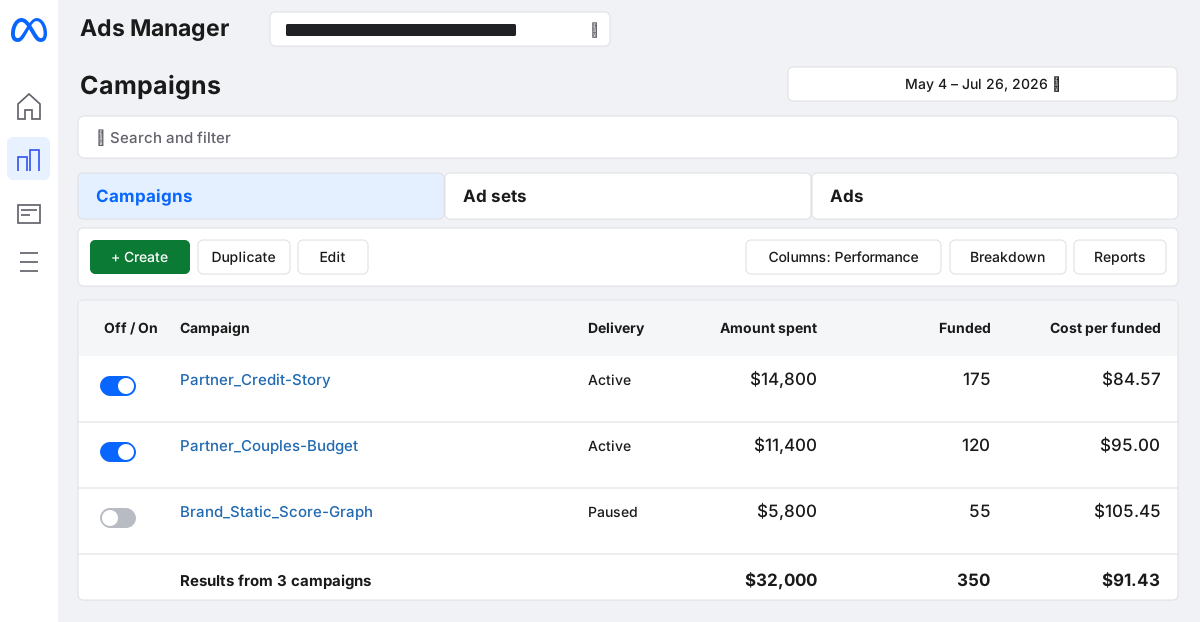
- Live weeks 1–2: paid test. After 7 days of organic data, the five strongest posts went into TikTok Spark Ads and Meta partnership ads, next to the brand's score-graph ad. The brand's old campaigns were switched off.
- Live weeks 3–8: scale. We paused the score-graph ad, held weekly media flat and moved budget weekly to the lowest cost per funded account.
- Live weeks 9–12: deposit nudge. Creator sign-ups stalled between account opened and first deposit. The client added a reminder quoting the creator's own deposit tip, and opened-to-funded kept climbing.
The results
| Metric | Before (prior 12 weeks, brand ads) | After (live weeks 1–12) | Change |
|---|---|---|---|
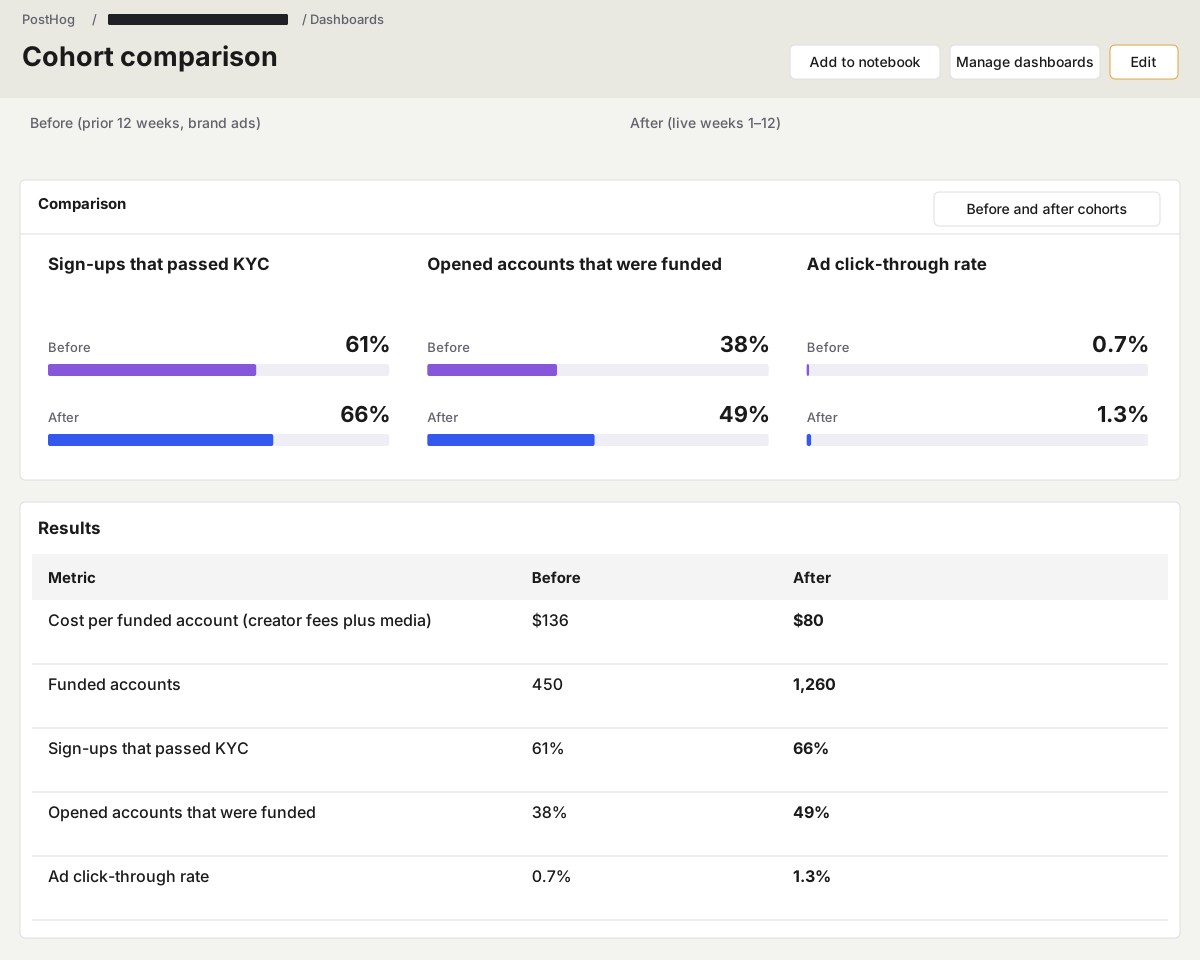
| Cost per funded account (creator fees plus media) | $136 | $80 | −41% |
| Funded accounts | 450 | 1,260 | 2.8x |
| Sign-ups that passed KYC | 61% | 66% | +5 pts |
| Opened accounts that were funded | 38% | 49% | +11 pts |
| Ad click-through rate | 0.7% | 1.3% | +0.6 pts |
What didn't work
- Counsel review was slow at first. The first scripts took 6 business days on average to approve, which pushed two creators into live week 1. By week 4, with a claims list both sides trusted, approvals took 2 days.
- A Gen Z first-card ad stayed expensive. It ran at $108.42 per funded account and was paused. Younger viewers opened accounts but often did not make a first deposit.
- The brand score-graph ad lost again. It ran at $105.45 per funded account and was paused in live week 3.
What we learned
- Get the claims list approved before the first brief. It made every later script a two-day review.
- Book creators who show their own numbers. First-person credit stories were the cheapest ads on both TikTok ($76.74) and Meta ($84.57).
- Watch opened-to-funded, not just installs. The deposit reminder fixed the step where creator sign-ups stalled.
Frequently asked questions
How much does a creator program for a credit-building app cost?
Each funded account cost $80 in creator fees and media, down from $136, across 1,260 funded accounts in 12 weeks. Paid creator ads ran at $87.80 per funded account and organic creator links at $65.45. Most Series A programs like this run $25,000–$50,000 a month in creator fees and media.
How much time does compliance review add to a fintech creator campaign?
Three weeks of setup before going live, most of it counsel review. The first scripts took 6 business days each; by live week 4, with an approved claims list, 2 days. The 41% drop was read over the 12 live weeks.
Would this work for a seed-stage fintech app, or a Gen Z first-card product?
A seed-stage app with a funded-account event and counsel on call can run the same five-post paid test on a smaller weekly budget. A Gen Z first-card product needs a different hook: the Gen Z first-card ad here ran at $108.42 per funded account and was paused.
Related case studies and guides
Same industry, other angles: