The company and program
| Client | A Series B savings app |
| Stage | Series B |
| Industry | Consumer fintech |
| Pillars | Creator marketing + Paid ads + Product growth |
| Timeline | 9 months, Jan 1 – Sep 30, 2026: three 90-day sprints |
| Channels | YouTube and TikTok personal-finance creators, Meta, TikTok and YouTube ads, KYC and funding onboarding, lifecycle email and push |
| Team | A dedicated Kiko growth lead plus agents for creator research, compliance tracking, ad reporting and funnel and cohort pulls. The client's engineers built the onboarding changes Kiko specced |
| Headline result | New funded accounts a month up 3.4x, from 2,000 to 6,800, at a 22% lower blended CAC |
| Measured in | Product analytics, the KYC vendor's dashboard, the core banking ledger, Meta, TikTok and YouTube ads managers, referral codes and a source question at sign-up |
The approach
- Hypothesis: a savings app pays for a sign-up but earns only on a funded account. If creators show a real savings goal being set up, ads reuse those approved videos, and onboarding removes the identity and first-deposit stalls, cost per funded account falls even as spend rises.
- Comparison: December 2025 was the baseline: Meta and TikTok ads at $70 per funded account from paid, 2,000 new funded accounts, a blended CAC of $50 and 29% of sign-ups funded within 14 days. Each later month was read against it, by source.
- Decision rule: a creator post got 7 days of organic data and went into paid only if its sign-ups funded within 14 days at 35% or better. Ad concepts got $500–$1,000 or 7 days and were killed above $75 per funded account. Onboarding changes shipped only after a 50/50 test lifted 14-day funding by 2 points or more.
How the three pillars connected
Creator marketing
We booked 12 creators in the first 30 days and 22 over the engagement, and seven were on recurring monthly integrations by sprint 3. They were budgeting and debt creators, such as a 900K-subscriber money-audit YouTuber, and saving-focused creators for women and young earners. Every script was written from the client's approved claims, with the partner bank named and FDIC wording signed off by the client's counsel. Creators brought 9,105 funded accounts at $37 each.
Paid ads
The baseline account ran rate-led static ads at $70 per funded account from paid. We moved spend to approved creator videos run as Meta partnership ads, TikTok Spark Ads and YouTube in-stream ads, inside each platform's financial-services rules, and optimised to the funded-account event rather than sign-ups. Monthly media roughly doubled from January to September, and paid brought 20,135 funded accounts.
Product growth
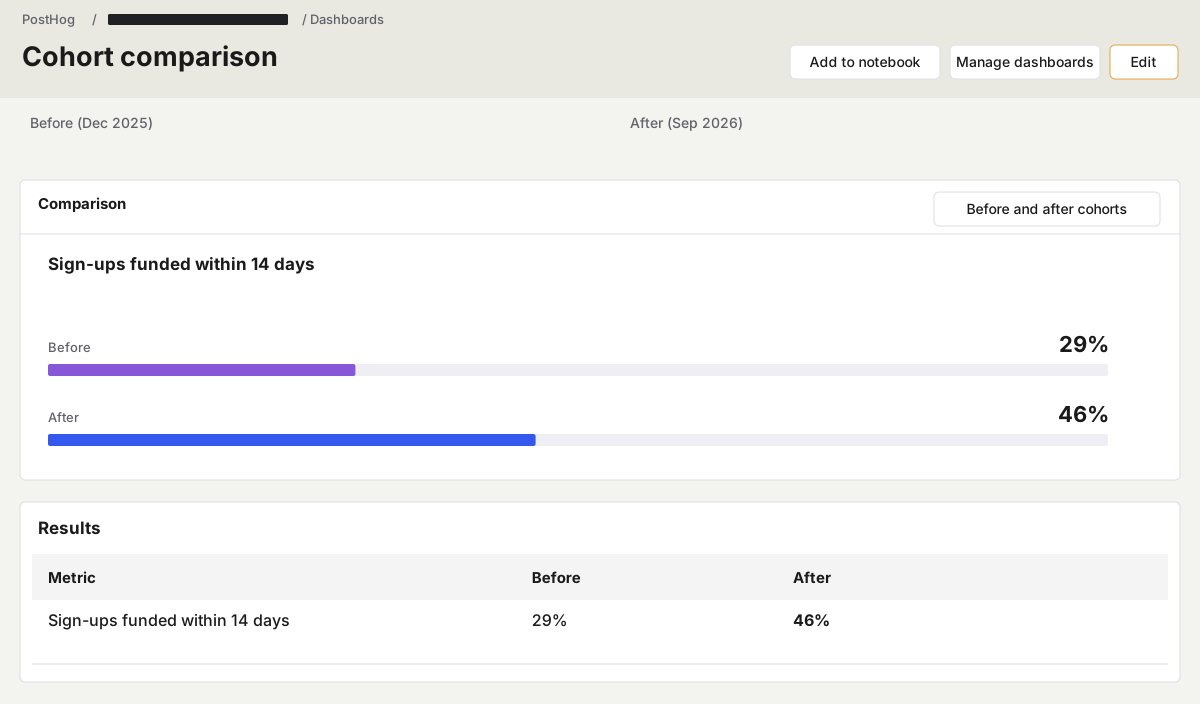
The funnel showed two stalls: 37% of sign-ups failed or abandoned identity checks, and many who passed never linked a bank. We specced auto-capture for ID scans, a document-upload fallback reviewed within 24 hours when address data failed to match, bank linking offered straight after a passed check, a "$100 to start your first goal" default, and a 48-hour reminder showing the user's goal. Identity verification rose from 63% to 81%, bank linking from 44% to 64%, and funding within 14 days from 29% to 46%.
How they fed each other
The creator videos that converted best showed the creator setting a named goal ("emergency fund: $1,000 by March") on screen, so goal-first ads replaced rate-led ads and the goal screen moved to the start of onboarding. Paid volume showed that the address-mismatch failures came mostly from users under 25 who had moved recently. The upload fallback fixed it for creator sign-ups, who skewed young, as much as for paid. Higher funding per sign-up let paid CAC hold near $66 while media doubled, and referral and organic funded accounts grew from about 570 to 1,665 a month.
What we changed
- Weeks 1–2: event audit, the funded-account definition, the December baseline by source, a pre-approved claims list with counsel, and a 12-creator shortlist scored on Kiko's six-point rubric with disclosure history weighted highest.
- Weeks 3–6: compliance review of every script, first creator posts in week 3, and 15 ad concepts tested at $500–$1,000 each. ID auto-capture into a 50/50 test.
- Weeks 7–13: auto-capture and the upload fallback shipped to all users. Four creator videos passed the rule and ran as partnership ads and Spark Ads.
- Weeks 14–26 (sprint 2): goal-first onboarding and the "$100 to start" default shipped. Ten more creators booked, seven on monthly integrations; media scaled on the approved winners.
- Weeks 27–39 (sprint 3): YouTube in-stream ads launched from creator long-form, media reached its highest month, and the 48-hour goal reminder went live.
The results
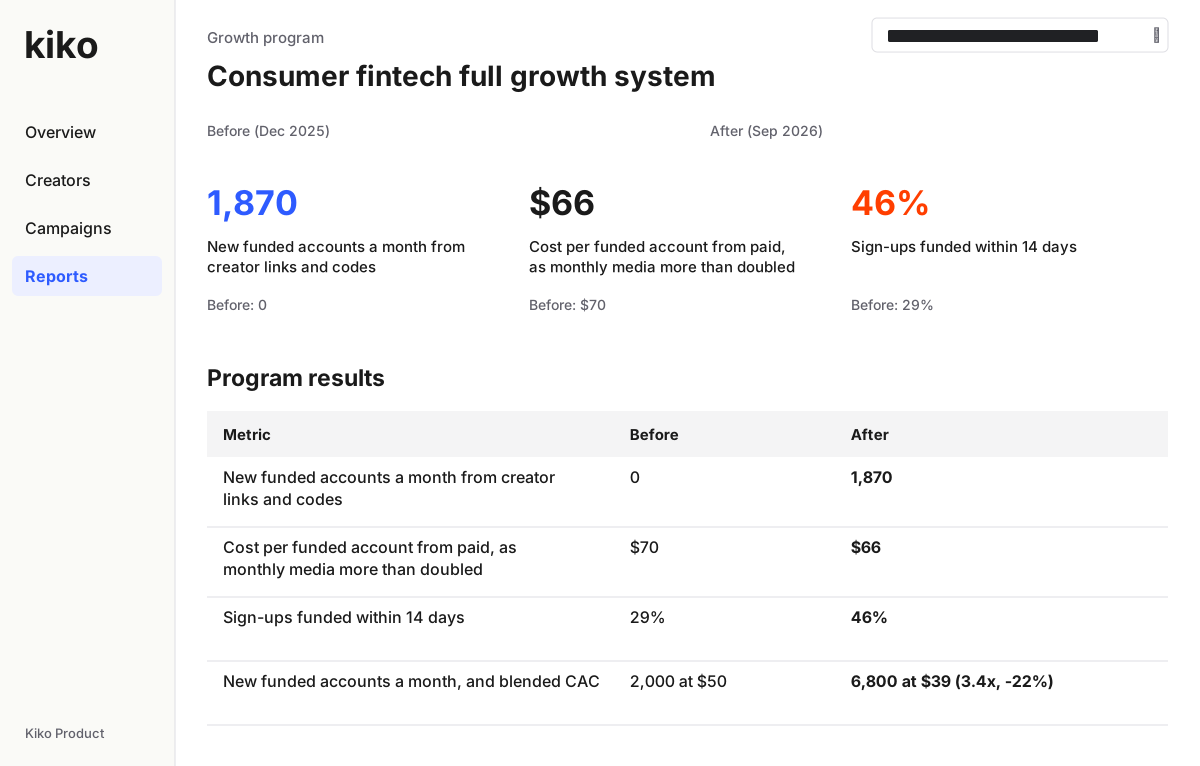
| Pillar | Metric | Before (Dec 2025) | After (Sep 2026) | Change |
|---|---|---|---|---|
| Creator marketing | New funded accounts a month from creator links and codes | 0 | 1,870 | +1,870 |
| Paid ads | Cost per funded account from paid, as monthly media more than doubled | $70 | $66 | −6% |
| Product growth | Sign-ups funded within 14 days | 29% | 46% | +17 pts |
| Combined | New funded accounts a month, and blended CAC | 2,000 at $50 | 6,800 at $39 (3.4x, -22%) | 3.4x volume, −22% CAC |
Total funded accounts grew from 80,000 to 110,400, and monthly net revenue from $430K to $614K.
What didn't work
- Rate-led ads. Ads leading with the savings rate needed fresh compliance approval every time the rate changed, and their sign-ups funded 9 points less often than goal-led ads. We retired them in sprint 2.
- Finance-meme creators. Three TikTok creators with large meme audiences drove cheap sign-ups, but only 38% passed identity checks. We stopped after one post each.
- A $50 sign-up bonus. It lifted funded accounts in a 4-week test, but 41% of bonus users withdrew within 30 days. Goal-based nudges replaced it.
What we learned
- Write the approved claims list with counsel before the first brief, so creator scripts clear review in days.
- Fix identity-check failures for the audience your creators bring, not the average user.
- Judge every channel on funded accounts and lead creative with the user's goal, not the rate.
Frequently asked questions
What does a full growth program cost for a Series B fintech app?
Each funded account cost $45 in creator fees and media across the 9 months, falling from $50 to $39; creators brought funded accounts at $37 each. Most Series B programs like this run $130,000–$270,000 a month in creator fees and media.
How long did compliance review add to the creator timeline?
Very little. The approved claims list was written with counsel in the first two weeks, so first creator posts still went live in week 3. Funded accounts reached 6,800 a month by month 9.
Would this work for a seed-stage savings app spending $20,000 a month?
The onboarding fixes and the funded-account kill rule work at any budget. The media plan does not: this program started at more than five times that budget in media alone and ran 22 creators. At seed, start with the KYC fixes.
Related case studies and guides
Same industry, other angles:
- Creator marketing: Cost per funded account down 41% in 12 weeks, a Series A credit-building app
- Paid ads: Monthly paid spend scaled from $60K to $240K with cost per funded account flat at $38, a Series B budgeting app
- Product growth: KYC completion up from 54% to 73% in 10 weeks, a Series A neobank
Playbooks and lists:
- Creator marketing for fintech apps, the industry front door
- How do fintech apps get creator content through compliance?, scaling Meta and TikTok ads for fintech and reducing KYC drop-off, the playbooks
- Personal-finance creators for fintech apps, the creator shortlist
- Fractional growth team, how Kiko runs all three pillars together