The company and program
| Client | A Series A dating app live in six US cities |
| Stage | Series A |
| Industry | Dating apps |
| Pillars | Creator marketing + Paid ads + Product growth |
| Timeline | 9 months, Jan 1 – Sep 30, 2026: three 90-day sprints |
| Channels | YouTube dating coaches, TikTok and Instagram local lifestyle creators, Meta ads, TikTok ads, onboarding, matching and paywall changes |
| Team | A dedicated Kiko growth lead plus agents for creator research by city, ad reporting and liquidity and cohort pulls. The client's engineers built the onboarding and matching changes Kiko specced |
| Headline result | Weekly mutual matches 2x and monthly subscription revenue 2.6x in 9 months |
| Measured in | Product analytics, RevenueCat, the app's attribution provider, Meta and TikTok ads managers, creator codes and a source question at sign-up, all split by city |
The approach
- Hypothesis: a dating app sells subscriptions to people who have already matched. If creators bring the side of each city's market that is thin, ads scale that mix by city, and onboarding gets every new user a first mutual match within 48 hours, matches and subscriptions grow together.
- Comparison: December 2025 was the baseline: Meta ads optimised to installs at $93 per subscriber from paid, 19,125 installs, 650 new subscribers, a blended CAC of $54 and 27% of installs matching within 48 hours. Each later month was read against it, by source and by city.
- Decision rule: a creator post got 7 days of organic data and went into paid only if its installs matched within 48 hours at 35% or better and came from the side of the market that city needed. Ad concepts got $500–$1,000 or 7 days and were killed above $80 per subscriber. Onboarding and matching changes shipped only after a 50/50 test lifted 48-hour matches by 3 points or more.
How the three pillars connected
Creator marketing
We booked 14 creators in the first 30 days and 38 over the engagement. Eight were national voices for intentional dating, such as a 450K-subscriber dating coach on YouTube and a coach who answers singles' questions in live streams several times a week. Thirty were local lifestyle creators, about five per city, chosen for the age and gender each city was short of. Every brief kept to true stories and made no promise that viewers would find a partner. Creators brought 3,160 subscribers at $40 each.
Paid ads
The baseline ran install-optimised Meta ads at $93 per subscriber from paid. We got Meta's prior written permission for dating ads on the account, set up TikTok through a sales representative as its dating policy requires, and ran creator videos as city-targeted ads optimised to a completed, verified profile. Monthly media nearly doubled from January to September, and paid brought 7,460 subscribers.
Product growth
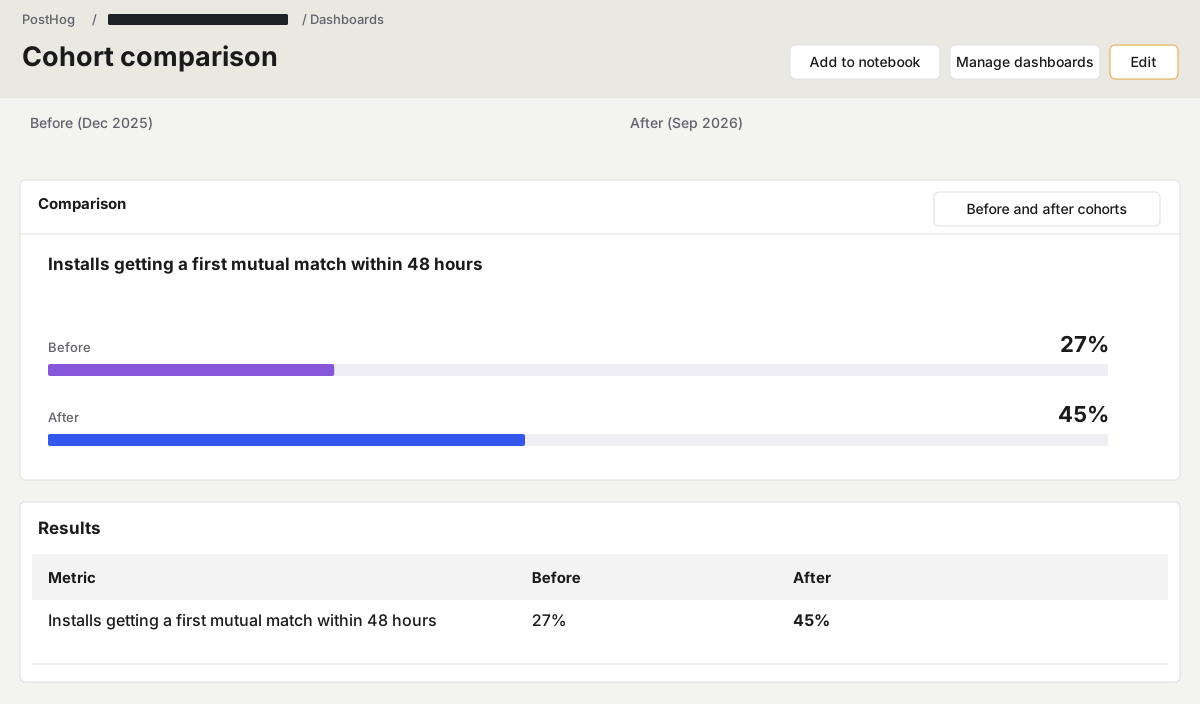
Funnel data showed that in three cities, new users saw fewer than 20 active profiles on their first day, and most left before matching. We specced a prompt-led profile builder that uses the questions from the best creator videos, photo verification inside onboarding, a 48-hour boost that shows new profiles to people active that day, and a paywall shown after the first match ("see who likes you"). Profile completion rose from 52% to 68%, first mutual match within 48 hours from 27% to 45% of installs, and subscription within 30 days from 3.4% to 4.9%.
How they fed each other
City-level data told us which side of each market to recruit, so creator briefs changed by city every month. The creator videos that converted best were "my honest profile review" formats, and their prompts became the profile builder. Paid volume exposed the thin first-day feed in three cities. The new-user boost fixed it for creator and organic installs too, and city-level budget pacing kept each market's ratio in range. More early matches lifted subscriptions per install, which cut paid CAC from $93 to $71 while media more than doubled.
What we changed
- Weeks 1–2: event and attribution audit by city, a first-match definition, the December baseline, Meta dating-ad permission and TikTok sales-rep setup, and a 14-creator shortlist scored on Kiko's six-point rubric.
- Weeks 3–6: first creator posts in week 3, timed to the cities with the thinnest supply. Eighteen ad concepts tested at $500–$1,000 each, and the 48-hour new-user boost into a 50/50 test.
- Weeks 7–13: the boost and inline photo verification shipped to all users. Five creator videos passed the rule and ran as city-targeted Meta and TikTok ads.
- Weeks 14–26 (sprint 2): the prompt-led profile builder and the post-match paywall shipped. Twenty-four more local creators booked; media scaled with city-level pacing.
- Weeks 27–39 (sprint 3): media reached its highest month, creators were re-briefed monthly from each city's ratio, and an annual plan was added, lifting average revenue per subscriber to $26 a month.
The results
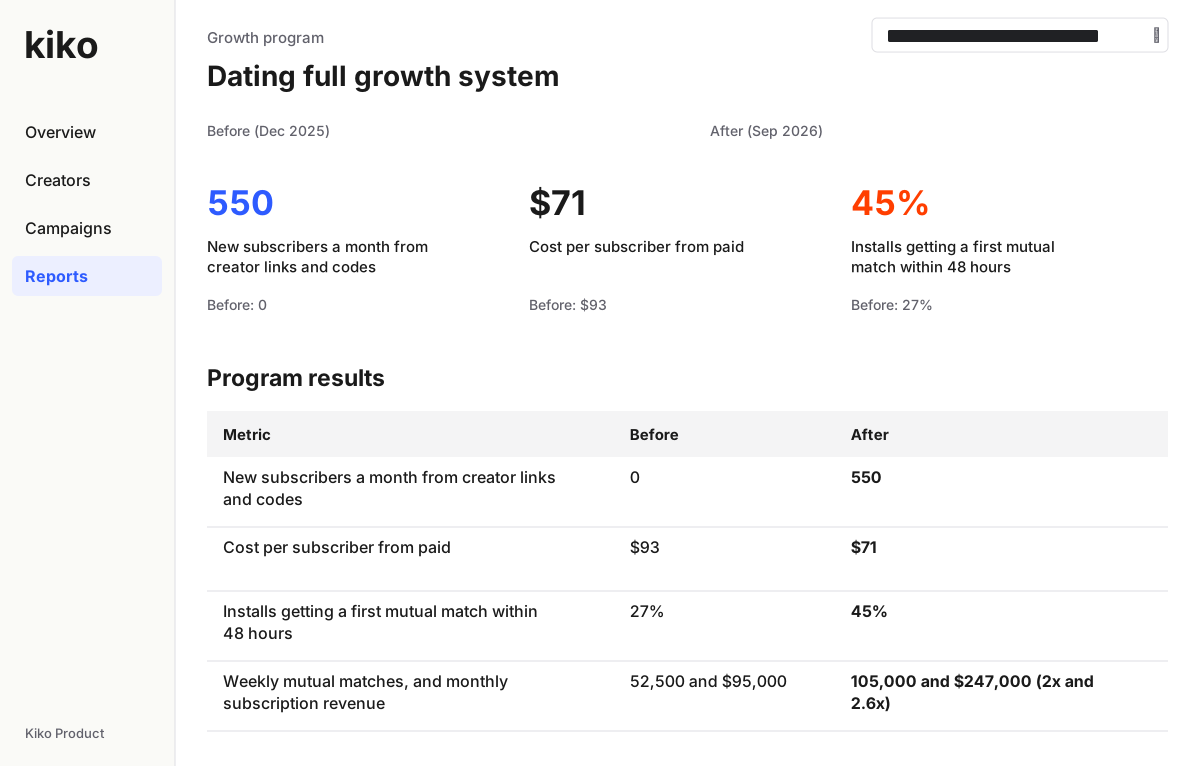
| Pillar | Metric | Before (Dec 2025) | After (Sep 2026) | Change |
|---|---|---|---|---|
| Creator marketing | New subscribers a month from creator links and codes | 0 | 550 | +550 |
| Paid ads | Cost per subscriber from paid | $93 | $71 | −24% |
| Product growth | Installs getting a first mutual match within 48 hours | 27% | 45% | +18 pts |
| Combined | Weekly mutual matches, and monthly subscription revenue | 52,500 and $95,000 | 105,000 and $247,000 (2x and 2.6x) | 2x and 2.6x |
Subscribers doubled from 4,750 to 9,500, blended CAC fell from $54 to $45, and monthly subscriber churn fell from 18.6% to 14.6%.
What didn't work
- Dating-fail comedy. Comedy creators with big dating-fail audiences drove cheap installs, but mostly from men in two cities that already had too many men. The ratio got worse, so we cut them after one post each.
- Creators who looked young. Two strong creator videos could not run as TikTok ads because the creators could appear 21 or younger, which TikTok's dating ad policy does not allow. We now check that before booking.
- A discounted first month. It lifted first purchases but cut revenue per subscriber without improving retention. We reverted it after 4 weeks.
What we learned
- Brief creators by city and by the side of the market each city needs, and change the brief monthly.
- Give every new user an audience on day one; the 48-hour boost did more for subscriptions than any paywall change.
- Clear dating-ad permissions on Meta and TikTok in week 1, before any creator content is ready to run.
Frequently asked questions
What does it cost to run creators, paid ads and product growth for a dating app?
Each new subscriber cost $44 in creator fees and media across the 9 months; blended CAC fell from $54 to $45 by September, and creators brought subscribers at $40 each. Most Series A programs like this run $45,000–$90,000 a month in creator fees and media.
How long does it take to fix a thin market in a dating app?
The 48-hour new-user boost went into a 50/50 test in week 3 and shipped to all users by week 7. First matches within 48 hours went from 27% to 45% of installs, and weekly matches doubled over 9 months.
Would this work for a seed-stage dating app launching its first city?
The city-by-city creator brief and the 48-hour boost carry over; start there. The paid plan does not: this program ran a Series A paid budget from month 1, after Meta dating-ad permission and TikTok sales-rep setup in week 1.
Related case studies and guides
Same industry, other angles:
- Creator marketing: 22,000 verified profiles in 8 weeks across Austin, Chicago and Denver, a seed-stage dating app launching in three US cities
- Paid ads: Cost per matched user down 33% while spend doubled, a Series A dating app
- Product growth: Share of new users getting a first match within 48 hours up from 46% to 71%, a seed-stage dating app
Playbooks and lists:
- Creator marketing for dating apps, the industry front door
- How do dating apps scale paid social while protecting match quality?, the paid playbook
- Dating and relationship creators, the creator shortlist
- Fractional growth team, how Kiko runs all three pillars together