The company and program
| Client | A seed-stage sales engagement tool. |
| Stage | Seed |
| Industry | B2B GTM and sales tools |
| Timeline | One 90-day growth sprint, June 29 – September 27, 2026. Conversions read through October 11 |
| Channels | Web app, in-app onboarding, lifecycle email, 15-minute setup calls |
| Team | A dedicated Kiko growth lead plus agents for event audits, funnel pulls, experiment write-ups and first drafts of onboarding emails. Client side: the founder (setup calls) and two engineers |
The approach
With about 250 trials a week, conversion takes too long to read on its own. We used "first sequence launched within 72 hours" as the fast read and trial-to-paid as the confirmation.
| Test | Hypothesis | Comparison | Decision rule |
|---|---|---|---|
| Mailbox first | Mailbox warm-up takes about 10 days, so a 14-day trial ends before most users see a reply | Connect Gmail or Outlook as step one and start warm-up on day 0, vs. connecting it after building a sequence | Ship if first sequence within 72 hours rises 5 points or more |
| AI first sequence | A blank editor stalls people who haven't written a sequence before | Import from CRM or CSV, then an AI-drafted 3-step sequence built from the user's website, vs. a blank editor | Same rule |
| Trial clock | Users should get 14 days of sending, not 14 days of setup | The trial starts at the first send, capped at 21 days from signup, vs. 14 days from signup | Ship if trial-to-paid rises for two weekly cohorts in a row, with no fall in cash collected per trial |
| Setup calls | Larger teams convert when someone helps them set up the first sequence | A 15-minute call with the founder for trials with 6+ seats at companies of 20+ people, vs. email onboarding | Keep if call-booked trials convert at twice the segment's baseline |
What we changed
- Weeks 1–2: audit and baseline. We rebuilt the trial funnel from product events. Only 28% of trials launched a sequence, 19% saw a reply before the trial ended, and median time to a first sequence was 108 hours.
- Week 3: mailbox first. Connection moved to step one and warm-up started on day 0.
- Week 4: AI-drafted first sequence. CRM and CSV import, then a 3-step draft built from the user's website.
- Week 5: trial clock at first send. 14 days of sending, capped at 21 days from signup.
- Week 6: setup calls. Trials with 6+ seats at companies of 20+ people were routed to the founder's calendar.
- Weeks 7–12: hold and measure. No new changes. We read each weekly trial cohort at trial end and held the sprint review in week 13.
The results
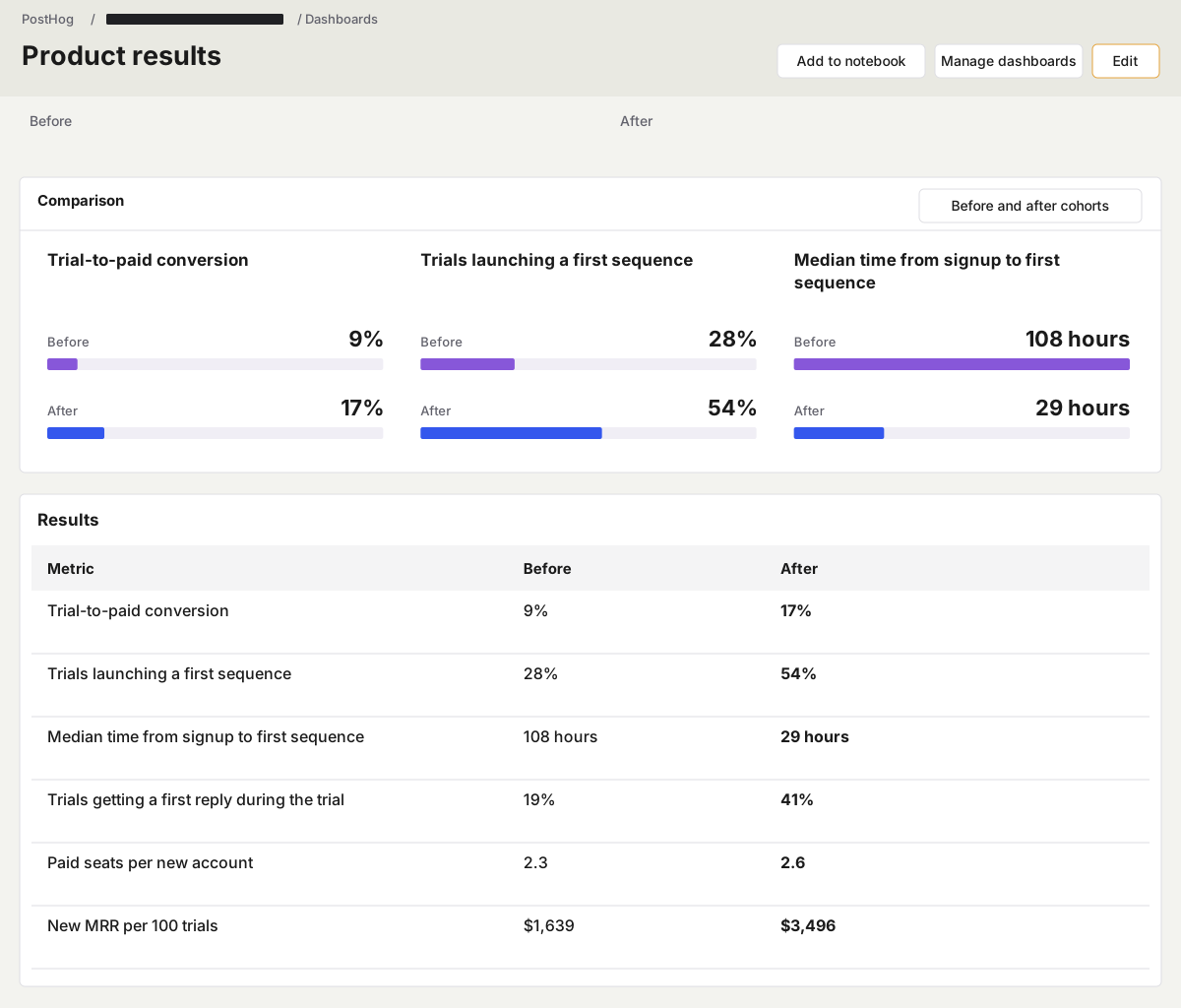
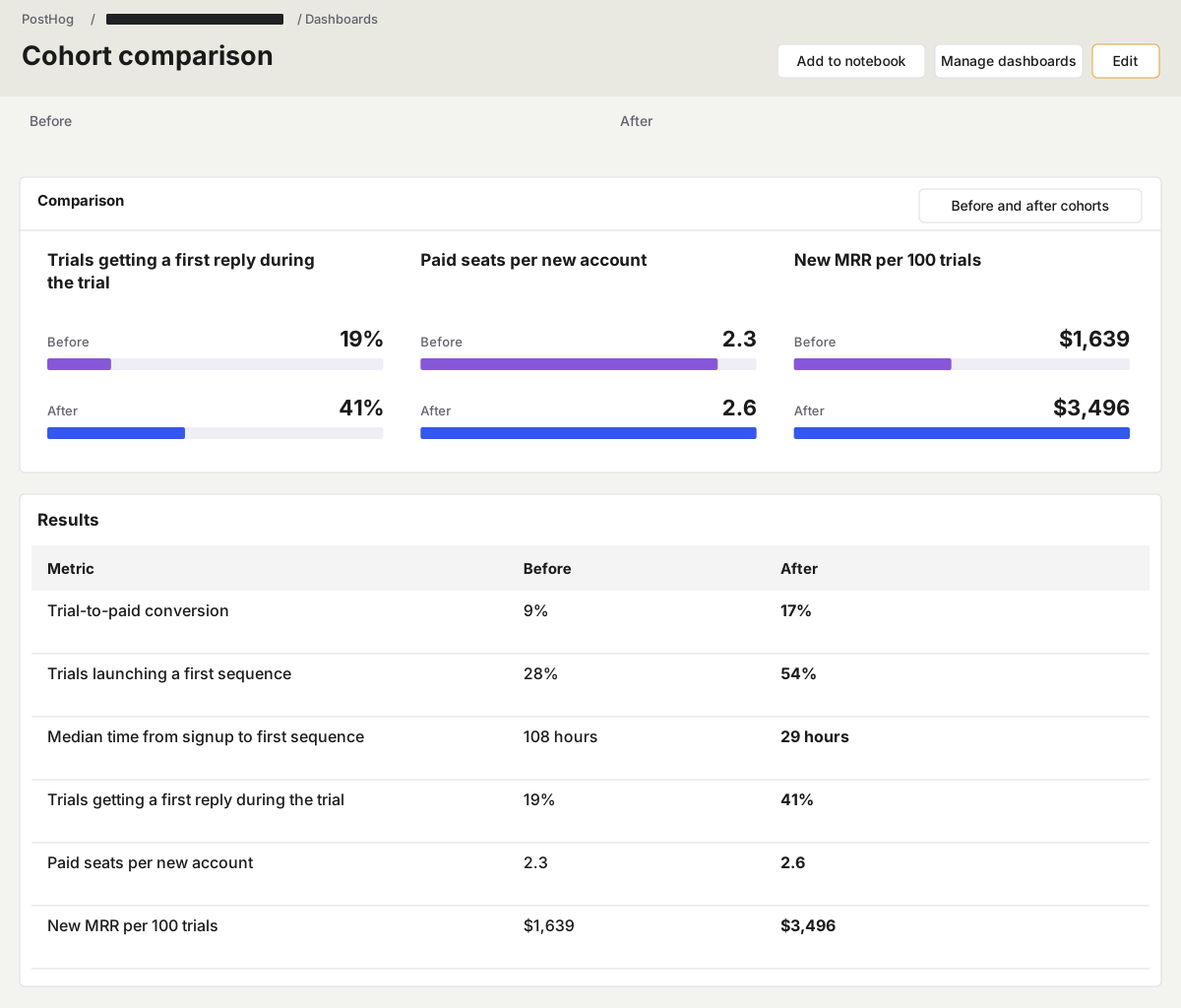
Before: 2,140 trials started in May–June 2026. After: 1,480 trials started in sprint weeks 7–12 (August 10 – September 20).
| Metric | Before | After | Change |
|---|---|---|---|
| Trial-to-paid conversion | 9% | 17% | +8 pts |
| Trials launching a first sequence | 28% | 54% | +26 pts |
| Median time from signup to first sequence | 108 hours | 29 hours | −73% |
| Trials getting a first reply during the trial | 19% | 41% | +22 pts |
| Paid seats per new account | 2.3 | 2.6 | +0.3 seats |
| New MRR per 100 trials | $1,639 | $3,496 | 2.1x |
What didn't work
- A product tour video at signup. 11% watched it, and first-sequence launches didn't move. We removed it.
- A flat 30-day trial for everyone. It ran in weeks 3–4 on a split, converted no better than 14 days and pushed cash two weeks later. Starting the clock at the first send did the job instead.
- Solo users. They rose from 6.2% to 10.8% but stayed far behind teams. The product is built for teams, so we stopped steering solo users toward setup calls.
What we learned
- Find the slowest step that sits outside the product, like mailbox warm-up, and start it on day 0.
- Measure the trial in days of real use, not calendar days.
- Spend founder time only where it converts. Setup calls converted 34 of 71 booked trials (47.9%).
Frequently asked questions
How much does it cost to fix trial conversion for a sales tool?
There was no creator or media spend, so the only cost was Kiko's 90-day sprint, priced from $10,000 a month. Two client engineers built the changes and the founder took the setup calls. New MRR per 100 trials went from $1,639 to $3,496.
How long does it take to double trial-to-paid?
Four changes shipped one a week in weeks 3–6. Weeks 7–12 were held with no new changes so each weekly cohort could be read at trial end, and conversions were read through October 11, two weeks after the sprint.
Would this work for a Series A sales tool, or one sold through sales reps?
The trial-clock change fits any self-serve product with a slow external setup step. Setup calls already fit a rep-led motion; here they converted 47.9% of booked trials. Solo users stayed at 10.8%, so this is a team-product fix.
Related case studies and guides
Same industry, other angles:
- Creator marketing: $1.1M in qualified pipeline in one quarter from 6 B2B creators
- Paid ads: $780K in qualified pipeline in 90 days from LinkedIn and Meta retargeting
- Full growth system: grew new ARR per quarter from $600K to $2.3M