The company and program
| Client | A Series A developer observability platform. |
| Stage | Series A |
| Industry | Developer tools |
| Pillars | Creator marketing + Paid ads + Product growth |
| Timeline | 9 months (three 90-day sprints), January–September 2026 |
| Channels | Developer YouTubers and engineering newsletters; Google search, YouTube and Reddit ads; install flow, docs and pricing page |
| Team | A dedicated Kiko growth lead plus agents for creator sourcing, claims pre-checks, ad variants, funnel pulls and weekly reporting; the client's developer-experience engineer |
| Headline result | Grew self-serve ARR from $800K to $3.2M in 9 months |
The approach
| Pillar | Hypothesis | Compared against | Decision rule |
|---|---|---|---|
| Creator marketing | Creators who debug a real slow request with the product on screen bring more paying orgs than "top observability tools" roundups | Roundup and news-commentary videos from creators of similar size | After 30 days, rebook creators under $450 per paying org; drop anyone over $700 |
| Paid ads | Creator debugging clips beat product-tour ads on YouTube and Reddit, and competitor-alternative search terms beat generic ones on Google | Product-tour ads; generic "observability" search terms | Each concept or ad group gets $1,000 or 7 days; scale anything under $450 per paying org |
| Product growth | A one-command install with auto-instrumentation raises first traces within 24 hours, and the first trace predicts payment | The old manual SDK setup | 50/50 split; ship if first-trace-within-24-hours rises 10 points or more at 95% confidence |
How the three pillars connected
Creator marketing
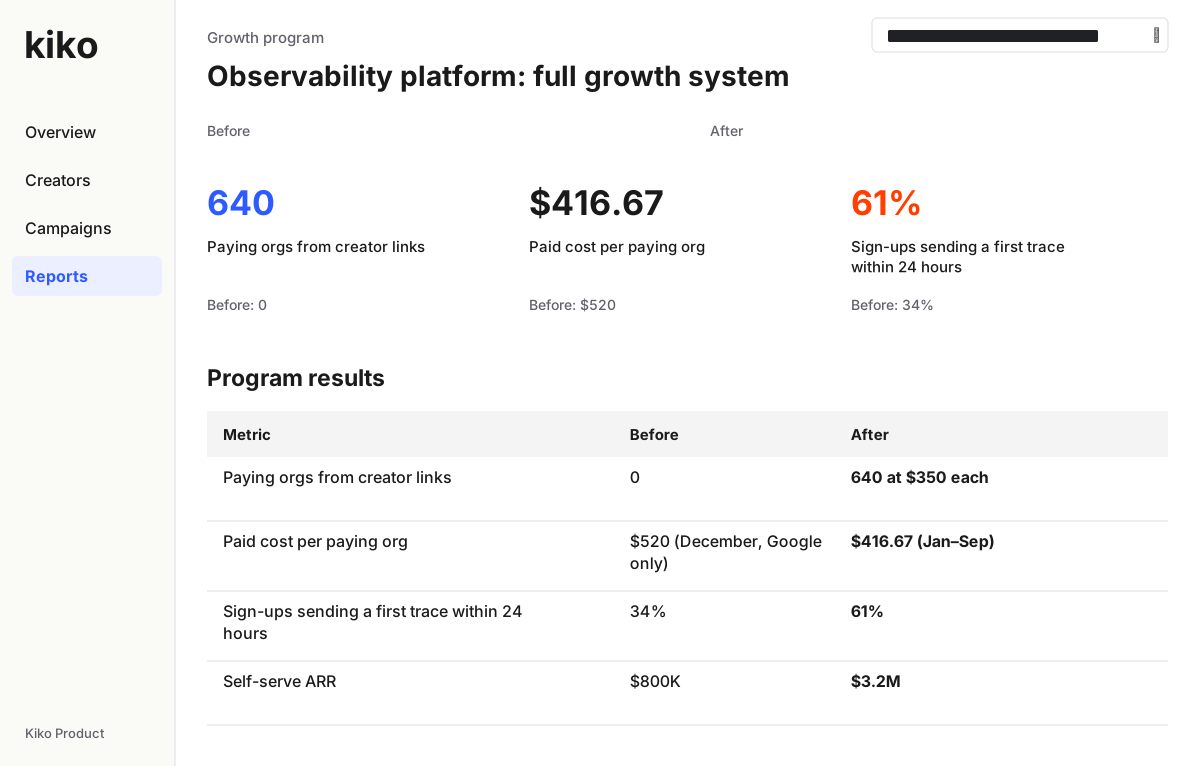
We booked 16 creators and newsletters, matched to the stack the platform instruments best. The core was a backend-internals YouTuber, a DevOps educator with a large following among platform engineers and a newsletter for senior engineers. Every video debugged a real slow request with the product, from install to fix. Creator links brought 640 paying orgs at $350 each.
Paid ads
Media scaled from $30,000 to $70,000 a month across Google search, YouTube and Reddit. Paid brought 1,200 paying orgs at $416.67 each, against $520 on Google alone in December. Creator debugging clips won on YouTube and Reddit; on Google, competitor-alternative and error-message terms beat generic ones.
Product growth
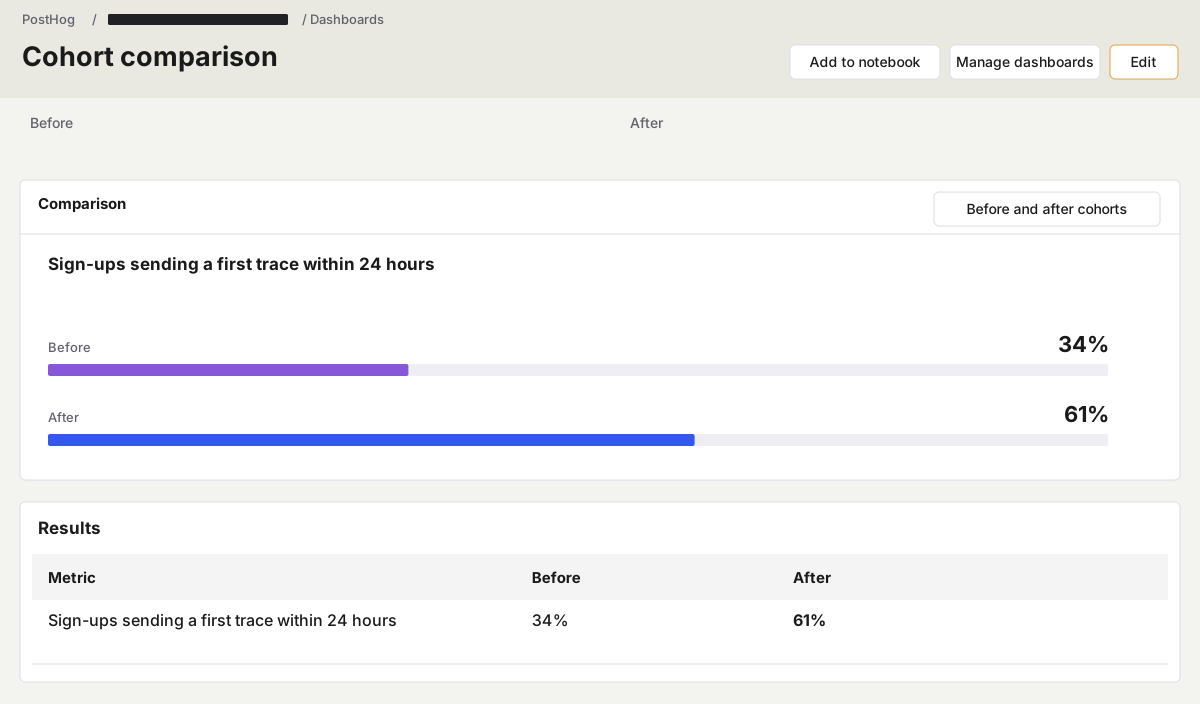
Paid volume made the setup problem visible: 52% of sign-ups installed the SDK, but only 34% sent a trace within 24 hours. Manual setup took most developers more than an hour. We shipped a one-command install with auto-instrumentation for the three most-used frameworks, a sample app that streams live traces, and usage pricing shown before the paywall. Sign-ups sending a first trace within 24 hours rose from 34% to 61%, median time to first trace fell from 3.2 hours to 11 minutes, and sign-up to paid within 30 days rose from 2.4% to 4.1%.
How they fed each other
Creators showed the moment that sold the product: watching a slow request light up in a trace. That became the paid creative and the target for the install fix. Paid volume made the setup drop obvious within a month. Once the first trace took minutes, the creators' viewers and the ads' clickers both reached it in the same sitting, and conversion rose for every channel. Developers who arrived through creators also expanded faster, which shows in later cohorts' net revenue retention.
What we changed
- Weeks 1–2: tie creator links, ad events and SDK events to first trace and paid plan. Pick the 3 most-used frameworks for auto-instrumentation.
- Weeks 2–5: book the first 8 creators with credits; first videos live in week 3.
- Weeks 3–8: test YouTube and Reddit creative and Google search terms, each with $1,000 or 7 days.
- Weeks 6–12: find the setup drop (52% install, 34% send a trace), then A/B test the one-command install; ship in week 12.
- Weeks 14–26 (sprint 2): creators to 12, newsletters added, sample app with live traces shipped.
- Weeks 27–39 (sprint 3): media to $70,000 a month, final 4 creators, usage pricing moved before the paywall.
The results
| Pillar | Metric | Before | After | Change | How measured |
|---|---|---|---|---|---|
| Creator marketing | Paying orgs from creator links | 0 | 640 at $350 each | +640 | Creator links and referral codes joined to billing |
| Paid ads | Paid cost per paying org | $520 (December, Google only) | $416.67 (Jan–Sep) | −20% | Google, YouTube and Reddit ads managers, joined to billing |
| Product growth | Sign-ups sending a first trace within 24 hours | 34% | 61% | +27 pts | A/B test, then full rollout; product analytics |
| Combined (headline) | Self-serve ARR | $800K | $3.2M | 4x | Billing system, month end |
What didn't work
- YouTube Shorts creators. Two brought 9 paying orgs, about $1,560 each. A trace needs a longer screen than a Short.
- Reddit stayed the most expensive paid channel at $480 per paying org. We kept it for its one strong subreddit and stopped broader targeting.
- Cutting the free tier's data limit lifted paid conversions for two weeks, then churn spiked. We reverted it after three weeks.
What we learned
- Brief creators to debug a real problem, from install to fix, on screen.
- Ship the faster first trace before scaling paid; it raises conversion for every source at once.
- Judge creators on paying orgs and their later expansion, not on sign-ups.
Frequently asked questions
How much does a full growth system cost for a developer tool?
Each new paying org cost $254.04 blended, against $320 before the program; creators alone were $350 and paid $416.67. Most Series A programs like this run $40,000–$100,000 a month in creator fees and media.
How long until ARR moved?
First creator videos were live in week 3 and the install fix shipped in week 12. Paid cost per paying org fell from $520 to $416.67 over the program, and ARR went from $800K to $3.2M by month 9.
Would this work for a seed-stage developer tool without a free tier?
Partly. The creator debugging briefs and the first-trace fix apply at any stage. Paid here needed $30,000 a month and enough sign-ups to expose the setup drop, so a seed tool should start with creators and the install work.
Related case studies and guides
Same industry, other angles:
- Creator marketing: 4,800 developer sign-ups in 10 weeks; 2,100 sent a first trace
- Paid ads: 6,200 production projects in one quarter from Reddit, YouTube and Google ads
- Product growth: Median time to first successful API call down from 3 days to 40 minutes
Guides and creators: