The company and program
| Client | A seed-stage API that turns PDFs and scans into structured JSON. |
| Stage | Seed |
| Industry | Developer tools |
| Timeline | 12 weeks of a 90-day sprint, June to August 2026 |
| Headline | Median time to first successful API call down from 3 days to 40 minutes |
| Channels | Signup flow, docs and quickstart, CLI, error messages, lifecycle email |
| Team | A Kiko growth lead plus agents: an event-audit agent, an error-clustering agent that grouped first-request failures daily, and an experiment write-up agent. The client's engineers built the changes |
The approach
- Hypothesis: gates before the first request, not the code itself, cause most of the wait, so removing them shortens time to first value more than better docs would.
- Comparison: each change against a 50/50 split of new signups, at least 200 per arm and 14 days. We read reach within 7 days and median time among those who reached it, with live-mode use at day 30 as the guardrail.
- Decision rule: ship if median time falls at least 25% or reach rises at least 3 points, and abuse signups stay under 1.5%.
What we changed
- Week 1: the event. One first-value event: the first 2xx from the developer's own code with their own file. Calls from the docs console didn't count.
- Week 2: server-side events.
signup_completed,api_key_created,first_request_failed(with error code),first_successandfirst_live_event, tagged by human or agent path and by docs language. - Week 3: cold run. We ran the quickstart cold in four languages. The longest wait was the account review before test keys; the top first error was a 401 from a placeholder key pasted from the docs.
- Weeks 4–6: instant test keys. Test keys at signup, with review moved to the first live-mode request. Median fell from 3 days to 2.1 hours.
- Weeks 5–7: keys in snippets. Signed-in developers saw their own test key in every code sample. 401s fell from 41% of first failures to 9%.
- Weeks 7–9: one command. A single
initcommand, plus a copy-paste prompt for coding agents, installed the SDK, set the key and parsed a sample file. Median reached 40 minutes. - Weeks 9–12: readout. We held the changes, read the final cohorts and defaulted the docs language tab from the signup answer.
The results
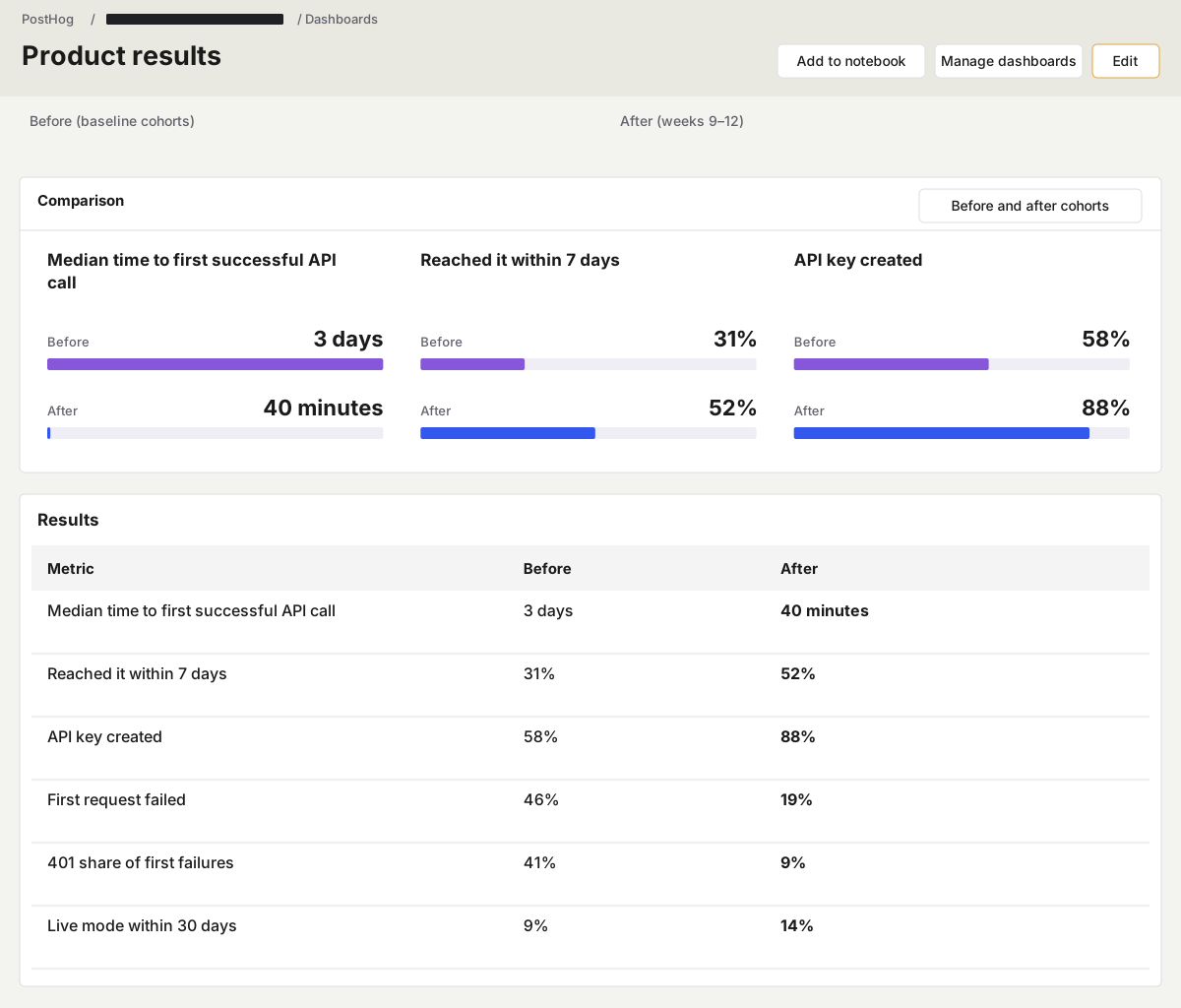
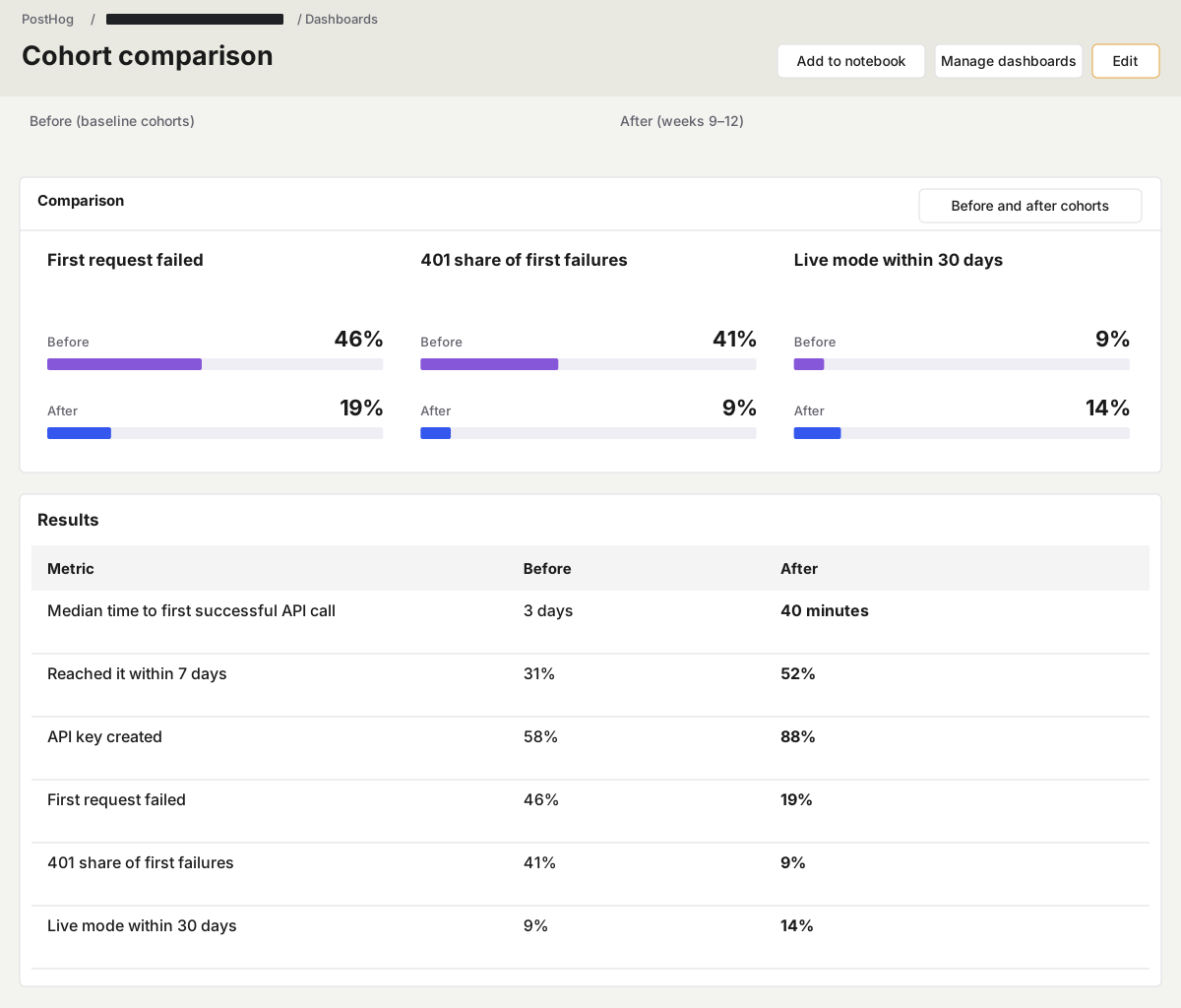
| Metric | Before (baseline cohorts) | After (weeks 9–12) | Change |
|---|---|---|---|
| Median time to first successful API call | 3 days | 40 minutes | −99% |
| Reached it within 7 days | 31% | 52% | +21 pts |
| API key created | 58% | 88% | +30 pts |
| First request failed | 46% | 19% | −27 pts |
| 401 share of first failures | 41% | 9% | −32 pts |
| Live mode within 30 days | 9% | 14% | +5 pts |
What didn't work
- An in-browser API console. It produced quick "successes" that didn't count, because no code was written, and reach on the real event went from 47% to 46%. We killed it.
- Abuse rose a little. Instant keys took abuse signups from 0.8% to 1.1%. The test-mode rate limit held the cost down, and the client accepted it.
- File-type errors stayed stubborn. 400s on unsupported files fell only from 22% to 17% of first failures. Developers test with the file they have, so format support is a product question.
What we learned
- Define first value with the developer's own resources, and measure it on the server.
- Run the quickstart cold before changing anything; the slowest step is often a gate, not code.
- Treat the coding-agent path as its own funnel.
Frequently asked questions
How much does a time-to-value sprint cost for a developer tool?
There was no media spend: the work ran as one Kiko 90-day sprint (sprints start from $10,000 a month). The client's own engineers built the three changes: instant test keys, signed-in keys in docs snippets and a one-command setup.
How long does it take to cut time to first value?
The first change shipped in weeks 4–6 and cut the median from 3 days to 2.1 hours. All three changes were live by week 9, and the final read ran in weeks 9–12.
Would this work for a Series A API that already issues keys instantly?
The biggest step here, instant keys, wouldn't apply. The other two still do: signed-in keys in snippets cut 401s from 41% to 9% of first failures, and the one-command setup took the median down to 40 minutes.
Related case studies and guides
Same industry, other angles:
- Creator marketing: 4,800 developer sign-ups in 10 weeks; 2,100 sent a first trace
- Paid ads: 6,200 production projects in one quarter from Reddit, YouTube and Google ads
- Full growth system: grew self-serve ARR from $800K to $3.2M in 9 months
More on developer tools: