The company and program
| Fact | Detail |
|---|---|
| Client | A Series A API observability platform: request tracing, error tracking and latency alerts for API teams. |
| Stage | Series A |
| Industry | Developer tools |
| Timeline | 10 weeks, August 3 – October 11, 2026 |
| Channels | YouTube integrations, newsletter sponsorships and a podcast host-read; no paid media |
| Team | 1 dedicated Kiko growth lead, plus agents for creator sourcing, demo-repo checks and daily activation reporting |
The approach
- Hypothesis: Developers who watch a creator instrument a real project from start to finish send a first trace at a much higher rate than developers who hear a sponsor read.
- Comparison: Build-along videos, where the creator added tracing to their own project from a public template repo, against explainer videos with a sponsor segment, newsletters and a podcast. All against the prior quarter's organic and docs sign-ups, which sent a first trace 26% of the time.
- Decision rule: Each creator was ranked on the first-trace rate of their own sign-ups after 7 days. Creators at 40% or above were rebooked.
What we changed
- Weeks 1–2: shortlist and template repo. We reviewed 70 developer creators, left out shows tied to an observability vendor, contacted 20 and signed 9: backend internals explainers, build-video channels with a labelled sponsor section, and animated system-design explainers. We built a public template repo so viewers could follow along.
- Weeks 3–4: all 9 creators go live. Four build-along videos, two explainers with a sponsor segment, two newsletter placements and one podcast read, each with its own link.
- Weeks 5–6: read and fix. Build-along sign-ups sent a first trace 52% of the time; the other formats averaged 36%. A minor SDK release broke one demo, so we pinned the SDK version in the template repo.
- Weeks 7–10: rebook. The 4 build-along creators and the stronger newsletter, at 45% on its own link, ran second placements on alerting and latency budgets.
The results
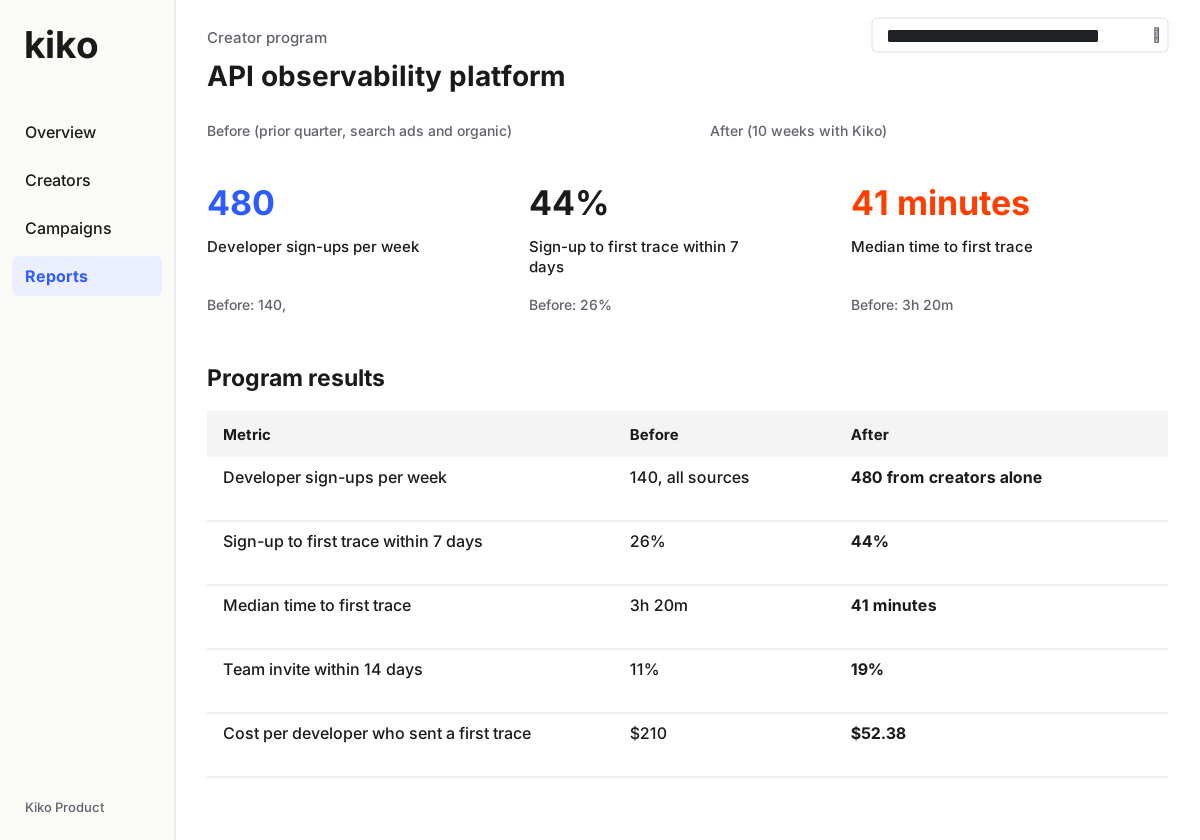
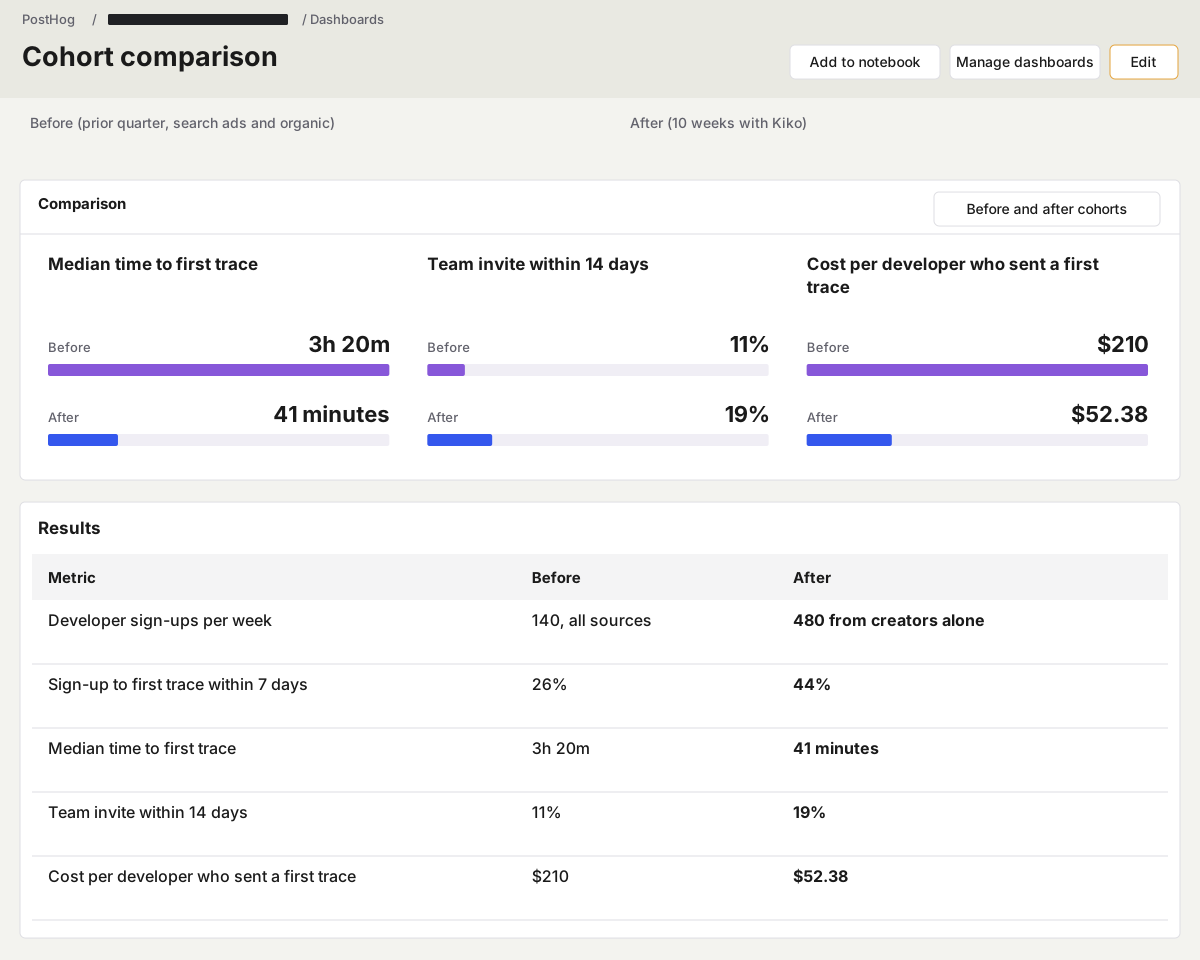
| Metric | Before (prior quarter, search ads and organic) | After (10 weeks with Kiko) | Change |
|---|---|---|---|
| Developer sign-ups per week | 140, all sources | 480 from creators alone | 3.4x |
| Sign-up to first trace within 7 days | 26% | 44% | +18 pts |
| Median time to first trace | 3h 20m | 41 minutes | −80% |
| Team invite within 14 days | 11% | 19% | +8 pts |
| Cost per developer who sent a first trace | $210 | $52.38 | −75% |
What didn't work
- Sponsor reads inside explainers. The two explainer channels brought 980 sign-ups, but only 34% sent a first trace. Their viewers came to learn a concept, not to wire up a tool.
- A breaking SDK release. In week 5 a minor release changed an import path one creator used on camera. That video's first-trace rate fell from 55% to 31% for 4 days, until we pinned the version in the template repo.
- Podcast attribution. 70% of the podcast's 580 sign-ups were credited only through self-report on the sign-up form. The read worked, but we could not tie it to a link with confidence.
What we learned
- Have creators instrument their own project, start to finish, on camera.
- Ship a public template repo with a pinned SDK version before the first video.
- Rank creators on first-trace rate, not sign-ups.
Frequently asked questions
What did 4,800 developer sign-ups from creators cost?
Each sign-up cost $22.92 and each developer who sent a first trace $52.38, against $210 on search ads, with no paid media. Most Series A programs like this run $30,000–$60,000 a month in creator fees.
How long until creator videos produce developer sign-ups?
Two weeks of shortlisting and template-repo work, then all 9 creators went live in weeks 3–4. Each creator's first-trace read came 7 days after their post, and rebooks ran from week 7 to week 10.
Would this work for a seed-stage developer tool without an SDK?
The format needs something a creator can wire into a real project on camera. Without an SDK or API there is no build-along, and sponsor reads here converted at 34%. A seed-stage tool with an SDK can run it at smaller scale, since the rebook rule works per creator.
Related case studies and guides
Same industry, other angles: