The company and program
| Client | A Series A AI voice notes app |
| Stage | Series A |
| Industry | Consumer AI apps |
| Pillars | Creator marketing + Paid ads + Product growth |
| Timeline | 7 months, Mar 1 – Sep 30, 2026: two 90-day sprints and a 30-day third sprint |
| Channels | TikTok, Instagram Reels and YouTube creators, TikTok Spark Ads, Meta partnership ads, onboarding, push and paywall |
| Team | A dedicated Kiko growth lead plus agents for creator research, creative tagging, ad reporting and cohort pulls. The client's two engineers built the onboarding and paywall changes Kiko specced |
| Headline result | 250,000 monthly active users in 7 months, from 41,000 |
| Measured in | Product analytics, RevenueCat, the app's attribution provider, TikTok and Meta ads managers, creator codes and an in-app "where did you hear about us" screen |
The approach
- Hypothesis: a voice notes app grows when new users form a daily habit, and a habit starts with a second note. If creators show the habit in their own day, ads repeat it, and onboarding gets a second note within 48 hours, retention rises and every install is worth more.
- Comparison: February 2026 was the baseline: Meta install ads at $240 per subscriber from paid, 22,000 installs, 150 new subscribers, a blended CAC of $80 and day-30 retention of 14%. Each later month was read against it, by source.
- Decision rule: a creator post got 7 days of organic data and went into paid only if its installs reached a second note within 48 hours at 40% or better. Ad concepts got $500–$1,000 or 7 days and were killed above $1.20 per install that recorded a second note. Onboarding changes shipped only after a 50/50 test lifted the 48-hour second-note rate by 4 points or more.
How the three pillars connected
Creator marketing
We booked 11 creators in the first 30 days and 31 over the engagement: 6 YouTube channels and 25 TikTok and Reels creators. On YouTube we used productivity teachers for working professionals, such as a 400K-subscriber channel, and beginner tutorial channels. On TikTok we used students, new parents and ADHD-productivity creators who filmed a real walk-and-talk note and the to-do list it produced. Creators brought 2,520 subscribers at $59 each and 141,000 installs.
Paid ads
The baseline was Meta app-install campaigns with static screenshots, at $240 per subscriber from paid. We rebuilt the account around creator clips as TikTok Spark Ads and Meta partnership ads, and moved optimisation from installs to an in-app "second note" event. Monthly media rose about fourfold from March to September, and paid brought 204,000 installs and 3,150 subscribers.
Product growth
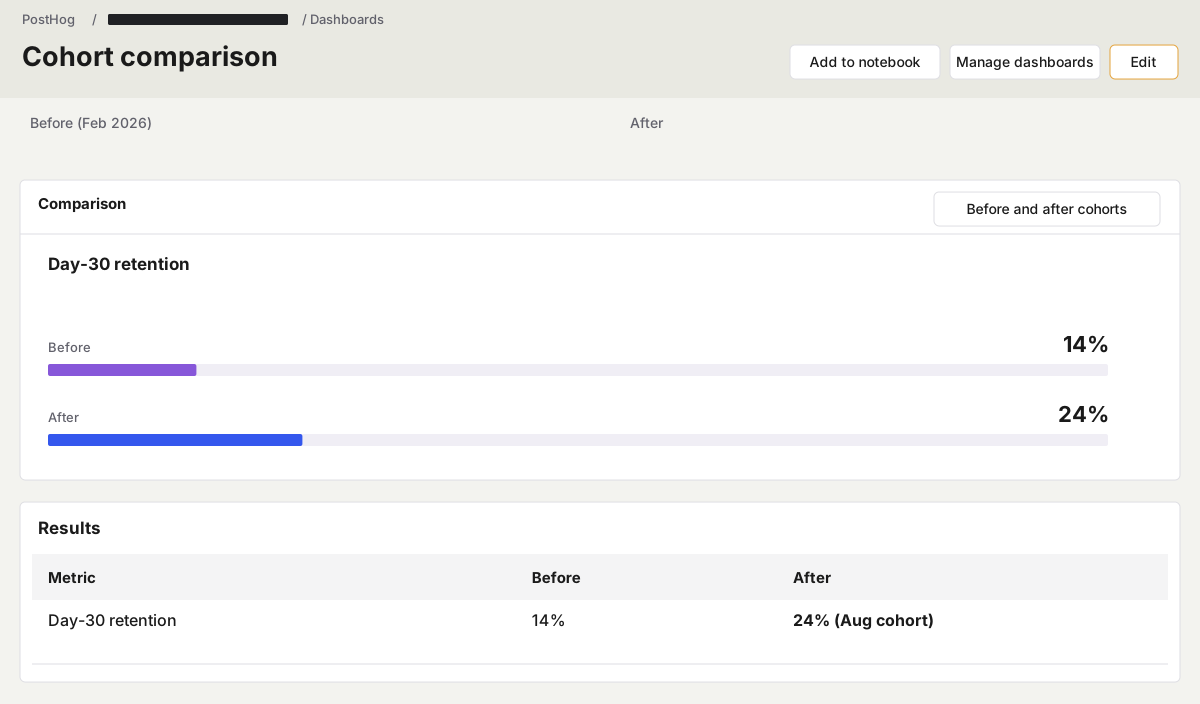
Funnel data showed 42% of new users never recorded anything: the microphone permission prompt came before they had seen what the app does. We specced a 20-second sample note playing first, the permission prompt after it, an automatic to-do list from the first note, a next-morning push ("talk through your day") and a paywall after the third note instead of on first open. The 48-hour second-note rate rose from 29% to 51%, and day-30 retention from 14% to 24%.
How they fed each other
The creator clips that converted best showed a walk home, a 60-second ramble and a clean to-do list on screen, so that became the first onboarding prompt and the opening of every Spark Ad. Paid volume exposed the permission leak in two weeks. Fixing it raised activation for creator and organic installs too, and cut paid CAC from $240 to $90. Summaries shared from the app carry a link back to it, which grew organic installs from 14,000 to 31,000 a month.
What we changed
- Weeks 1–2: event audit, the second-note definition, the February baseline by source, and an 11-creator shortlist scored on Kiko's six-point rubric.
- Weeks 3–6: first creator posts live in week 3. Fourteen ad concepts tested at $500–$1,000 each, and sample-note-first onboarding into a 50/50 test.
- Weeks 7–13: the new onboarding and the next-morning push shipped to all users. Five creator clips passed the rule and ran as Spark Ads and partnership ads, optimised to the second-note event.
- Weeks 14–26 (sprint 2): the paywall moved to after the third note with a 7-day trial. Twenty more creators booked, and media scaled on the winning clips.
- Weeks 27–30 (sprint 3): media reached its highest month on the winning concepts, and share links were added to every summary.
The results
| Pillar | Metric | Before (Feb 2026) | After | Change |
|---|---|---|---|---|
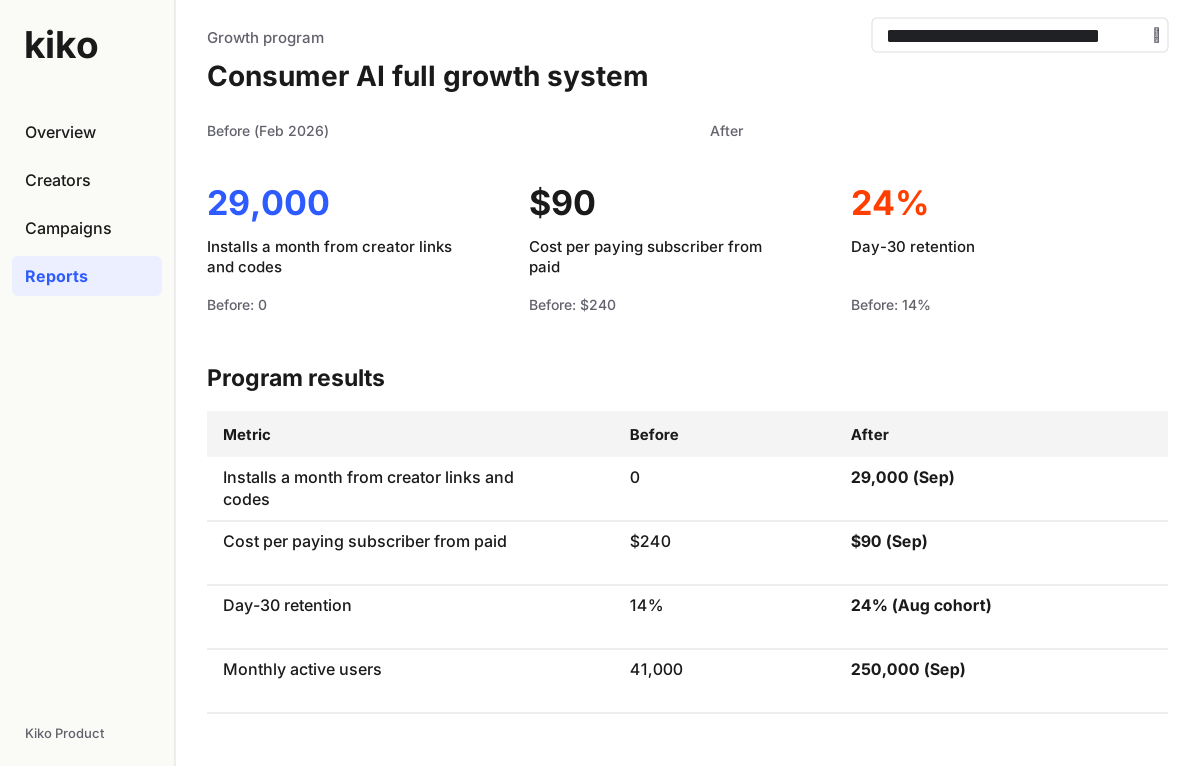
| Creator marketing | Installs a month from creator links and codes | 0 | 29,000 (Sep) | +29,000 |
| Paid ads | Cost per paying subscriber from paid | $240 | $90 (Sep) | −63% |
| Product growth | Day-30 retention | 14% | 24% (Aug cohort) | +10 pts |
| Combined | Monthly active users | 41,000 | 250,000 (Sep) | 6.1x |
Blended CAC per paying subscriber fell from $80 to $40, and MRR grew from $9,620 to $75,850. The August cohort is the latest with a full 30 days of data.
What didn't work
- AI news roundups. Mentions in two AI news roundup videos brought curious early adopters who tried the app once; day-30 retention for those installs was 6%.
- A hard paywall. Putting the paywall on first open raised trial starts per install but cut the second-note rate by a third. We reverted it after 2 weeks.
- Install-optimised campaigns. Meta app campaigns optimised for installs bought cheap installs that never recorded a note. Switching the optimisation event to the second note raised cost per install and cut cost per subscriber.
What we learned
- Define activation as the second use, not the first, and optimise ads to that event once it has enough volume.
- Show the product working before asking for a permission or a payment.
- Pick creators whose day looks like the user's day; lifestyle fit beat AI-audience reach.
Frequently asked questions
How much did it cost to get an AI app to 250,000 monthly active users?
Each new paying subscriber cost $43 in creator fees and media across the 7 months, falling from $80 in February to $40 in September; creators brought subscribers at $59 each. Spend grew with results, with monthly media rising about fourfold.
How fast did retention move after the onboarding change?
The sample-note-first onboarding went into a 50/50 test in weeks 3 to 6 and shipped to all users by week 7. Day-30 retention went from 14% for the February cohort to 24% for the August cohort.
Would this work for a Series B AI note-taking app that already has 1M installs?
The second-note definition and showing the product before the permission prompt apply at any size. The media plan does not: monthly media here rose about fourfold over 7 months, so don't assume the $90 paid CAC holds at a larger budget.
Related case studies and guides
Same industry, other angles:
- Creator marketing: 48,000 installs in 9 weeks at a blended $1.42 CPI, a seed-stage AI note-taking app
- Paid ads: 2.1x 60-day ROAS on TikTok and Meta at $70K a month, a Series A AI journaling app
- Product growth: Day-30 retention up from 12% to 21%, a seed-stage AI homework-help app
Playbooks and lists:
- Creator marketing for consumer AI apps, the industry front door
- How do consumer AI apps grow installs with creators?, the installs playbook
- Consumer AI app creators, the creator shortlist
- Fractional growth team, how Kiko runs all three pillars together