The company and program
| Client | A seed-stage AI note-taking app for iPhone and Android. |
| Stage | Seed |
| Industry | Consumer AI apps |
| Timeline | 9 weeks, 3 August – 4 October 2026. First posts in week 3, paid amplification from week 4 |
| Channels | TikTok and Instagram Reels creator posts, YouTube integrations, TikTok Spark Ads, Meta partnership ads |
| Team | 1 dedicated Kiko growth lead, plus agents for creator scoring, hook tagging and daily install reporting |
The approach
- Hypothesis: a creator recording a real lecture or meeting, then scrolling the finished summary, sells a note-taker better than a talking-head feature list.
- Comparison: real-recording videos against talking-head feature videos and the brand's static feature-grid ad, at matched budgets in TikTok and Meta.
- Decision rule: each ad concept got $500–$1,000 or 7 days. Pause above $1.80 CPI; scale below $1.60.
What we changed
- Weeks 1–2: score and sign. We scored 120 creators on Kiko's six-point rubric and signed 10 for the first 30 days: two YouTube productivity reviewers plus eight TikTok and Reels creators at 10K–200K followers who post study-with-me and day-in-my-job videos. Every contract included 90 days of paid usage in the base fee.
- Week 2: brief. Record one real class or meeting with the app, then show the summary and the search on screen. Kiko checked every script for accuracy and FTC disclosure.
- Week 3: organic posts. All 10 creators posted the week classes started, with tracked links, and each post got 7 days of organic data.
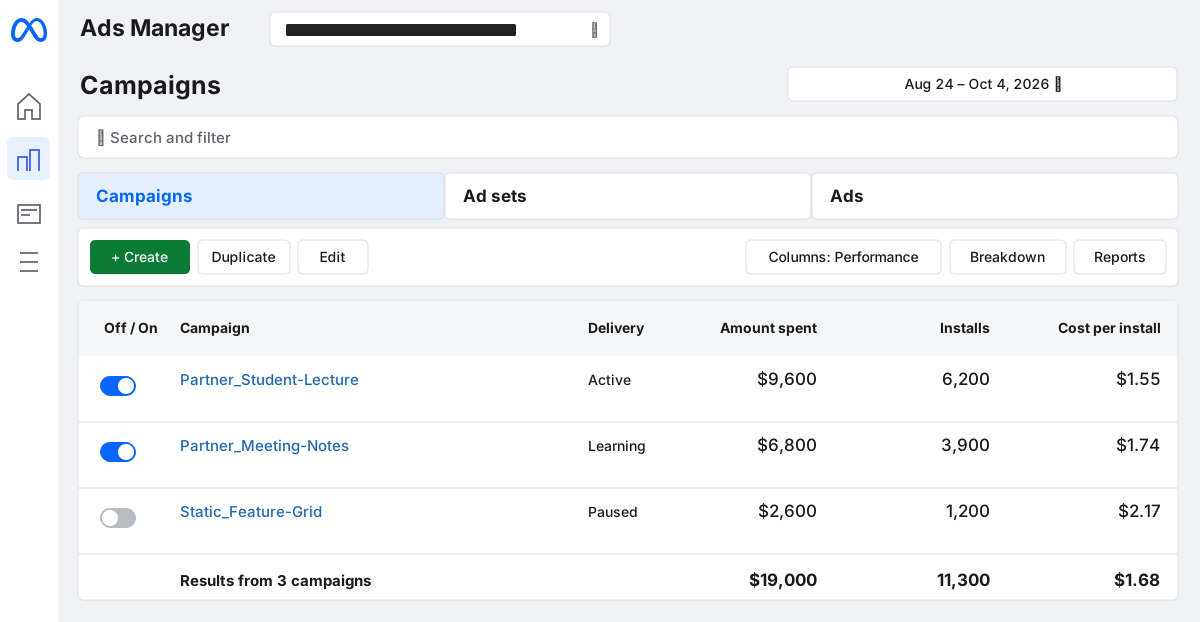
- Week 4: paid test. The six strongest posts went into TikTok Spark Ads and Meta partnership ads, next to a talking-head feature ad and the brand's static feature grid.
- Weeks 5–9: scale. Talking-head and static ads were paused, six more student creators were added to feed new hooks.
The results
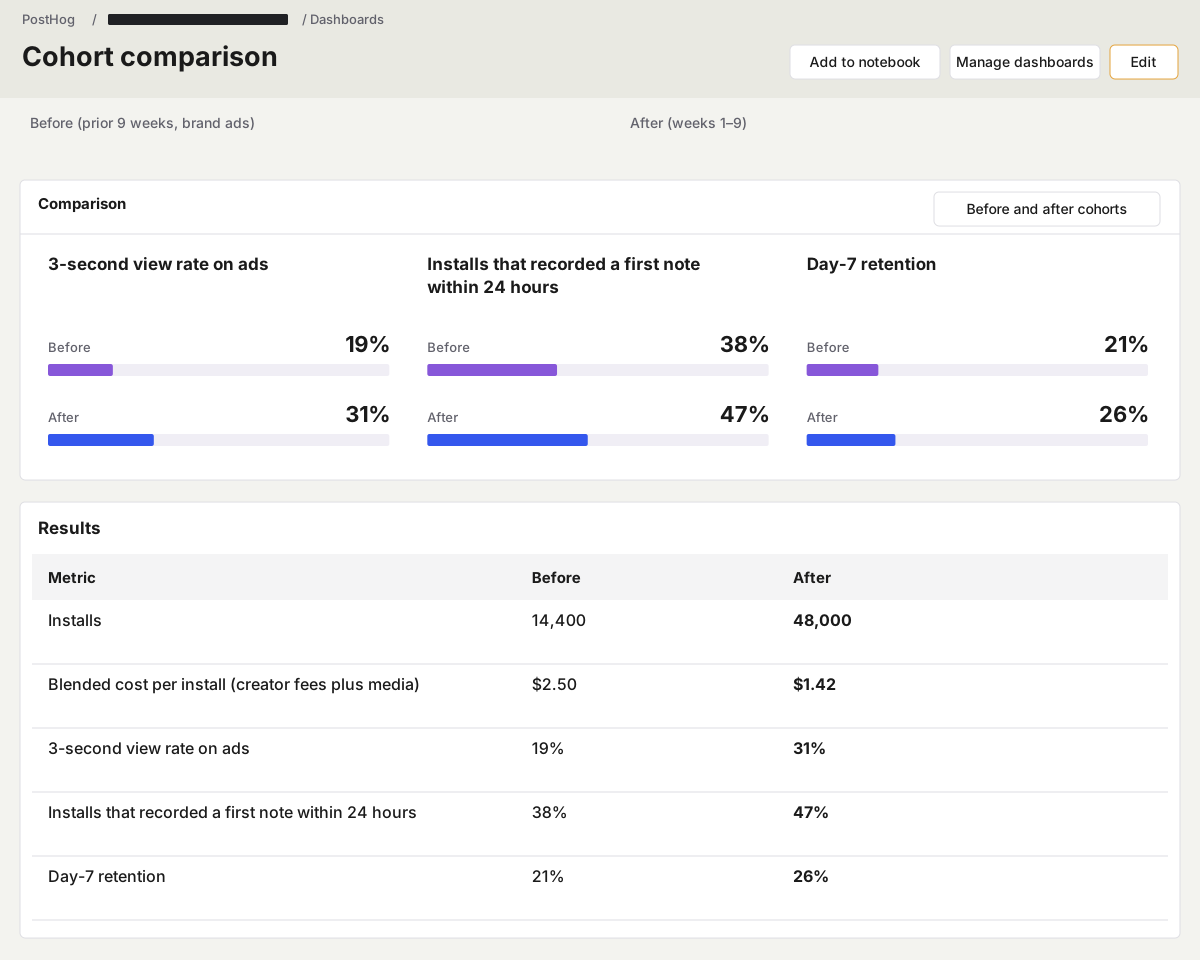
| Metric | Before (prior 9 weeks, brand ads) | After (weeks 1–9) | Change |
|---|---|---|---|
| Installs | 14,400 | 48,000 | 3.3x |
| Blended cost per install (creator fees plus media) | $2.50 | $1.42 | −43% |
| 3-second view rate on ads | 19% | 31% | +12 pts |
| Installs that recorded a first note within 24 hours | 38% | 47% | +9 pts |
| Day-7 retention | 21% | 26% | +5 pts |
What didn't work
- Talking-head feature videos lost. The TikTok talking-head ad ran at $1.81 CPI and was paused. Listing features did not land without a real recording on screen.
- The static feature grid lost by more. It ran at $2.17 CPI on Meta, close to the old brand baseline.
- Meeting-notes hooks cost more than lecture hooks. Work-meeting ads ran $1.51–$1.74 CPI against $1.34–$1.55 for lecture ads. The September student window was the bigger, cheaper audience.
What we learned
- Launch in the first week of classes. Lecture-recording videos posted that week drove the cheapest installs of the program.
- Keep a YouTube reviewer in the mix. YouTube installs had the best day-7 retention, at 31%.
- Add creators mid-program. The six creators added in week 5 kept new hooks coming as the first ads fatigued.
Frequently asked questions
What does it cost to get app installs with creators?
In this program, a blended $1.42 per install in creator fees and media across 16 creators, TikTok Spark Ads and Meta partnership ads, against $2.50 on the brand's own ads. Most seed programs like this run $15,000–$35,000 a month in creator fees and media.
How quickly did the installs come in?
Creators were signed in weeks 1–2 and posted in week 3, the first week of classes. Paid testing ran in week 4, and weeks 5–9 scaled the lecture-recording ads with six more creators.
Would this work for a Series A meeting-notes app selling to professionals?
Partly. Work-meeting hooks ran $1.51–$1.74 CPI here against $1.34–$1.55 for lecture hooks, so expect higher unit costs and no September spike. The real-recording format and the $1.80 pause rule still apply.
Related case studies and guides
Same industry, other angles:
- Paid ads: 2.1x 60-day ROAS on TikTok and Meta at $70K a month
- Product growth: Day-30 retention up from 12% to 21%
- Full growth system: reached 250,000 monthly active users in 7 months
More on consumer AI apps: