The company and program
| Client | A seed-stage AI photo app for headshots, restores and styled portraits. |
| Stage | Seed |
| Industry | AI creative tools |
| Timeline | 30 days, September 2026, after a 5-day setup |
| Channels | TikTok (in-feed and Spark Ads), Meta (Reels, feed and partnership ads) |
| Team | A Kiko growth lead plus agents: a variant-generation agent that cut each winning template into 10–15 edits, and a daily cohort agent that pulled revenue by campaign |
The approach
- Hypothesis: template and trend demos bring users who export and pay, so they win on cost per paying user even with a higher CPI than output showcases.
- Comparison: three formats at equal starting budgets on both platforms: template or trend demo, output showcase, and creator how-to (Spark Ads on TikTok, partnership ads on Meta).
- Decision rule: each concept got $500–$1,000 or 7 days. Scale when 7-day ROAS clears 2.0x and first-export rate clears 40%. Kill below 1.5x.
What we changed
- Setup, 5 days. We added a server-side
first_exportevent and passed subscription revenue back to both ad platforms. Optimization moved from install to first export, then to trial start on TikTok once a campaign cleared 50 a week. - Days 1–7: format test. Six concepts per format shared $500 a day. Every AI-made ad carried TikTok's AIGC label or a caption on Meta, and faces were the creators' own, with written consent in the contract.
- Days 4–10: creators. Six photo and editing creators at 40K–250K followers recorded how-to videos on their own photos, with 90 days of paid usage in the base fee.
- Days 8–30: scale the winner. Template demos took most of the budget. The variant agent cut 12 edits of each winner a week, and daily spend rose from about $500 to about $1,300.
- Day 15: paywall default. The paywall opened on the annual plan for template-demo traffic. Annual share of payers went from 38% to 61%.
The results
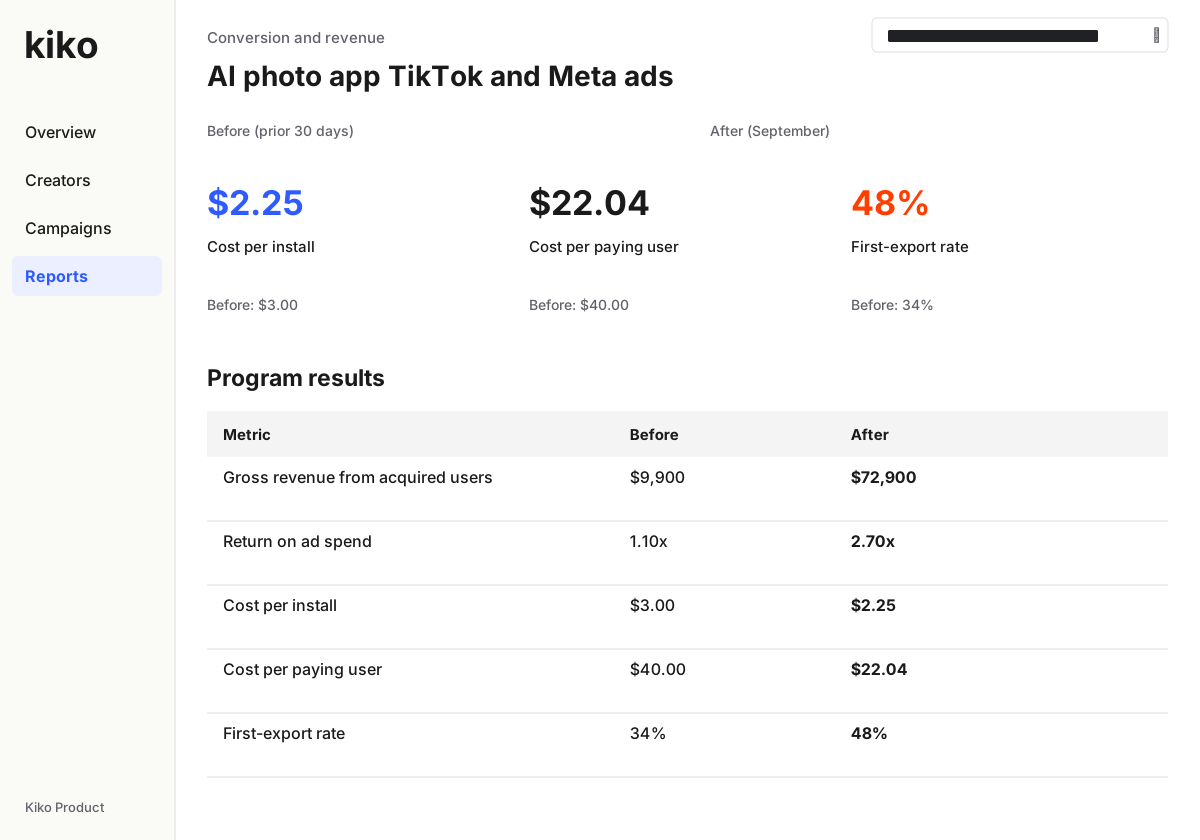
| Metric | Before (prior 30 days) | After (September) | Change |
|---|---|---|---|
| Gross revenue from acquired users | $9,900 | $72,900 | 7.4x |
| Return on ad spend | 1.10x | 2.70x | +1.60x |
| Cost per install | $3.00 | $2.25 | −25% |
| Cost per paying user | $40.00 | $22.04 | −45% |
| First-export rate | 34% | 48% | +14 pts |
What didn't work
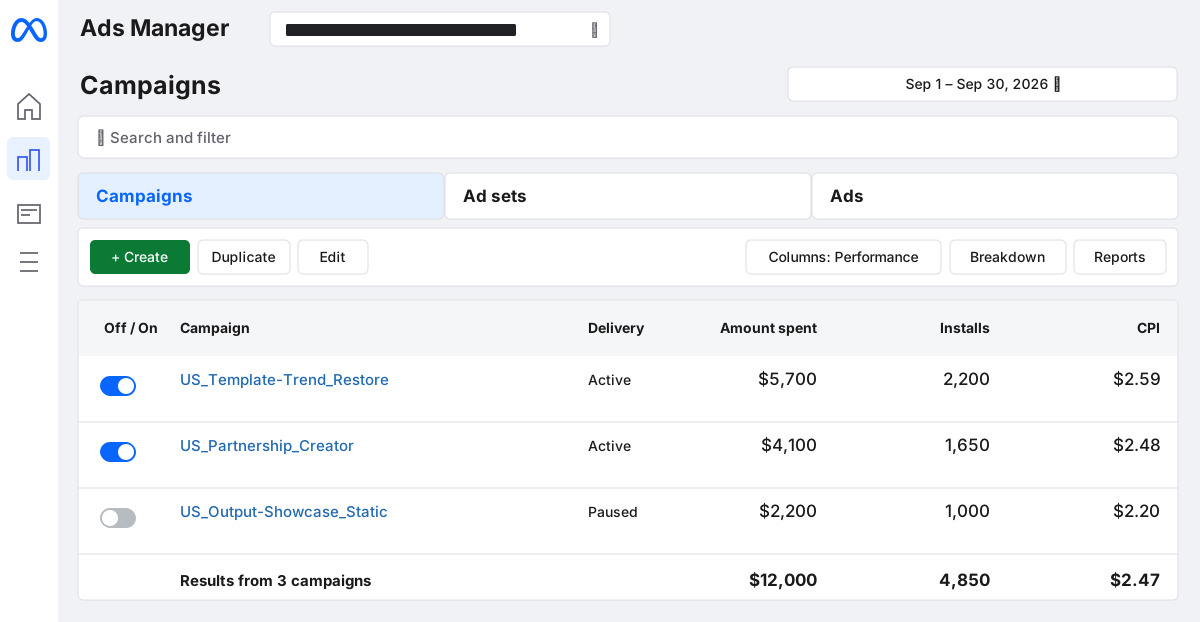
- Static output showcases. Meta statics returned 2.0x and were paused. A still image of an AI portrait looked like every other app's ad.
- Net is lower than gross. After the store's 15% fee, the month's return was 2.30x. Annual plans pay up front, so month two will look weaker than month one.
- A before/after restore concept was rejected on Meta for an exaggerated result. We rebuilt it with real, unretouched user photos and a plain caption.
What we learned
- Lead with a template the viewer can copy, and show the prompt or the steps.
- Optimize to the first export, not the install.
- Label every AI-made ad, and use only faces you have written consent for.
Frequently asked questions
What does it cost to reach 2.7x ROAS on TikTok and Meta?
Paying users cost $22.04 each, down from $40.00, and installs $2.25. Net of the store's 15% fee, the month returned 2.30x. Most seed programs like this run $15,000–$35,000 a month in creator fees and media.
How fast did the return on ad spend move?
Setup took 5 days. The format test ran on days 1–7 at $500 a day, and template demos were scaling by day 8. The 2.7x figure covers the full 30-day window, September 2026, against 1.1x in the prior 30 days.
Would this work for a Series A AI video app, or a B2B design tool?
A Series A AI video or image app with a consumer paywall, yes: template demos and first-export optimization carry over. A B2B design tool, no. The 2.7x rests on same-month annual plans, and a seat-based sale with a longer cycle won't close inside 30 days.
Related case studies and guides
Same industry, other angles:
- Creator marketing: 6,300 trial starts in 10 weeks at $11.40 per trial
- Product growth: First export within 24 hours up from 29% to 52%
- Full growth system: A Series A AI video generation app grew MRR from $180K to $640K in 8 months