The company and program
| Client | A Series A AI video generation app |
| Stage | Series A |
| Industry | AI creative tools |
| Pillars | Creator marketing + Paid ads + Product growth |
| Timeline | 8 months, Feb 1 – Sep 30, 2026: two 90-day sprints and a 60-day third sprint |
| Channels | TikTok and YouTube creators, TikTok Spark Ads, Meta partnership ads, onboarding, paywall and lifecycle email |
| Team | A dedicated Kiko growth lead plus agents for creator research, creative tagging, ad reporting and cohort pulls. The client's engineers built the onboarding and paywall changes Kiko specced |
| Headline result | MRR from $180K to $640K in 8 months |
| Measured in | Product analytics, RevenueCat and Stripe, TikTok and Meta ads managers, the app's attribution provider and tracked creator codes |
The approach
- Hypothesis: in AI video the output is the ad. If creators publish clips they actually made, ads reuse those clips, and onboarding gets a new user to their own finished export before the paywall, then creator, paid and organic users all subscribe at higher rates.
- Comparison: January 2026 was the baseline: TikTok and Meta ads built from brand footage at $77 per subscriber from paid, 1,000 new subscribers, a blended CAC of $46 and 31% of sign-ups exporting a video in their first session. Each later month was read against it, by source.
- Decision rule: a creator post got 7 days of organic data and went into paid only if its sign-ups exported in the first session at 45% or better. Ad concepts got $500–$1,000 or 7 days and were killed above a $70 cost per subscriber. Onboarding and paywall changes shipped only after a 50/50 test lifted subscriptions per sign-up by 10% or more.
How the three pillars connected
Creator marketing
We booked 12 creators in the first 30 days and 26 over the engagement: 9 YouTube channels and 17 TikTok creators. On YouTube we used AI video testers with 100K–300K subscribers and AI filmmaking teachers. On TikTok we used short-form creators who post before-and-after edits. Every brief asked for one finished clip made in the app, with YouTube's altered-content setting turned on for realistic output. Creators brought 8,200 subscribers at $26 each.
Paid ads
The baseline ads used brand footage and cost $77 per subscriber from paid. We rebuilt the account around creator clips run as TikTok Spark Ads and Meta partnership ads, with 90 days of paid usage negotiated into each creator's base fee. Monthly media rose by about a third from February to September, and paid brought 9,500 subscribers.
Product growth
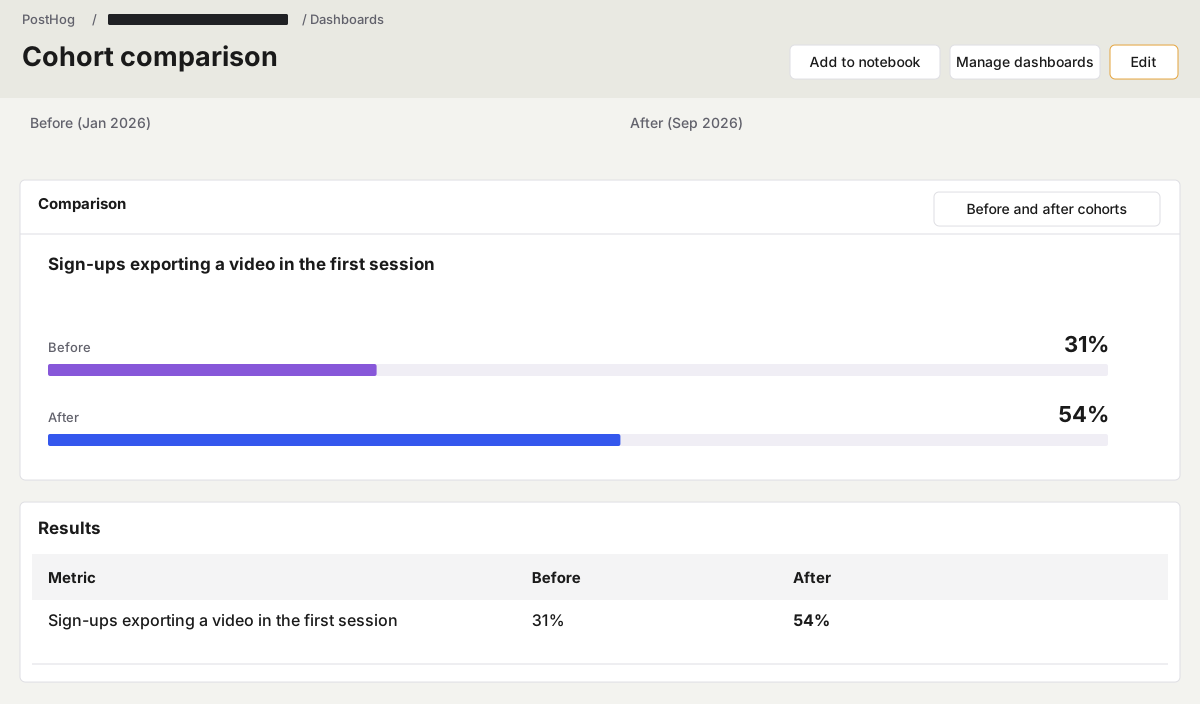
New users had to choose a model, write a prompt and wait in a shared render queue. We specced a template-first start that matches the ad the user came from ("photo to 5-second clip"), a priority queue for each user's first render, a watermark-free first export, and a paywall shown after that export with the user's remaining credits. First export in the first session rose from 31% to 54%, and trial-to-paid from 18% to 27%.
How they fed each other
The creator clips that converted best were photo-to-video edits of pets and old family photos, so those became the first templates in onboarding and the hooks in paid. At paid volume, analytics showed 36% of new users waiting more than 3 minutes for a first render and leaving; the priority queue fixed that for every channel. Higher conversion then cut paid CAC from $77 to $49 as media scaled. Exported clips shared with the app's end card grew organic subscribers from 400 to 2,930 a month, about half of all new subscribers by September.
What we changed
- Weeks 1–2: event audit, a first-value definition (first exported video), the January baseline by source, and a 12-creator shortlist scored on Kiko's six-point rubric, with AI-label rules in every brief.
- Weeks 3–6: first creator posts live in week 3. Sixteen ad concepts tested at $500–$1,000 each, and the priority first render into a 50/50 test.
- Weeks 7–13: template-first onboarding and the priority queue shipped to all users. Six creator clips passed the rule and ran as Spark Ads and partnership ads.
- Weeks 14–26 (sprint 2): the paywall moved after the first export and an annual plan was added. Fourteen more creators booked, and media scaled on the winning clips.
- Weeks 27–35 (sprint 3): media reached its highest month, creative was refreshed every 10–14 days from the creator library, and a win-back email for lapsed subscribers launched.
The results
| Pillar | Metric | Before (Jan 2026) | After (Sep 2026) | Change |
|---|---|---|---|---|
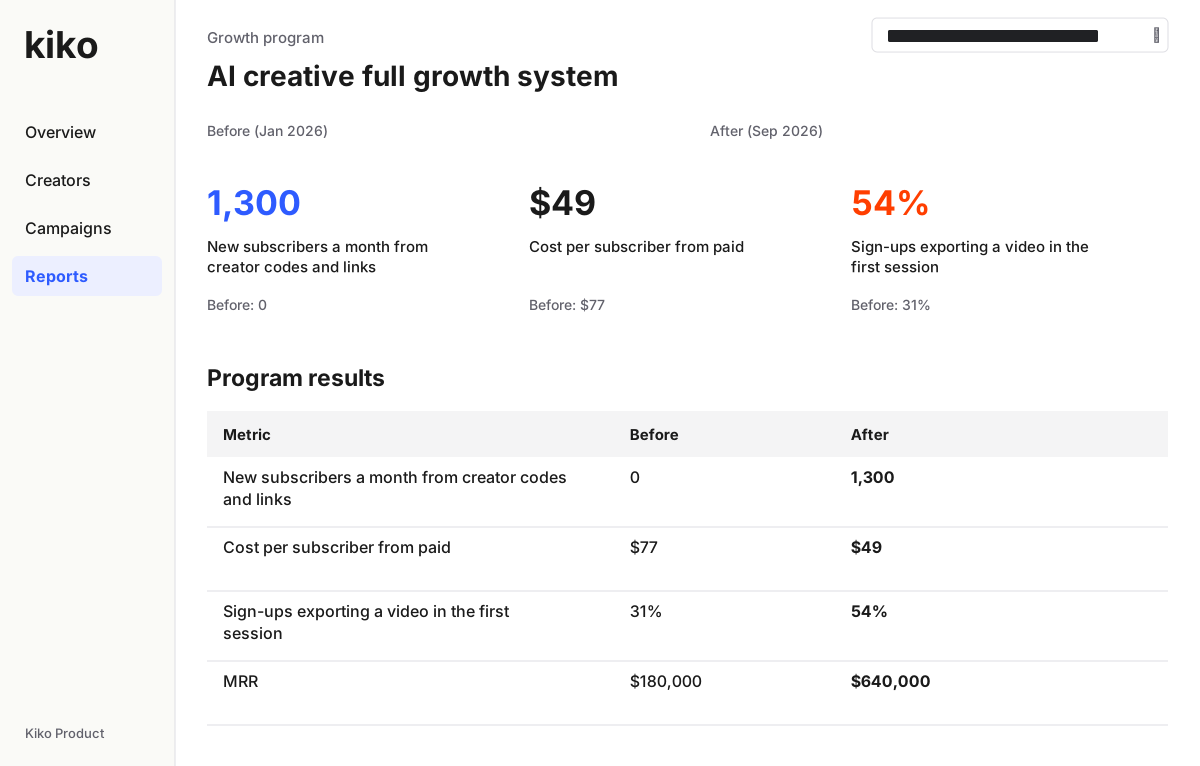
| Creator marketing | New subscribers a month from creator codes and links | 0 | 1,300 | +1,300 |
| Paid ads | Cost per subscriber from paid | $77 | $49 | −36% |
| Product growth | Sign-ups exporting a video in the first session | 31% | 54% | +23 pts |
| Combined | MRR | $180,000 | $640,000 | 3.6x |
Blended CAC fell from $46 to $18 as organic grew to about half of new subscribers, and monthly subscriber churn fell from 11.2% to 7.8%.
What didn't work
- Desktop-workflow reviews. Two long YouTube reviews brought 310 subscribers at about $50 each, nearly twice the creator average. Both creators worked in a desktop editing workflow, and viewers who installed the mobile app could not repeat what they had seen.
- A weekly plan. A low-priced weekly plan lifted first purchases but doubled churn among those buyers. We removed it after 5 weeks.
- Reels-only creators. Creators who posted only on Instagram Reels brought subscribers at about twice the TikTok creator cost, so we moved that budget to TikTok.
What we learned
- Turn the best-converting creator clip into the first onboarding template, so the first thing a new user makes matches what they just watched.
- Give every new user a fast first render; queue time was the biggest leak in the funnel.
- Negotiate 90 days of paid usage into every creator fee up front, so winning clips can run as ads the week they prove out.
Frequently asked questions
What does it cost to grow an AI video app with creators, paid ads and onboarding work together?
Each new subscriber cost $21 in creator fees and media over the 8 months: $56 from paid ads and $26 from creators, with organic bringing about half. Series A programs like this one run $80,000–$100,000 a month in creator fees and media.
How long did it take to see MRR move?
Creator posts went live in week 3. The priority first render shipped to everyone in week 7, with the first creator-clip Spark Ads the same sprint. MRR went from $180,000 to $640,000 over 8 months as media scaled.
Would this work for a seed-stage AI image app with no paid budget yet?
The onboarding half would: a template-first start and a fast first render need engineers, not media. The paid half would not; this program ran paid media at a Series A budget from month 1 and scaled on creator clips with paid usage rights.
Related case studies and guides
Same industry, other angles:
- Creator marketing: 6,300 trial starts in 10 weeks at $11.40 per trial, a seed-stage AI video editor
- Paid ads: 2.7x return on ad spend in 30 days on TikTok and Meta, a seed-stage AI photo app
- Product growth: First export within 24 hours up from 29% to 52%, a Series A AI design tool
Playbooks and lists:
- Creator marketing for AI creative tools, the industry front door
- How should AI creative tools run TikTok and Meta ads?, the paid playbook
- AI creative tool creators, the creator shortlist
- Fractional growth team, how Kiko runs all three pillars together