The company and program
| Client | A Series A AI design tool for social graphics, ads and presentations, sold to marketers and small businesses on a free plan and a $15-a-month Pro plan. |
| Stage | Series A |
| Industry | AI creative tools |
| Timeline | One 90-day sprint, April 6 to July 5, 2026 |
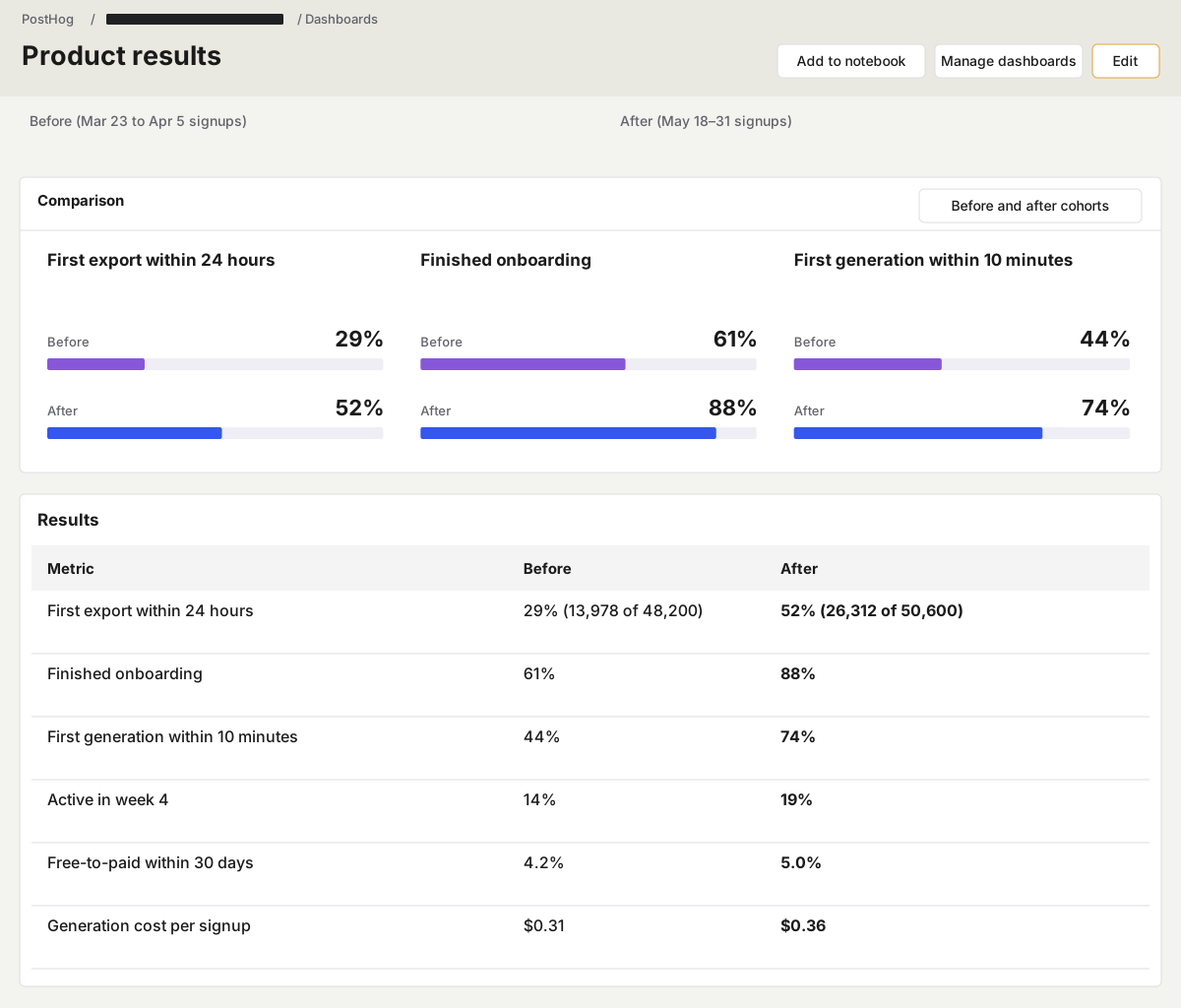
| Headline | First export within 24 hours up from 29% to 52% |
| Channels | In-product onboarding, the editor's first screen, the export flow, lifecycle email |
| Team | A Kiko growth lead plus agents: a funnel-audit agent, a session-replay agent that tagged where new users stalled, and an experiment write-up agent. The client's growth engineer and a product designer built the changes. |
The approach
- Hypothesis: new users leave before they make anything. The shortest path to a first finished, exported design lifts retention and paid conversion more than more templates or more features.
- Comparison: each change ran against a 50/50 split of new signups for at least 7 days. The final read compares signups from the two weeks before kickoff (March 23 to April 5) with weeks 7–8 (May 18–31), after every winner was live.
- Decision rule: ship if first export within 24 hours rises at least 3 points at 95% confidence, free-to-paid doesn't fall, and generation cost per signup stays under $0.40. Kill it otherwise.
What we changed
- Weeks 1–2: events and replays. We instrumented every onboarding step, first generation and export, and reviewed 200 session replays. Three stalls stood out: the questionnaire, the blank canvas, and the export menu, where 38% of users who left without exporting had seen the upgrade prompt.
- Weeks 3–4: tests B and E, onboarding length. Six questions cut to two (role and what you're making) lifted completion from 61.4% to 87.9%. A brand-kit upload step was cut.
- Weeks 3–5: test A, prompt-first start. The editor opened on a prompt prefilled from the signup answer ("Instagram post for a coffee shop launch") instead of a blank canvas. First export within 24 hours rose from 30.1% to 41.6%.
- Weeks 4–6: tests C and D, export and auto-drafts. Free export with a labelled watermark, and the upgrade offered after export, lifted first export from 44.0% to 51.3% while free-to-paid held (4.6% control, 4.9% variant). Auto-generating three drafts on first load was killed.
- Week 7: winners to 100%. Tests A, B and C shipped to all new signups on May 18.
- Weeks 7–13: the read and handover. We read week-4 activity and 30-day paid conversion for May 18–31 signups and handed over the dashboards and the test backlog.
The results
| Metric | Before (Mar 23 to Apr 5 signups) | After (May 18–31 signups) | Change |
|---|---|---|---|
| First export within 24 hours | 29% (13,978 of 48,200) | 52% (26,312 of 50,600) | +23 pts |
| Finished onboarding | 61% | 88% | +27 pts |
| First generation within 10 minutes | 44% | 74% | +30 pts |
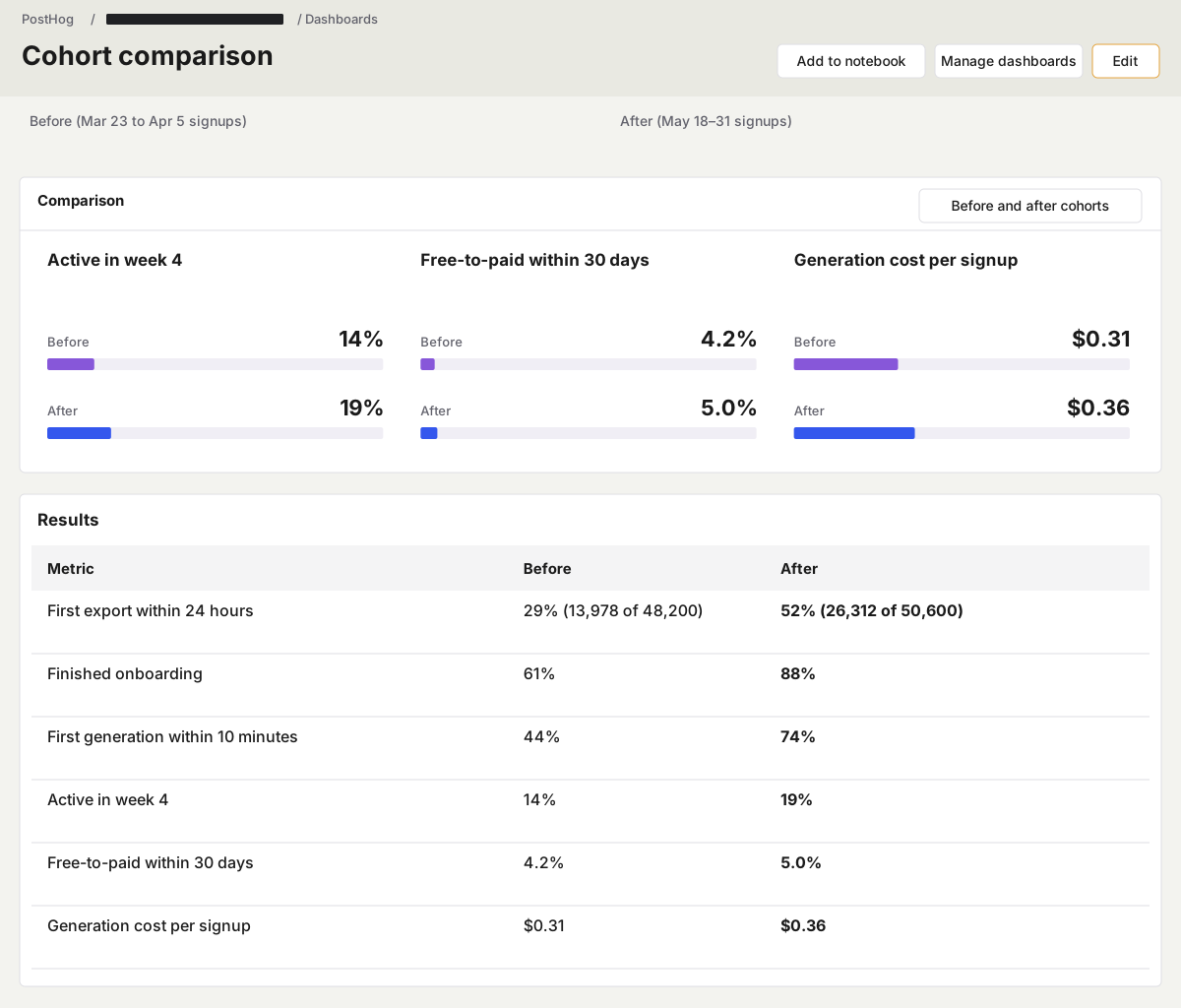
| Active in week 4 | 14% | 19% | +5 pts |
| Free-to-paid within 30 days | 4.2% | 5.0% | +0.8 pts |
| Generation cost per signup | $0.31 | $0.36 | +$0.05 |
What didn't work
- Drafts before the user asked. Generating three designs on first load added 0.6 points of first exports, which was not significant, and raised generation cost per signup by 62%. Generation now starts only when the user submits the prompt.
- A brand-kit upload in onboarding. It cut onboarding completion by 8 points. We moved it to after the first export, where 23% of exporters now upload one.
- An autoplay tutorial video. 91% of new users skipped it within 5 seconds. We removed it without a test.
What we learned
- Start new users on a prompt, not a blank canvas.
- Make the free path to an export obvious, and sell the upgrade after the first export.
- Put a cost guardrail on every AI-generation test.
Frequently asked questions
What does an onboarding sprint cost for an AI design tool?
There was no media spend: the work ran as one Kiko 90-day sprint (sprints start from $10,000 a month). The hidden cost to watch is GPU: generation cost per signup rose from $0.31 to $0.36, under the $0.40 cap.
How fast can onboarding changes show results?
Session replays took two weeks. Tests ran in weeks 3–6, three winners shipped on May 18 (week 7), and the two-week read cohort closed at the end of May. Budget 13 weeks including handover.
Would this work for a seed-stage AI video editor with a paid trial only?
The prompt-first start and the two-question onboarding transfer. Test C doesn't: it depended on a free watermarked export, and the stall it fixed was users seeing an upgrade prompt at export. Check your own replays for the equivalent.
Related case studies and guides
Same industry, other angles:
- Creator marketing: 6,300 trial starts in 10 weeks at $11.40 per trial
- Paid ads: 2.7x return on ad spend in 30 days on TikTok and Meta
- Full growth system: grew MRR from $180K to $640K in 8 months
More on AI creative tools: