The company and program
| Client | A seed-stage AI coding tool: an IDE extension with a coding agent, a free tier with monthly credits and a $20-a-month Pro plan. |
| Stage | Seed |
| Industry | AI coding tools |
| Timeline | One 90-day sprint, June 1 to August 30, 2026 |
| Channels | In-product onboarding, the credit-limit paywall, lifecycle email |
| Team | A Kiko growth lead plus agents: an event-audit agent, a cohort-report agent and an experiment write-up agent. The client's two engineers built the product changes. |
The approach
- Hypothesis: free users who never see the agent make a change they keep don't pay. Getting more of them to a first accepted edit in week one, and not cutting them off mid-task at the credit limit, lifts free-to-paid more than any pricing change.
- Comparison: each change ran against a 50/50 split of new signups for at least 14 days. The final read compares signups from the two weeks before kickoff (May 18–31) with weeks 7–8 (July 13–26), after every winner was live, on 30-day free-to-paid.
- Decision rule: ship if the primary metric rises at least 2 points at 95% confidence and month-2 paid retention doesn't fall. Kill it otherwise.
What we changed
- Weeks 1–2: events and the activation definition. We instrumented install, first task, accepted edit, credit-limit hit, paywall view and subscription. "First accepted edit within 7 days" predicted paying best: 9 in 10 users who paid within 30 days had reached it first.
- Weeks 3–6: test A, sample repo and suggested first tasks. New users could run the agent on a sample repo before connecting their own, with three first tasks suggested for their language. Accepted edits within 7 days rose from 22.4% to 40.2%.
- Weeks 3–6: test B, a trial at the credit limit. Users who ran out of credits could finish the task they were on and start a 7-day Pro trial. Limit-hit users paying within 30 days rose from 17.8% to 28.9%.
- Weeks 3–6: tests C and D. A day-2 email with the user's first accepted edit and a suggested next task, and a paywall that showed the annual plan first. Both were killed.
- Week 7: winners to 100%. Tests A and B shipped to all new signups on July 13, which opened the read cohort.
- Weeks 7–13: the read and handover. We read 30-day conversion on July 13–26 signups and handed over the dashboard, the event spec and a ranked backlog of next tests.
The results
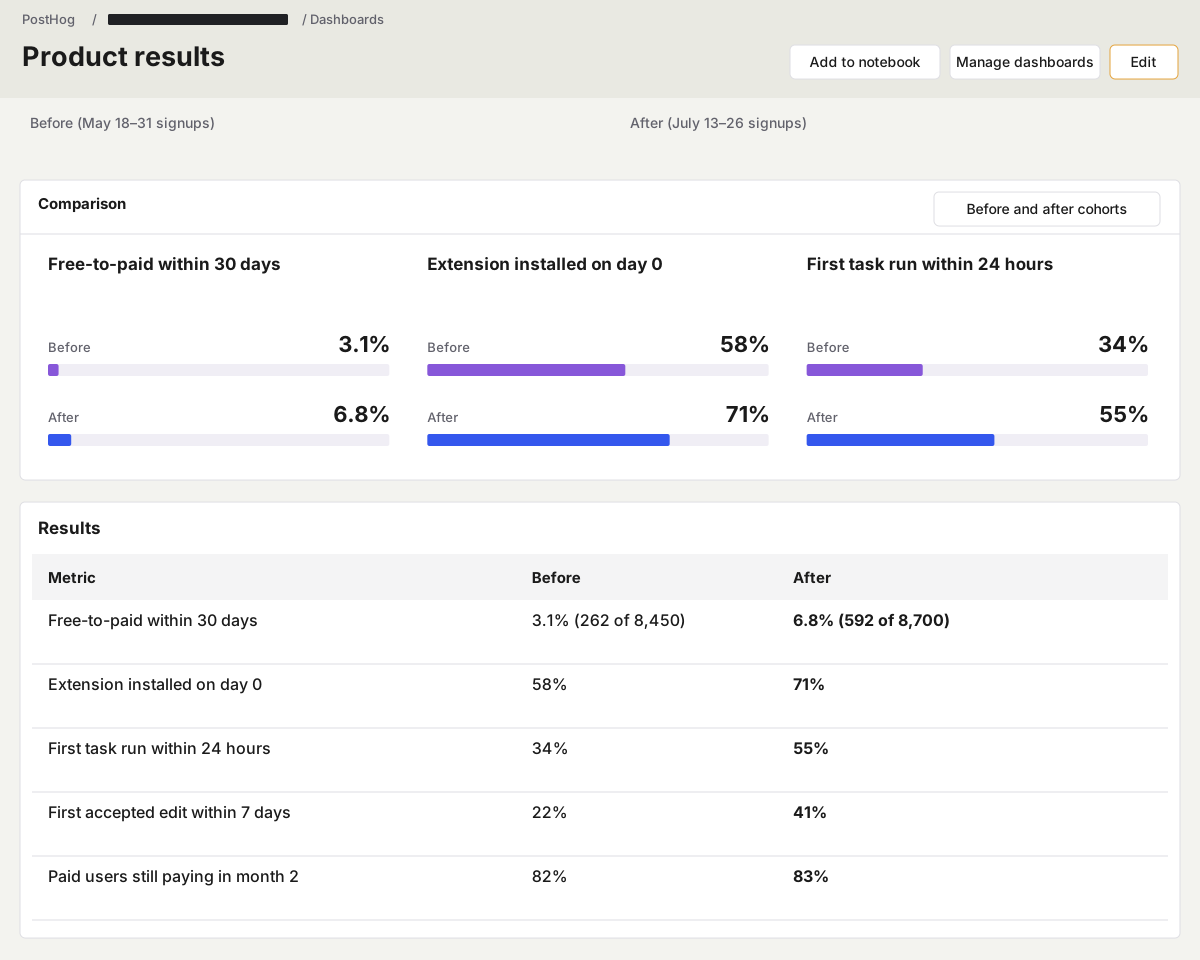
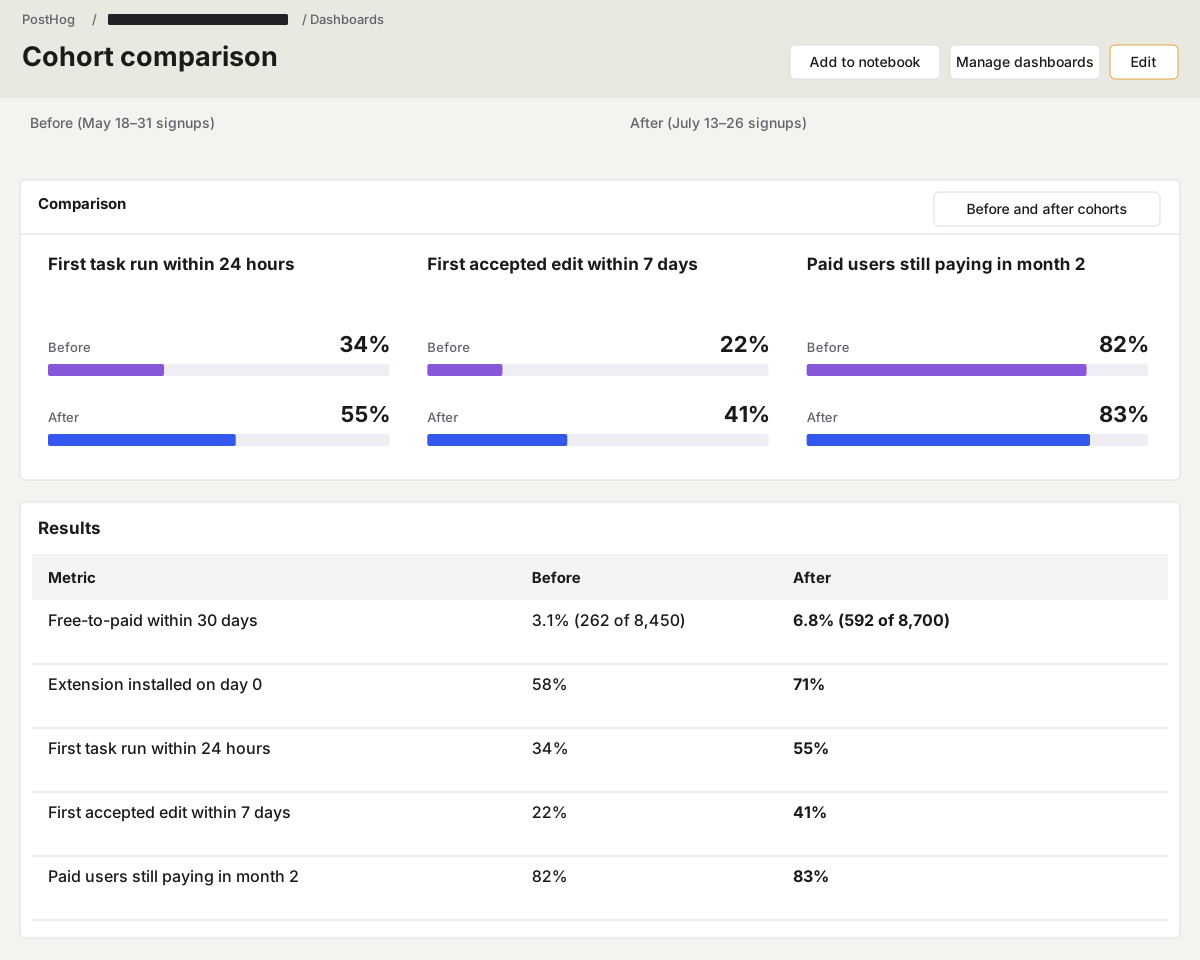
| Metric | Before (May 18–31 signups) | After (July 13–26 signups) | Change |
|---|---|---|---|
| Free-to-paid within 30 days | 3.1% (262 of 8,450) | 6.8% (592 of 8,700) | +3.7 pts |
| Extension installed on day 0 | 58% | 71% | +13 pts |
| First task run within 24 hours | 34% | 55% | +21 pts |
| First accepted edit within 7 days | 22% | 41% | +19 pts |
| Paid users still paying in month 2 | 82% | 83% | +1 pt |
What didn't work
- The day-2 next-task email. Accepted edits went from 22.6% to 23.4%, which was not significant. Users who stalled had stalled at install, before they had an edit to be reminded of.
- Showing the annual plan first. Paywall-to-paid fell from 12.1% to 10.4%. Annual is now offered after the first paid month.
- Team repos. On team accounts, connecting a repo needed an org admin to approve the app, and 31% of team signups stalled there. The sample repo only partly helped, so it is the first item on the next sprint's backlog.
What we learned
- Pick the activation event by checking which one predicts paying, before testing anything.
- Let new users watch the agent work on a sample repo before asking for access to their own code.
- Turn the credit limit into a trial offer at the moment of need, not a wall.
Frequently asked questions
How much does a 90-day activation sprint cost?
There was no media spend: the work ran as one Kiko 90-day sprint (sprints start from $10,000 a month). The client's two engineers built the changes. New paid users per two-week cohort went from 262 to 592.
How long before free-to-paid moved?
Tests started in week 3. Both winners shipped to all signups on July 13, week 7, and the 30-day read on July 13–26 signups closed in late August. Count on 13 weeks from kickoff to a final number.
Would this work for a Series A coding tool selling to teams?
Only partly. The sample repo and the credit-limit trial fixed individual signups. Team accounts stalled at org-admin approval of the repo app, 31% of them, and that was not solved in this sprint.
Related case studies and guides
Same industry, other angles:
- Creator marketing: 11,200 sign-ups in launch month, 38% from creator links
- Paid ads: 8,900 paid seats in one quarter at $118 CAC from YouTube and Reddit ads
- Full growth system: grew to 1,900 paying teams in 6 months
More on AI coding tools: