The company and program
| Client | A seed-stage AI code review tool |
| Stage | Seed |
| Industry | AI coding tools |
| Pillars | Creator marketing + Paid ads + Product growth |
| Timeline | 6 months, Apr 1 – Sep 30, 2026: two 90-day sprints |
| Channels | YouTube developer creators, developer newsletters, YouTube ads, Reddit ads, onboarding and in-product prompts |
| Team | A dedicated Kiko growth lead plus agents for creator research, ad reporting and funnel and cohort pulls. The client's engineers built the onboarding changes Kiko specced |
| Headline result | 1,900 paying teams in 6 months, from 410 |
| Measured in | Product analytics, Stripe, YouTube and Reddit ads managers, tracked creator links and a source question at install |
The approach
- Hypothesis: developers buy a code review tool after they see it catch something real, first on a creator's screen and then on their own pull request. If creators show a real catch, ads repeat it and onboarding produces a first review within a day, conversion rises in every channel at once.
- Comparison: March 2026 was the baseline: search ads at $1,000 per paying team from paid, 70 new paying teams, a blended CAC of $171 and 38% of installs getting a first review within 24 hours. Each later month was read against it, by source.
- Decision rule: a creator video got 7 days of organic data and went into paid only if its installs reached a first review within 24 hours at 50% or better. Ad concepts got $500–$1,000 or 7 days and were killed above a $400 cost per paying team. Onboarding changes shipped to everyone only after a 50/50 test lifted 24-hour first review by 5 points or more.
How the three pillars connected
Creator marketing
We booked 9 YouTube creators and 3 developer newsletters in the first 30 days and 13 creators over the engagement. The core was hands-on reviewers for professional developers, such as a 250K-subscriber web and TypeScript reviewer, and AI coding educators with 100K–200K subscribers. Every brief asked for the tool reviewing a real open-source pull request, with the catch left unedited. Creators brought 600 paying teams at $110 each.
Paid ads
Before Kiko, the team ran search ads at a $1,000 cost per paying team. We moved budget to YouTube in-stream ads cut from creator videos and Reddit ads in developer communities, using the same 20-second "it found the bug" clips. Monthly media a little more than doubled from April to September, and paid brought 314 paying teams.
Product growth
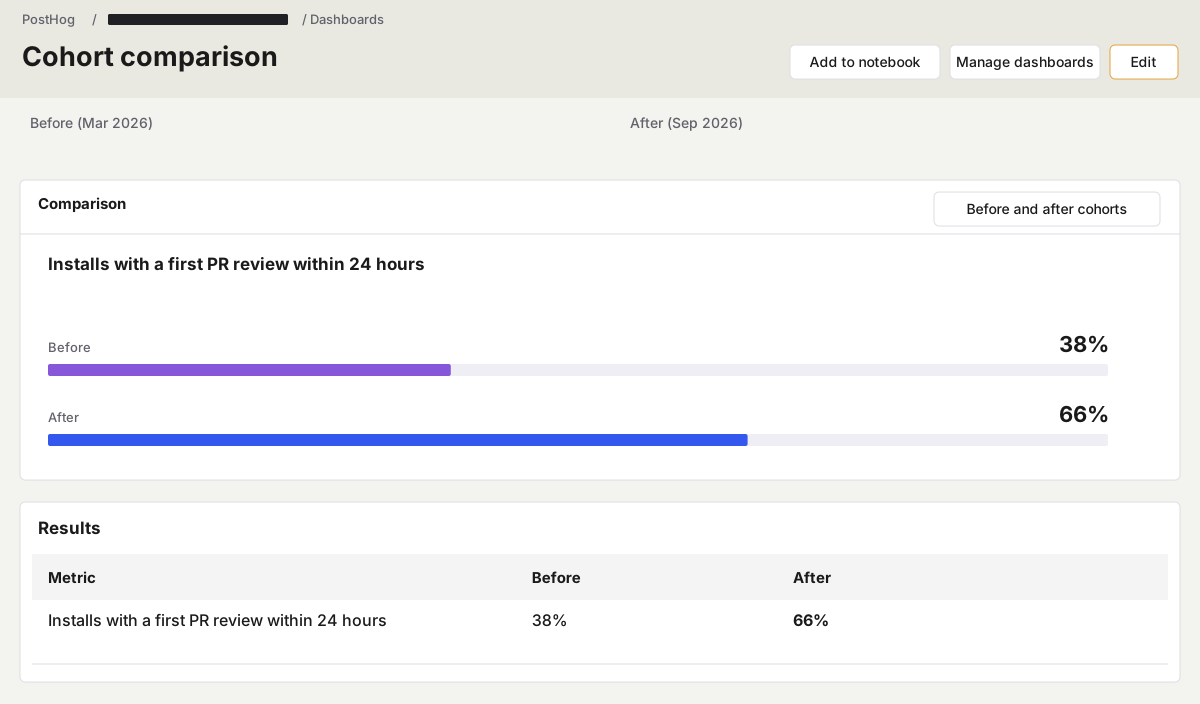
The funnel showed why paid looked expensive. After install, the tool waited for a new pull request, so the median first review took 2.6 days and many teams never came back. We specced three changes: pick the most active repo automatically, review the latest open pull request the moment the app is installed, and add an "invite the PR author" link inside the review comment. First review within 24 hours rose from 38% to 66% and install-to-paid within 30 days from 7.5% to 12%.
How they fed each other
The creator catches that converted best were null-check and race-condition bugs, so those became the ad hooks and the examples on the install page. Paid volume exposed the first-review delay within three weeks. Fixing it raised conversion for creator and organic installs too, and cut paid CAC from $1,000 to $262. Reviews posted inside pull requests then put the tool in front of every teammate, which grew organic sign-ups from 58 to 191 paying teams a month.
What we changed
- Weeks 1–2: event audit, a first-value definition (first review on a real pull request), the March baseline by source, and a creator shortlist scored on Kiko's six-point rubric.
- Weeks 3–6: first creator videos live in week 3. Ten ad concepts tested at $500–$1,000 each, and instant review of the latest open pull request into a 50/50 test.
- Weeks 7–13: instant review and auto-picked repo shipped to all users. Three creator videos passed the rule and ran as YouTube and Reddit ads.
- Weeks 14–20 (sprint 2): four new creators added, two newsletters moved to monthly placements, and the invite link live in review comments. Media scaled on the three winning concepts.
- Weeks 21–26: media reached its highest month on the winning concepts, and a usage summary went into the day-12 email before the team trial ends.
The results
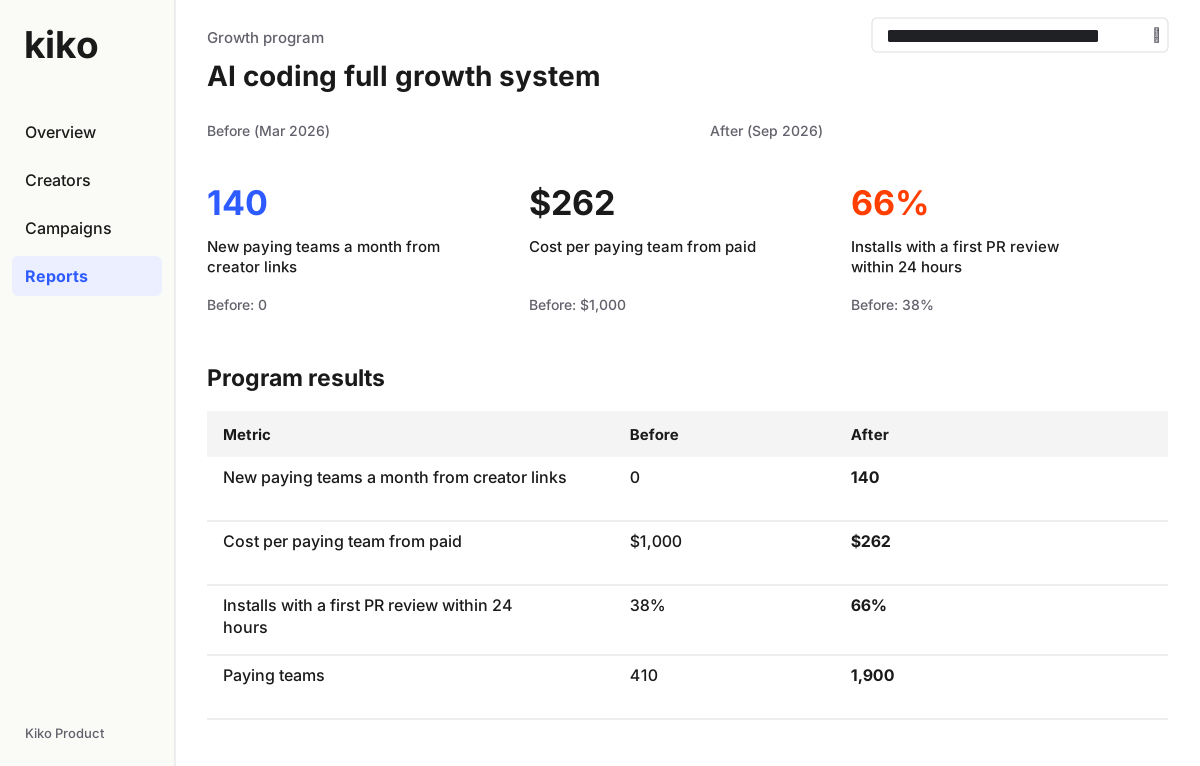
| Pillar | Metric | Before (Mar 2026) | After (Sep 2026) | Change |
|---|---|---|---|---|
| Creator marketing | New paying teams a month from creator links | 0 | 140 | +140 |
| Paid ads | Cost per paying team from paid | $1,000 | $262 | −74% |
| Product growth | Installs with a first PR review within 24 hours | 38% | 66% | +28 pts |
| Combined | Paying teams | 410 | 1,900 | 4.6x |
Blended CAC fell from $171 to $80, MRR grew from $57,400 to $285,000, and monthly team churn fell from 3.7% to 2.6%.
What didn't work
- Launch-day threads on X. Three sponsored threads brought 11 paying teams, about $680 each. Developers clicked but installed on personal accounts that never became teams.
- Broad Reddit targeting. Interest-based Reddit campaigns cost about $600 per paying team. Narrowing to developer communities around specific languages fixed it.
- Usage-based pricing. A per-review pricing test confused team leads during the trial, and we reverted it after 3 weeks.
What we learned
- Brief creators to review a real open-source pull request and keep the catch on screen, uncut.
- Fix time to first value before scaling media; the instant-review change did more for paid CAC than any new ad.
- Put the invite inside the product's own output, so every review recruits the next teammate.
Frequently asked questions
How much does it cost to run creators, paid ads and product growth together for a developer tool?
Each new paying team cost $99 in creator fees and media across the 6 months and $80 by September: $262 from paid ads and $110 from creators. Most seed programs like this run $20,000–$35,000 a month in creator fees and media.
How long before a full growth system shows results for an AI coding tool?
First creator videos went live in week 3. The instant-review change shipped to everyone in week 7, with the first creator-clip ads the same sprint. Paying teams went from 410 to 1,900 in 6 months.
Would this work for a Series A developer tool sold per seat instead of per team?
The instant first-review fix applies to any tool that waits for a trigger event. The invite inside the review comment does not: per-seat tools need another expansion loop, and the $262 paid CAC assumes team pricing near $150 a month.
Related case studies and guides
Same industry, other angles:
- Creator marketing: 11,200 sign-ups in launch month, 38% from creator links, a seed-stage AI coding assistant
- Paid ads: 8,900 paid seats in one quarter at $118 CAC from YouTube and Reddit ads, a Series B AI coding tool
- Product growth: Free-to-paid conversion up from 3.1% to 6.8% in a 90-day sprint, a seed-stage AI coding tool
Playbooks and lists:
- Creator marketing for AI coding tools, the industry front door
- How do we launch an AI coding tool with creators?, the launch playbook
- AI coding tool creators, the creator shortlist
- Fractional growth team, how Kiko runs all three pillars together