The company and program
| Client | A seed-stage AI coding assistant for VS Code, JetBrains and the terminal. |
| Stage | Seed |
| Industry | AI coding tools |
| Timeline | 4 weeks of prep in August 2026, then launch month, 1–30 September 2026 |
| Channels | YouTube (dedicated videos, integrations, Shorts, one live stream) and two developer newsletters |
| Team | 1 dedicated Kiko growth lead, plus agents for creator scoring, technical script review and daily UTM reporting |
The approach
- Hypothesis: launch-day reach creators fill the top of the funnel, but deep tutorials bring the developers who actually use the tool. Both are worth booking, at different times.
- Comparison: launch-day explainer and review against week-2 to week-4 deep tutorials and build-alongs, on cost per sign-up and on the share of sign-ups who accepted a first AI edit within 7 days.
- Decision rule: keep a creator in the follow-on plan if their sign-ups reach 50% first-edit rate at $9.50 or less per sign-up.
What we changed
- Week −4 to −3: score and book. We scored 41 creators and newsletters on Kiko's six-point rubric and booked 10: an 800K-subscriber short-explainer channel, two opinionated review channels for web and TypeScript developers, a deep-tutorial channel for professional engineers, two coding-agent build-along channels, a Shorts creator for vibe coders, a live-coding streamer, an AI-engineering newsletter and a general developer newsletter.
- Week −2 to −1: early access. Every creator got a pro account two weeks early and a one-page brief: use it on your own codebase, show one accepted edit and one rejected edit, and say what you would not use it for. Kiko checked each script for technical accuracy and FTC disclosure.
- Launch week (week 1): reach. The short explainer and the first hands-on review went live on launch day, alongside the founders' launch post.
- Weeks 2–3: depth. The deep tutorial, two build-alongs and the AI-engineering newsletter went live, one or two a week, so sign-ups never dropped to the baseline.
- Week 4: long tail and read. The second review, the Shorts creator, the live stream and the second newsletter went live. We read every creator against the decision rule and handed the client a rebooking plan for month two.
The results
| Metric | Before (beta month, August) | After (launch month, September) | Change |
|---|---|---|---|
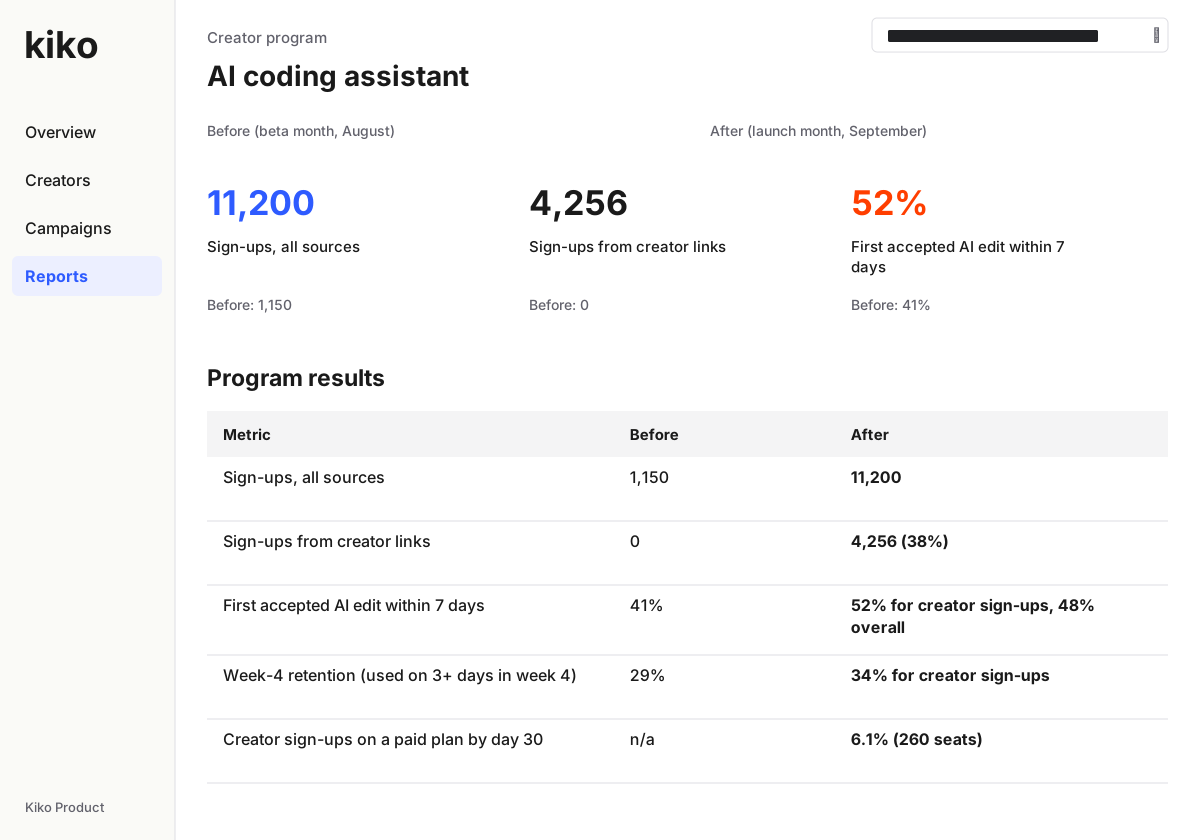
| Sign-ups, all sources | 1,150 | 11,200 | 9.7x |
| Sign-ups from creator links | 0 | 4,256 (38%) | new source |
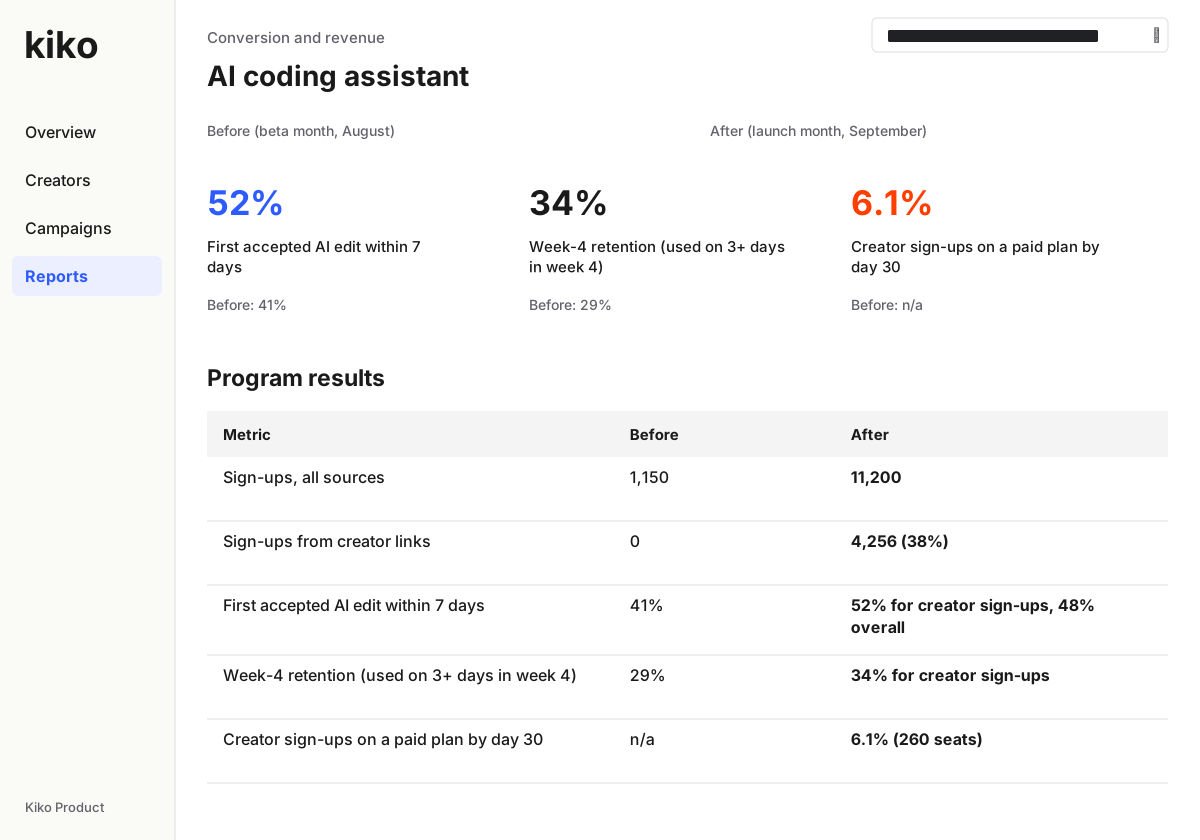
| First accepted AI edit within 7 days | 41% | 52% for creator sign-ups, 48% overall | +11 pts (creator), +7 pts (overall) |
| Week-4 retention (used on 3+ days in week 4) | 29% | 34% for creator sign-ups | +5 pts |
| Creator sign-ups on a paid plan by day 30 | n/a | 6.1% (260 seats) | n/a |
What didn't work
- Launch-day reach was shallow. The short explainer brought the most sign-ups (1,310), but only 43% of them accepted a first edit. The deep tutorial and the two build-alongs ran at 63%.
- Shorts and the live stream barely registered. Together they brought 110 sign-ups. Developers clicked through from long videos, not from short clips.
- The second newsletter missed the bar. It cost $13.00 per sign-up with a 45% first-edit rate. We left it out of the month-two plan.
What we learned
- Stagger the roster: one or two reach creators on launch day, then a deep tutorial or build-along every few days for the rest of the month.
- Give creators the product two weeks early and ask them to show a rejected edit. The honest videos converted best.
- Judge creators on first accepted edit, not sign-ups. The cheapest sign-ups were not the best users.
Frequently asked questions
How much does a creator launch cost for an AI coding tool?
$8.00 per creator sign-up in creator fees across 10 creators, with no paid media. Most seed launches like this run $15,000–$35,000 a month in creator fees.
How far ahead do you book creators for a launch?
Four weeks. Scoring and booking took weeks −4 to −3, and creators got pro accounts two weeks before launch. Posts then ran across all four launch weeks rather than one day.
Would this work for a Series A developer tool that has already launched?
The staggered roster and the first-edit bar apply to any feature launch. The 11,200 figure doesn't; 62% of it came from sources other than creator links, including the founders' launch post, which only a first launch gets. For an established tool, see the activation study below.
Related case studies and guides
Same industry, other angles:
- Paid ads: 8,900 paid seats in one quarter at $118 CAC from YouTube and Reddit ads
- Product growth: Free-to-paid conversion up from 3.1% to 6.8% in a 90-day sprint
- Full growth system: grew to 1,900 paying teams in 6 months
More on AI coding tools: