What is the new way to do influencer marketing?
It replaces three habits from 2019: static creator databases, low-volume cold outreach and picking by follower count. Instead, you source creators from each platform's own recommendations, judge them by CPM on median recent views, outlier rate and trajectory, and run cohorts of 10 to 20 creators. Lock in the one or two winners, spend 10 to 20% of the budget amplifying their content, and repeat. This article is the written version of my video from April 2026.
Why does the 2019 influencer model fail?
You know the routine. Sign up for a creator database, send 100 cold emails, get two or three replies, pay the quoted rate, run it, hope. "It almost never does." Then the team decides influencer marketing doesn't work and goes back to Meta ads that cost more every quarter.
Influencer marketing didn't fail. Their model did.
I ran a company backed by Snapchat that grew entirely through influencer marketing. I've seen programs burn money and I've seen ones quietly bring in millions. The difference was the system behind them.
Why are creator databases a broken source?
The database model feels logical. Millions of creators, filters, outreach. "Except, it doesn't work like that."
- They're static. "A lot of these databases are static snapshots." The creator whose last five videos did 400,000 views in two weeks is almost certainly not in one yet.
- They're self-selected. Creators in databases are largely there because they're hunting for work. You're fishing in a pond of people who need to be in that pond.
- They decay. "This is a game of alpha and data decays fast." The creator who was hot 12 months ago might be in steep decline today.
Then cold outreach makes it worse. Instagram DMs have limits, TikTok DMs barely work for business, and email only works with the right infrastructure. The deeper problem is volume.
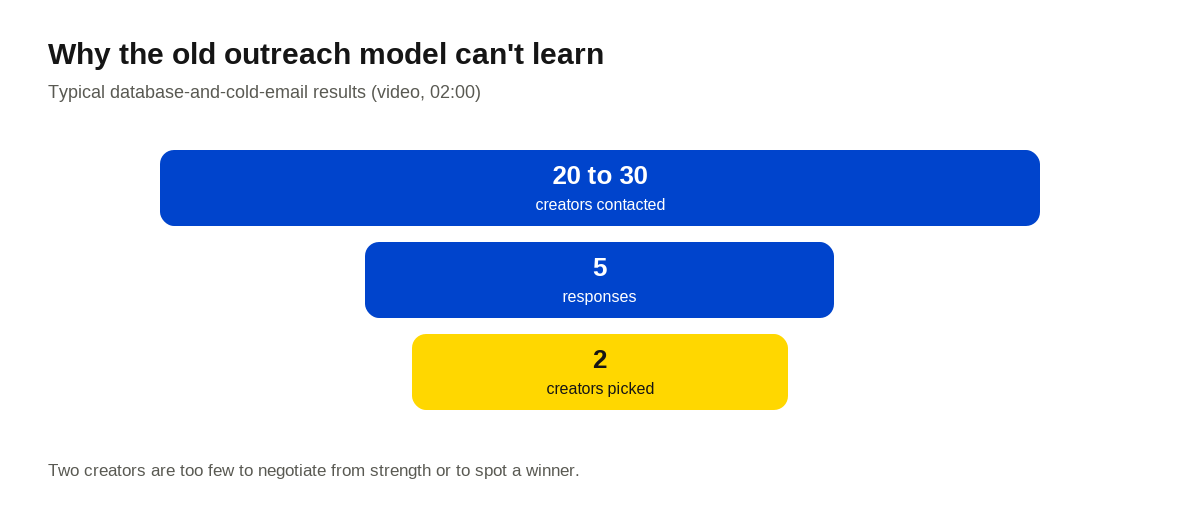
"You cannot identify winners from a sample size of two." You also can't negotiate from strength with two.
Why is follower count the wrong metric?
"Follower count in 2026 means almost nothing."
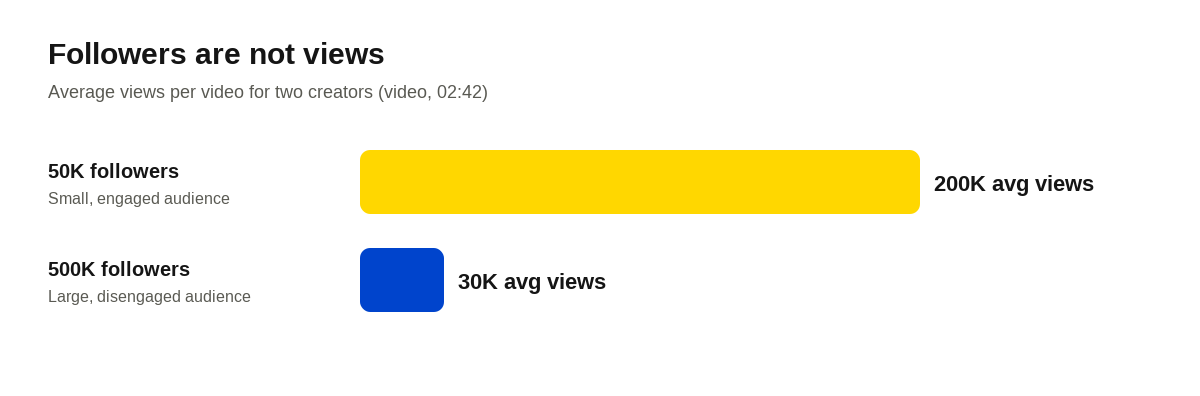
A creator with 50,000 followers averaging 200,000 views will outperform one with 500,000 followers averaging 30,000, every time. Databases sort by followers because it's the number that looks impressive.
The architecture is the problem: static databases, low-volume outreach, follower-first selection. None of it was built for how the creator economy works.
How do you find creators by reverse engineering the platforms?
Stop paying a third party for information the platforms give away. YouTube, TikTok, Instagram, LinkedIn and X all have recommendation algorithms whose job is to surface the creators winning right now. "When you're doing this, you're essentially searching a live database that updates in real time."
Here's the workflow, platform by platform:
- Search the terms your ICP would actually type.
- Click into the channels getting the most consistent views.
- Check their last 15 to 30 videos. Not their top performers, their most recent ones.
- Open the recommended channels on the side. "This is the algorithm literally handing you a list of creators."
- Rinse and repeat on each platform.
It takes more time up front than buying a list. That's exactly why it works: your competitors aren't doing it. This is the approach behind Kiko's creator sourcing.
How do you judge creator quality?
Volume matters at the top of the funnel. "But volume without quality is just expensive noise." Trust is the currency, and if the integration feels forced, it doesn't transfer. Judge four things:
| Signal | What to measure | Why it matters |
|---|---|---|
| CPM | Fee ÷ median recent views × 1,000 | Price per thousand real views, not per follower |
| Outlier rate | How often the creator spikes above their median | "You're buying a lottery ticket on their ceiling." |
| Trajectory | Are the last 10 videos rising or falling? | The algorithm rewards momentum |
| Vibe check | Watch the content yourself | Would the audience trust this recommendation? |
The CPM math most teams skip
"Take the creator's fee, divide it by their median recent views, and then multiply by 1,000." That's the CPM.
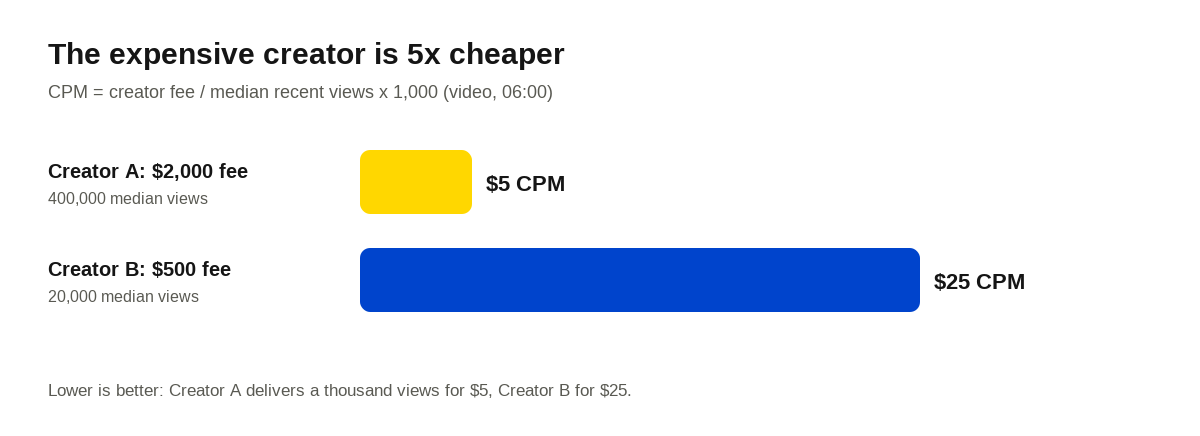
"The more expensive creator is actually 5x cheaper per thousand impressions." Most companies never run this. They pay the quoted rate and wonder why results are inconsistent. Check typical CPMs by niche in creator rates for AI and developer tools.
The part no spreadsheet does
You have to watch the content. Does your product feel native to what they make? "Data narrows the list, but taste always makes the final call."
Why should influencer marketing be a system, not a campaign?
"Campaigns end. Systems get better over time."
The campaign version: pick creators, run posts, check numbers, feel underwhelmed, try again six months later with slightly different creators. The system version compounds.
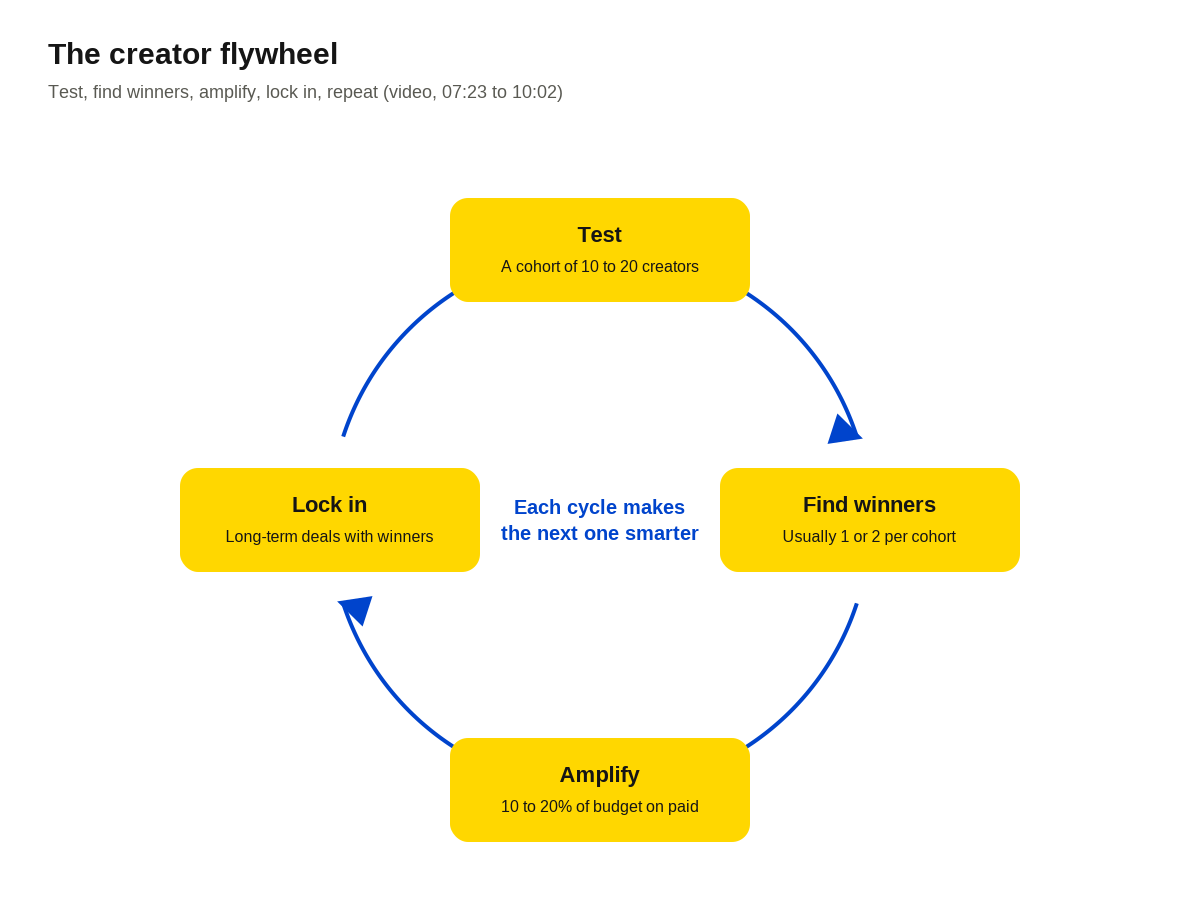
- Test a cohort of 10 to 20 creators. Most won't hit. That's expected.
- Find winners. You're hunting for the one or two you can build on.
- Lock them in with longer-term deals, ongoing relationships, exclusives where possible. A creator who drives results for you will probably drive them for your competitor. "The companies that move fast on locking in winning creators build the moat."
- Amplify. Put 10 to 20% of the budget into paid amplification on TikTok, Meta and YouTube. Creator content works as ads because "it doesn't feel like an ad. It feels like a recommendation."
- Repeat with what you learned. Each cycle makes the next one smarter.
Paid ads get more expensive every year. This channel gets cheaper and more effective the longer you run it.
How do you measure influencer marketing?
Track what you can: unique links, UTM parameters and conversion data for every creator. Then accept that much of the value is indirect. Someone watches a video, doesn't click, and Googles you three days later. "Perfect attribution is a myth in this channel." Getting close enough to make confident decisions is the goal. The creator CAC calculator helps set the target.
Is the first creator post a fair test?
No first attempt is the best version. Not your first product, your first hire or your first ad campaign. Yet teams judge influencer marketing by one post. "Remember, the first creator video is just a data point." Take what resonated back to the creator, adjust, and run the next one.
Frequently asked questions
Are creator databases worth paying for?
They are a weak primary source. Databases are static snapshots, skew toward creators actively seeking work, and miss the creators with momentum right now. Platform recommendation algorithms update in real time and are free.
How do you calculate a creator's CPM?
Divide the creator's fee by their median views on recent videos, then multiply by 1,000. A $2,000 creator with 400,000 median views is a $5 CPM, five times cheaper per thousand views than a $500 creator with 20,000.
How big should the first creator cohort be?
Start with 10 to 20 creators. Most will not hit, and that is expected; the goal is to find the one or two winners to lock in and build on.
How much should go to paid amplification?
Set aside 10 to 20% of the creator budget to run winning creator videos as paid ads on TikTok, Meta and YouTube.
Full transcript
YouTube's English captions for the video, grouped into paragraphs with start times. We fixed obvious caption errors (names, numbers, misheard words) and left the wording as spoken.
[00:00] Influencer marketing in 2026 can generate millions of dollars of revenue for almost any business. Yet, most companies will never see a dollar of that because they're running influencer marketing like it's still 2019. They'll sign up for some massive creator database, blast out 100 cold emails, get two or three replies, pay whatever rate they're quoted, run the campaign, and then hope something sticks. It almost never does. So, they decide, hey, influencer marketing does not work for our brand. And they go back to pouring money into meta ads that are getting more expensive every single quarter. But here's the reality. Influencer marketing didn't fail. Their model did. I used to run a company backed by Snapchat that grew entirely through influencer marketing. And before that, I ran product for Beyoncé. I've seen influencer programs burn money to the ground. And I've also seen ones that quietly have brought in millions of dollars in revenue. The differences in budget or brand size or even the creators you pick. It's a system behind how you run influencer marketing. So, in this video, I'm going to break down the model that the best growth teams are using in 2026 and why it works so much better than the old way. But first, we have to start off with a major problem, and that's the fact that the data and outreach model is broken. So, why is the old database and outreach model structurally broken? See, the database model feels logical on the surface. You pay for a platform, you get access to millions of creators, you can then filter by niche and follower count and start reaching out. It's clean, it's simple, it's scalable. Except, it doesn't work like that. And here's the actual reason why. A lot of these databases are static snapshots.
[01:24] The creator economy is extremely dynamic. So, you know, the creator who's dominating their niche right now, the one whose last five videos did 400,000 views in the last two weeks, they're almost certainly not in any database yet. And you know, they don't need to be. They're winning without it. Plus, the creators who are in databases are largely there because they're hunting for work. They've signed up. They listed their rates. They made themselves easy to find. Feels logical on the surface. When your entire sourcing strategy is based on it, you're fishing in a pond full of people who need to be in that pond. Also, this is a game of alpha and data decays fast. The creator who was super hot 12 months ago and made it into a database might actually be in a steep decline today. These databases are not indexing in real time. They don't update in real time. The platforms themselves do though. Now layer cold outreach on top of this already flawed foundation. Instagram DMs have scale restrictions.
[02:10] TikTok DMs barely function for business outreach. Email works but only if you have the right infrastructure. And the truth is that most companies don't. But the deeper problem with cold outreach isn't the channel, it's the volume. So most companies will reach out to 20 to 30 creators, get five responses, pick two, and call it a campaign. That's not enough volume to learn anything at all. You cannot build leverage negotiating with just two creators. You cannot identify winners from a sample size of two. And then there's the follower count trap. You know, sorting creators by followers and then just working down the list. Follower count in 2026 means almost nothing. A creator with 50,000 followers averaging 200,000 views per video will always outperform a creator with 500,000 followers averaging 30,000 views every single time. But the databases sort by followers because that's number that looks impressive. So companies keep picking the wrong creators and keep getting terrible results. This is why the model is structurally broken. It's not that companies are executing it badly. is that the entire architecture, static databases, low volume outreach, follower first selection, these things were never built for how the creator economy actually works. So, if you can't rely on databases and you can't rely on follower count, how do the best growth teams actually find the right creators? The answer is simpler than you might think and it's been sitting in front of everyone this entire time. How modern teams reverse engineer platforms instead of searching for them. See, the biggest mistake companies make in creator discovery is going to a third party to find information that the platforms already give away for free. Literally every major platform, YouTube, TikTok, Instagram, LinkedIn, X, they have an amazing recommendation algorithm. And that algorithm's entire job is to surface the creators who are winning right now. Not 2 years ago, not the ones with the biggest follower counts, the ones whose content is performing today.
[03:49] When you go directly to each platform, you can feed it signals by searching for terms your ideal customer would search for, watching the content that comes up, clicking into channels that the algorithm recommends for you. When you're doing this, you're essentially searching a live database that updates in real time. That's an unfair advantage over every competitor you have that's still paying for a static tool. So, here's what this actually looks like in practice. You go to YouTube and you search a term your ICP would actually type. Go ahead and look at what comes up. Click into the channels getting the most consistent views. Check out their last 15 to 30 videos, not their top performers, their most recent ones, and let the algorithm show you what it's currently rewarding. Then, you want to look at the recommended channel section on the side. This is the algorithm literally handing you a list of creators. It considers both peers and competitors in the space. This is your sourcing list. This is where it starts. You simply rinse and repeat for each platform. Each platform's algorithm is a live signal of who's winning in your niche right now. You just have to know how to read it. Now, this approach is harder than buying a pre-built list since it takes more time up front. But that's exactly why it works because your competitors aren't doing it. The best creators in any niche aren't waiting to be discovered in a database. They're winning on the platform. Go and find them there. The result is a sourcing list that's current, relevant, and full of creators with actual momentum. Not creators who were hot in 2023. Not creators who signed up to a platform because they needed brand deals.
[05:03] Creators the algorithm is actively pushing right now. Okay, so now you have a real sourcing list. Creators with actual momentum pulled directly from the platforms. But having the right list is only half the question. Because at this point, most companies make their second major mistake. They think more creators automatically means better results. Which is why we have to discuss why creator quality beats creator quantity more than ever. Let's talk about creator quality versus creator quantity. There's a version of influencer marketing that's purely a numbers game. Email thousand creators, work with 50 of them, cast the widest net possible, and let volume do the work. And volume does matter, especially at the top of the funnel when you're still learning. But volume without quality is just expensive noise. The reason quality matters more than ever in 2026, comes down to trust. Trust is the actual currency of the creator economy right now. When a creator recommends your product to their audience, they're spending a piece of the trust they've built over the years making consistent content. If the creator doesn't genuinely fit your product, if the integration feels forced, or if the audience can smell the sponsorship from a mile away, that trust does not transfer. So, how do you actually evaluate quality? It starts with CPM, cost per thousand views based on their recent performance, not their follower count. So, take the creator's fee, divide it by their median recent views, and then multiply by 1,000. That gives you the CPM. So, for example, a creator charging $2,000 with 400,000 median views is a $5 CPM. A creator charging $500 was 20,000 median views is a $25 CPM. The more expensive creator is actually 5x cheaper per thousand impressions. Most companies never run this calculation. They just pay the quoted rate and wonder why results are inconsistent. Then there's outlier rate.
[06:31] How often does this creator spike with a hit? You're not just buying their median performance. You're buying a lottery ticket on their ceiling. So a creator who consistently hits two to three extra median views on their best content is worth significantly more than their baseline suggests. Trajectory matters a lot too. Is this creator growing or declining? So, a creator with 100,000 followers whose last 10 videos are trending upwards is a way better bet than a creator with 500,000 followers whose views have been quietly shrinking for 6 months. The algorithm rewards momentum. You want to be aligned with creators the platform is currently pushing. And then there's the vibe check, the part that no spreadsheet can do for you. You actually have to watch each creator's content. Does your product feel native to what they make or would an integration feel forced? Would their audience trust a recommendation from them in your category? This is the part where human judgment still wins over any AI tool. Data narrows the list, but taste always makes the final call. So, now you know how to find the right creators and how to pick the right ones. Yet, ironically, even the businesses that do both these things right still leave most of the value on the table. And it all comes down to one fundamental misunderstanding about what influencer marketing actually is. The operational shift from campaigns to systems. So, it's time to shift from campaign thinking to systems thinking.
[07:43] Most companies treat influencer marketing like a campaign. They pick some creators, they run the post, they check the numbers, they feel underwhelmed, and then they move on. Then 6 months later, they try again with a slightly different set of creators and get slightly different underwhelming results. On the other hand, the companies turning influencer marketing into their best growth channel treat it as a system. And the difference between a campaign and a system is compounding. Campaigns end. Systems get better over time. So, let's break down what this looks like. You start with a cohort of maybe 10 to 20 creators and most of them won't hit. That's expected, but it's fine. You're not looking for every creator to perform. You're hunting for the one or two winners that you can build on. That's the whole point of the first cohort. When you find those winners, and you will, don't treat them like a one-off transaction. Lock them in. Longer-term deals, ongoing relationships, exclusive arrangements if possible. Because if a creator is driving real results for your product, they'll probably drive real results for your competitor's product, too. The companies that move fast on locking in winning creators build the moat. The companies that don't hand the moat to someone else. Then you take the content that performed and you amplify it. Set aside 10 to 20% of your budget specifically for paid amplification.
[08:48] When a creator video performs organically, put money behind it. Run it as an ad on TikTok, Meta, on YouTube. You've already proven that the content works with real audiences. Now scale it. Creator content running as paid ads is outperforming traditional ad creative right now because it doesn't feel like an ad. It feels like a recommendation. Apply what you learned from cohort one to cohort two. Your hit rate improves. You know more about what resonates with your audience. You know which content formats are working and you know which creator profiles tend to convert. Each cycle makes the next one smarter. This is the flywheel. Test, find winners, amplify, lock in, and repeat. And it compounds in a way that paid ads never will because paid ads get more expensive every year while this channel gets cheaper and more effective the longer you do it. And yes, attribution won't be perfect, but that's okay. Track what you can. unique links, UTM parameters, conversion data from every creator. But accept that a lot of the value is going to be indirect. Someone watches a creator video, it doesn't click, Googles you three days later and converts.
[09:42] That's the real value you generated. Getting close enough to make confident decisions is the goal. Perfect attribution is a myth in this channel. Companies that figure this out aren't just running better influencer campaigns. They're building a distribution channel their competitors can't easily copy. Real trust with audiences, content that compounds, and a growth channel that gets stronger every quarter. There's something you already know, but probably aren't applying to your influencer marketing. No first attempt at anything is ever the best version. Not your first product, not your first hire, and not even your first ad campaign. Yet, somehow, when it comes to influencer marketing, people usually judge the entire thing by the first post. Remember, the first creator video is just a data point. Take what resonated, bring it back to the creator, make adjustments based on what worked. The truth is, between everything we discussed today, you have everything you need to run this yourself. But if you want to skip straight to a short list of prevetted, pre-negotiated creators who are already winning your category right now, that's what Kiko's creator sourcing does. Link in description. And if you want to keep turning influencer marketing into one of the strongest revenue channels your business has ever built, hit subscribe. We're just getting started.
Sources and scope
This article is the written version of the video above, published on YouTube on 2026-04-15. Quotes come from the full transcript. The figures in the charts (the CPM example, the follower-versus-views comparison, the outreach funnel and the cohort sizes) are the examples and working ranges I give in the video, not market studies. No third-party statistics are cited.
- The video: https://www.youtube.com/watch?v=rc0BfSDDkBc (accessed 2026-11-14)