How do startups go viral on purpose?
They flood one window of time with content about one brand. Algorithms reward signals (clips, views, engagement), so a coordinated wave of creator posts reads as real interest, and real viewers follow. The engine is three channels running together: creator campaigns, owned accounts and paid ads. Expect cohorts of at least 10 creators, and 10 to 20% of the creator budget set aside for amplification. This article is the written version of my video.
What is the surround sound effect?
It's the magic that happens when the top creators in a category start posting about your company in a condensed period of time.
Here's where it gets interesting. Reach is not the point. In the video I put it this way: "It's not about how many people see something, it's actually about who sees it and in what context they see it."
The mechanics are blunt. "Algorithms can't distinguish between manufactured volume and genuine interest." They push whatever has the most clips, views and engagement. So when a company floods the system with content tied to one brand, the feed starts treating that brand like something people care about. Then people do. "The audience trusts the algorithm and the algorithm trusts volume."
What does Kick's clipping program show?
Kick is the most extreme version, which is why it's worth studying. The platform pays creators to clip streams and repost them across TikTok, YouTube Shorts, Instagram Reels and X. Kick says its clipping program drove over three billion views in September 2025 alone. Individual streamers run the same play: one, N3on, reportedly spent about $1.4 million paying 303 clippers over five weeks.
You don't need Kick money. The same job gets done three quieter ways:
| Tactic | How it works | Trade-off |
|---|---|---|
| Paid clipping networks | Pay creators per post or per view to repost clips tied to one brand | Highest volume, the Kick version |
| Creator seeding | Ship product or early access to dozens or hundreds of creators, hoping for organic posts | Lower cost per creator, much higher volume |
| Systematic influencer deals | Negotiate paid partnerships with hundreds of micro-influencers posting in a coordinated window | The Gamma version |
All three manufacture what looks like organic virality.
What is the three-channel growth flywheel?
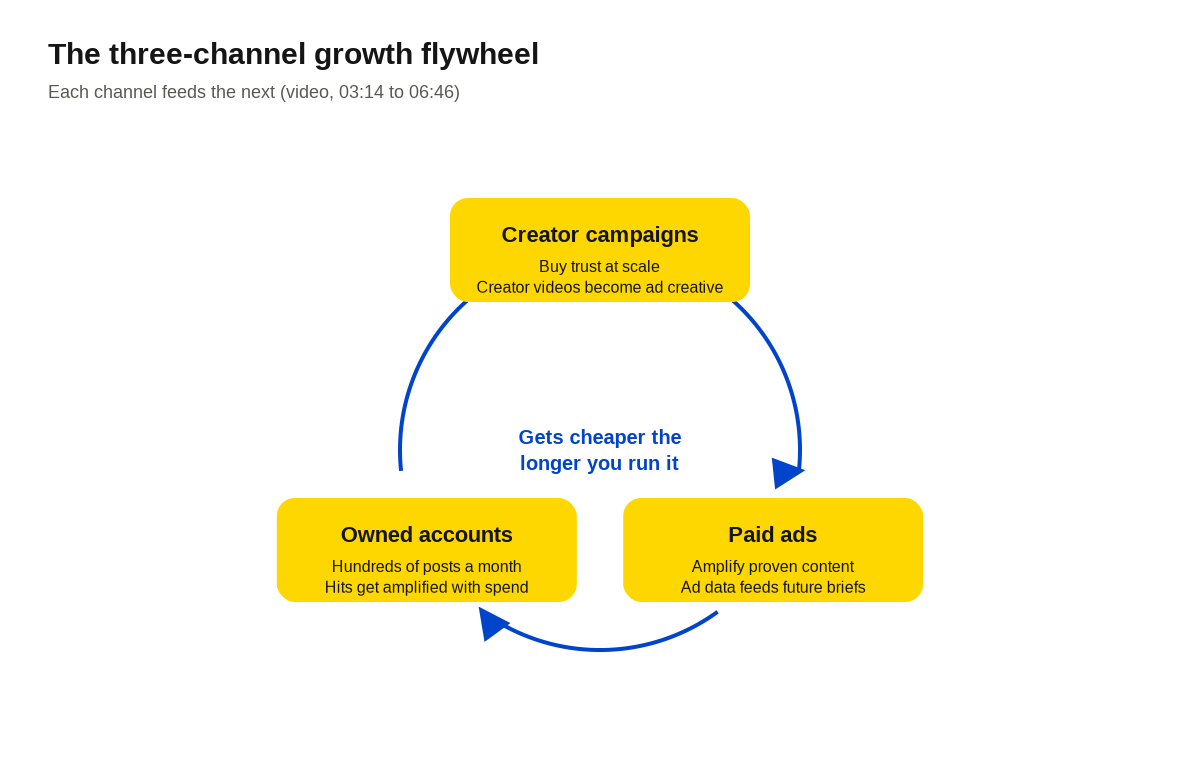
"Every winner I've seen this year is some version of this three channel system." The edge is not any one channel. It's how they reinforce each other.
Gamma is the cleanest example. It reported $100 million in ARR with about 50 people and a $2.1 billion valuation in November 2025. Its co-founder Grant Lee has said the company worked with more than 1,000 micro-influencers, and Business Insider reported that word of mouth drives over 50% of its subscriber growth. Anthropic ran its first Claude brand campaign, Keep thinking, in 2025, and one third-party count found 31 creators publishing 50 sponsored #ClaudePartner posts on LinkedIn.
The common thread: creators across YouTube, TikTok, X, Instagram and LinkedIn talking about the product at the same time, "until the algorithm decides they matter."
Channel one: creator campaigns buy trust
"Paid ads buy attention. Creator campaigns buy trust." That difference is the whole game in 2026. This is where surround sound gets built: the top creators in a category posting in a condensed window, backed by a wide base of smaller creators.
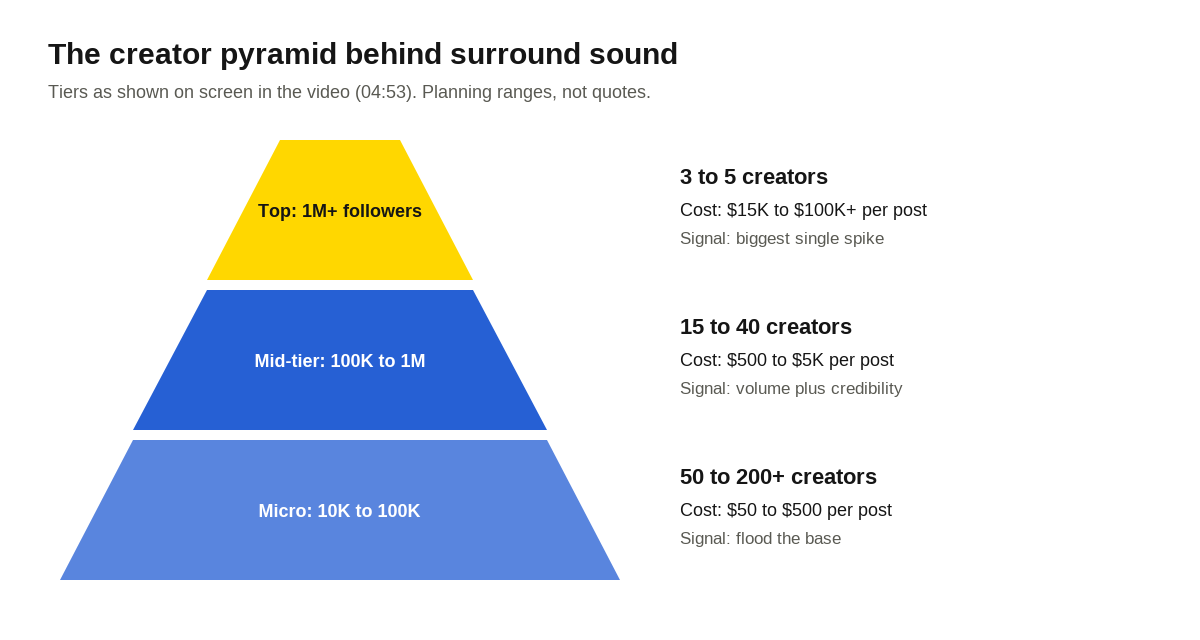
The cost ranges in that pyramid are planning numbers from the video, not quotes. For real benchmarks by niche, see creator rates for consumer apps and creator rates for AI and developer tools.
Channel two: owned accounts are the volume layer
Brand-owned accounts scaled horizontally across TikTok and Reels, posting hundreds of videos a month. Often that means hiring UGC creators to make and post from those accounts. The cost of producing this content has dropped sharply in the last year. The catch: "You literally need hundreds of videos per month, or you're not even in the game."
Channel three: paid ads amplify what already works
Take the content that is already performing organically and put money behind it. "Literally the less it feels like an ad the better." My standard recommendation: set aside 10 to 20% of your total creator budget for paid amplification from day one.
The trade-off: each channel alone is either expensive (creators), slow (owned) or low-trust (paid). Together, creator videos become ad creative, owned hits get fuel, and ad data writes next month's briefs. "The whole system gets cheaper and more effective the longer you run it if you do it right."
Why do most founders still lose at this?
It's not budget, creators or platforms. It's how they think about the channel.
The biggest mistake founders make is treating creator marketing like a one-off campaign instead of the channel to build and grow over time.
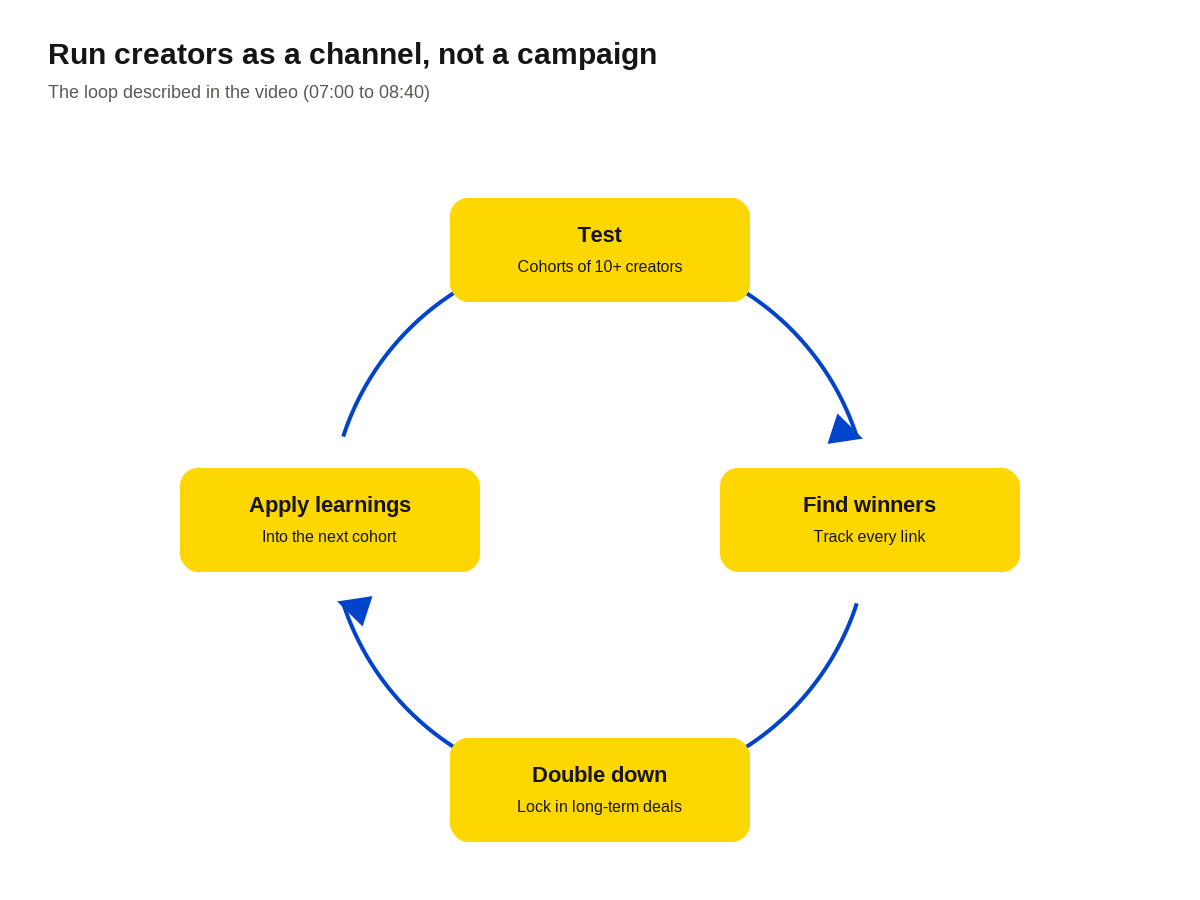
A campaign has a start date, an end date and a did-it-work question. A channel is a system. "This is a hit-driven business." You can't predict which creator or video breaks through, so you run enough volume to find out. The best Meta ad teams already work this way: test hundreds of creatives, kill most, scale the few.
The founders getting this wrong share three habits:
- Too few creators. Two or three, lukewarm results, channel declared broken.
- No tracking. No way to tell which creator drove traffic or sales.
- Paying the first quote. No market context and no idea what a negotiation looks like.
The ones getting it right do the opposite:
- Cohorts of at least 10 creators per round, because you need volume to find winners.
- Tracking from day one: UTMs, branded short links, AppsFlyer if you're a mobile app.
- Break-even expectations for the first one or two cohorts. That's the cost of real signal.
- Lock in winners on long-term deals. "Locking in winning creators in your category is a real moat."
- Carry learnings into the next cohort, so the hit rate compounds.
What actually kills creator programs?
"What kills most creator programs is not strategy, it's operations." Email chains, contracts, payments, follow-up, tracking, tax compliance. Multiply by 50 creators and the marketing team drowns. Teams that build the operations scale. Teams that don't plateau.
And the timing argument is the opposite of paid. Paid ads get more expensive every quarter as you saturate your first audience. This channel tends to get cheaper every cycle. Most founders tried it once, saw nothing, and wrote it off. "And that's why it still works in 2026."
The only question is whether you lock in your category's best creators before someone else proves them out.
How does this compare to running paid ads alone?
| Paid ads alone | Three-channel flywheel | |
|---|---|---|
| What you buy | Attention | Trust, then attention on top |
| Cost over time | Rises as your best audience saturates | Tends to fall as learnings compound |
| Creative | New production every cycle | Creator videos become ad creative |
| Moat | None, anyone can bid | Long-term deals with proven creators |
For a fuller comparison, see creator marketing vs paid social for apps. To work out what a creator customer should cost, use the creator CAC calculator.
Frequently asked questions
What is the surround sound effect in creator marketing?
It is what happens when the top creators in a category post about one company in a short window. Viewers see several trusted voices at once and read it as genuine momentum, and platform algorithms push the brand further because the signals stack up.
How many creators do you need to start?
Run cohorts of at least 10 creators per round. Fewer than that and you cannot tell a winner from noise, and you have no leverage in negotiation.
How much of a creator budget should go to paid amplification?
Set aside 10 to 20% of the total creator budget from day one. Use it to run creator videos that already performed organically as ads on Meta, TikTok and YouTube.
Do you need Kick-level money to manufacture virality?
No. Kick is the brute-force version. Startups get the same effect at a fraction of the cost by combining creator campaigns, owned accounts and paid amplification, and by running them as a system rather than a one-off campaign.
Full transcript
YouTube's English captions for the video, grouped into paragraphs with start times. We fixed obvious caption errors (names, numbers, misheard words) and left the wording as spoken.
[00:00] What if I told you there's a formula for going viral 100% of the time, and it has nothing to do with your product, your founder brand, or whether you've ever made a single piece of content yourself? In fact, these startups are doing exactly what I'm exposing in this video. Like Kick, whose official clipping program generated over 3 billion views in a single month. And it's the same system AI companies like Suno and Gamma and even Anthropic are running to scale in 2026. I ran product for Beyoncé, built company backed by Snapchat, and in the last 3 months alone, I've personally paid out over $100,000 to creators running these exact systems for venture-backed startups. So, in this video, I'm breaking down the three strategies fast-growing startups are using to manufacture virality in 2026. And the one mistake separating the founders pulling this off from the ones still wondering why their launch flopped. Section one, the surround sound playbook. So, before we get to those three strategies, you need to see the most extreme version of this happening on the internet right now. Because once you see what's going on at Kick, every other viral startup story is going to make a whole lot of sense. Kick runs an official clipping program where the platform pays creators to clip and repost streamer content across TikTok, YouTube Shorts, Instagram Reels, and X.
[01:08] Adin Ross has publicly stated that Kick has paid clippers up to $2 million in a single month. The typical rate is around $500 per million views. Adin's a Kick equity holder, so he's reporting from the inside. Walk through what the economic reality looks like for the clipper, and you start to understand why this works. One Kick streamer named Clavicular has a network of around 1,500 paid clippers posting roughly 70,000 clips per month. That's just for one streamer. Another streamer named N3on, also working with Adin Ross, paid 300 clippers almost $1.4 million over a 5-week stretch and has a wider network of over 1,000 clippers. Kick's official program generated over 3 billion views in September 2025 alone on Kick's own statement. So, that's Kick. But this same trick is happening everywhere right now. It's just quieter and it's cheaper.
[01:54] Paid clipping networks are the Kick version. Companies pay creators to post or preview, flooding every platform with clips tied to one brand. Creator seeding campaigns are the cleaner sibling. Brands ship product or early access to dozens or sometimes hundreds of creators hoping for organic posts. Lower cost per creator, much higher volume. Systematic influencer deals are the Gamma version. Founders or growth teams negotiate paid partnerships with hundreds of micro influencers in a category posting within a coordinated window. All three are doing the same job. They're manufacturing what looks like organic virality. Algorithms can't distinguish between manufactured volume and genuine interest. They push whatever has the most signals, most clips, most views, most engagement. So, companies flood the system with thousands of pieces of content tied to one brand and the algorithm starts treating them like a thing people actually care about. Real viewers show up because their feed told them you're popular. The audience trusts the algorithm and the algorithm trusts volume. There's a phrase for what these companies are building. I call it the surround sound effect. It's the magic that happens when the top creators in a category start posting about your company in a condensed period of time.
[02:58] It's not about how many people see something, it's actually about who sees it and in what context they see it. That's what Kick is doing at brute force scale and that's what these AI startups everyone's talking about figured out how to do for a fraction of cost, which brings us to the actual playbook. The three channel growth flywheel. This is the framework the best AI companies are running in 2026. Every winner I've seen this year is some version of this three channel system. The real edge isn't any one channel by itself. It's how they all reinforce each other. Gamma is the cleanest example. They hit over 100 million in ARR with a 50-person team and at $2.1 billion valuation as of November 2025. Their co-founder Grant Lee went on Lenny's podcast and said he personally onboarded over a thousand micro influencers and that the word of mouth driven by those creators accounts for about 50% of their subscriber growth.
[03:47] And Anthropic, who makes Claude, hired a dedicated influencer marketing manager in 2025 and ran a multi-million dollar campaign called Keep thinking that included all parts of the ecosystem from influencer partnerships to podcasts. They also have a #ClaudePartner where you can see over 50 sponsored creator posts on LinkedIn from 31 different mid-tier creators. If you've been on YouTube or LinkedIn in the last 6 months, you've probably seen these without realizing what they were. The common thread across both these companies and many more is that they're getting creators across YouTube, TikTok, X, Instagram, and LinkedIn to talk about the product simultaneously until the algorithm decides they matter. And once you understand what they're doing, the whole playbook breaks down into three channels. Every single one of these companies is running all three of these channels at the same time. Channel one is creator campaigns where these companies are buying trust at scale.
[04:35] Creators with existing audiences are making content about their product. Paid ads buy attention. Creator campaigns buy trust. There's a massive difference, and trust is the currency in 2026. This is where the surround sound effect really gets built. Top creators in a category posting about your product in a condensed window. So, at the top of the pyramid, you have fewer creators, bigger audiences, higher cost per post, but also the biggest signal. I've covered extensively in my other videos how to find, source, and vet these creators. Go check it out. Channel two is owned accounts, which is the bottoms-up UGC layer. Company scale brand-owned accounts horizontally across TikTok and Reels posting hundreds of videos per month. Often, this means hiring UGC creators to make and post content from those accounts. Sometimes, it means scaling zero follower accounts that look organic, but actually aren't. The cost of creating content at scale has come down dramatically in the last 12 months.
[05:27] You can hire creators off platforms like Sideshift, or you could even use AI tools like Sora to produce this content at scale. It really depends on the format and the audience you're going for. So, this is cheap per post, but only works at real volume. You literally need hundreds of videos per month, or you're not even in the game. This is the closest sibling of what Kick is doing, just at the startup scale instead of millions per month. Channel three is paid ads, which is the amplification layer on top of the first two. It's simple. Take the cream of content that's already performing organically and put money behind it to amplify it. Authentic creator content as paid ads is totally outperforming traditional ad creative. Literally the less it feels like an ad the better. My standard recommendation is to set aside 10 to 20% of your total creator budget specifically for amplification. This is how the best growth teams are doing it right now.
[06:14] You've already validated the content works organically and now you can put money behind it. This is a flywheel, not three separate plays. Think about it. Each one of these three reinforce each other. Creator videos become content for paid ads. The hits you get on your owned accounts get amplified with paid spend. Paid ad performance data feeds future creator briefs and owned account formats. The whole system gets cheaper and more effective the longer you run it if you do it right. That's the cleaner version of what Kick is doing. You don't need Kick level money to run it. You just need to actually do all three together and do it in a smart way. Why most founders still lose at this? This is the part of the conversation almost nobody wants to hear because it's not about budget, it's not about creators, and it's not about platforms. It's how you think about the channel itself. The biggest mistake founders make is treating creator marketing like a one-off campaign instead of the channel to build and grow over time. A campaign has a start date, it has an end date, it has a did it work question at the finish. A channel is a system. You test, you find winners, you double down on winners, you cut everything else, you apply the learnings to the next cohort.
[07:15] This is a hit-driven business. It's nearly impossible to predict in advance which creator or piece of content is going to break through. So, you have to run enough volume to find the ones that actually do. Think about how the best meta ad teams already work. Test hundreds or thousands of creatives, kill the ones that don't work, and scale up the few that do. This is the same mentality you need to bring to building creators as a channel. The founders I talk to who are messing this up basically will just run two or three creators, see lukewarm results, and decide the whole channel is broken. Oh, usually they have no tracking infrastructure either, so they can't even tell which creator drove traffic or sales or anything at all. They also tend to just pay whatever the first rate is that a creator quotes them. They have no market context and no understanding for what a negotiation looks like in this space. The companies doing this well run cohorts of at least 10 creators per round to start, not two or three.
[08:04] Remember, you need volume to identify winners. They set up tracking from day one, UTMs, custom branded short links, AppsFlyer if you're a mobile app. Your data sources get stitched together so you can see the ripple effects of a video across your entire funnel. They go in expecting cohorts one or two to break even or maybe even lose money, but that's the cost of finding real signal. The moment a winner shows up, they lock in that creator for a long-term deal and double down on the content format. If a creator drives results for your product, they'll probably drive results for your competitor, too. Locking in winning creators in your category is a real moat. They apply the learnings from each cohort to the next, and the hit rate tends to compound over time. What kills most creator programs is not strategy, it's operations. Email chains, contracts, payments, follow-up, performance tracking, tax compliance. Multiply that by 50 creators and your marketing team is drowning in admin work. The companies that build this right are able to scale, and the ones that don't plateau quickly. Paid ads get more expensive every quarter as you saturate your initial audience. This channel tends to get cheaper and more effective every cycle. You're compounding learnings, you're locking in winners on longer-term deals, you're turning organic hits into amplification fuel. After 6 months of running this system, your hit rate will look completely different from where you started. And that's where the opportunity is right now. Most founders try creator marketing once, didn't see results, and wrote off the whole channel. And that's why it still works in 2026. The companies running it now are locking in cheap creator deals.
[09:26] Everyone else is going to have to pay way more for the same creators a year from now after they've been proven out. If you want to skip the 100 hours of figuring this out for yourself and go straight to a list of pre-vetted creators already winning in your category, that's what Kiko does for venture-backed startups every day. Book a call with our team using the link in description and we'll walk you through what running this looks like for your business. If you're still figuring out whether creator marketing fits your business, hit subscribe. We got more videos coming on exactly how to run this in 2026 and beyond.
Sources and scope
This article is the written version of the video above, published on YouTube on 2026-09-11. Quotes come from the full transcript. Third-party figures are attributed below; all were accessed 2026-11-14.
- Kick's three billion clip views in September 2025: Win.gg, Kick clipping program. https://win.gg/kick-clipping-program/
- N3on paying 303 clippers about $1.4 million over five weeks: Complex, 2026-04-23. https://www.complex.com/pop-culture/a/alex-ocho/n3on-303-clippers-stream-boost
- Gamma's $2.1 billion valuation, $100 million ARR and about 50 employees: TechCrunch, 2025-11-10. https://techcrunch.com/2025/11/10/ai-powerpoint-killer-gamma-hits-2-1b-valuation-100m-arr-founder-says/
- Gamma's 1,000+ micro-influencers: Lenny's Podcast with Grant Lee, 2025-11-13. https://www.lennysnewsletter.com/p/how-50-people-built-a-profitable-ai-unicorn
- Word of mouth as over 50% of Gamma's subscriber growth: Business Insider via AOL, 2025-11-14. https://www.aol.com/articles/why-one-founder-personally-onboarded-082819799.html
- Anthropic's first Claude brand campaign: ContentGrip, 2025-09-27. https://www.contentgrip.com/claude-ai-brand-campaign/
- 31 creators and 50 #ClaudePartner posts: Favikon, 2025-06-30. https://favikon.com/blog/inside-anthropic-influencer-marketing-program
The creator pyramid's cost ranges are the planning ranges shown in the video, not market data. The video also cites clipping payouts that we could not trace to a public source, so they are left out of the article text and appear only in the transcript.