Why do brands now pay creators instead of platforms?
Because platform ads stopped being a cheat code. Apple's iOS 14.5 in 2021 broke much of Facebook's cross-app tracking, and a post-pandemic rush back into ads pushed prices up. Smart brands stopped asking how to buy more space and started asking who people listen to. The answer was creators. To make it work, test 20 to 50 creators in your first 90 days and expect 3 to 5 to drive most of the results. This article is the written version of my video.
How did buying attention work before the internet?
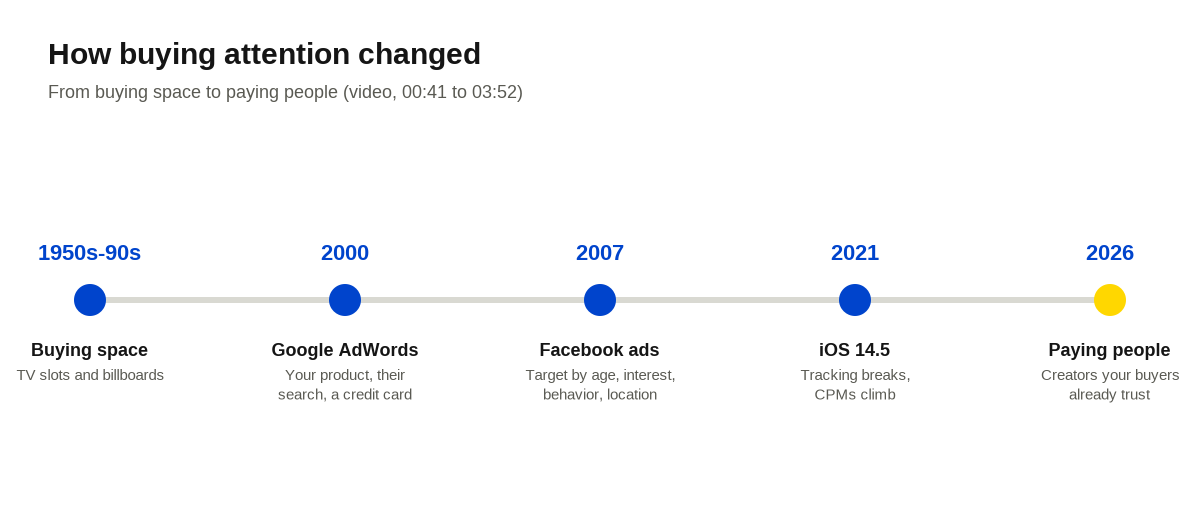
For most of the 20th century, getting in front of people meant one thing: "buying space." A commercial you saw a dozen times a week. A billboard the size of a house on your drive to work. "The brands with the biggest budgets bought the most space."
Here's the thing. That model only rewarded whoever could afford the most repetition.
What changed when Google and Facebook opened ads to everyone?
The internet leveled the field. Google launched AdWords in 2000, and any brand with a few hundred dollars could show up the moment someone searched. "Just your product, their search, and a credit card." Then in 2007 Facebook opened its ad platform, and you could target by age, interest, behavior and location.
What once took a primetime TV slot now took 15 minutes on a laptop. For over a decade, the brands that figured this out early won.
Why did platform ads stop working so well?
"Markets are very efficient." Everyone saw the bigger pie. By 2021 the tool that felt like a cheat code was the most crowded room on the internet.
Two things hit at once. Apple's iOS 14.5 required apps to ask permission before tracking users, which dismantled much of the targeting brands had built their growth models on. And businesses flooded back into ads after the pandemic, so bidding got brutal. Facebook CPMs had already jumped 38% in one stretch of late 2020. The economics that made Facebook and Google "feel like money printers start feeling more like an incinerator."
So the smartest brands changed the question. Not "How do we buy more space?" but "Who do people actually listen to?"
The answer was people. The YouTubers, podcasters and niche voices their customers chose to watch every week. "The people who had spent years building genuine trust with an audience that no algorithm could manufacture."
The shift: from paying platforms to paying people. That's creator marketing.
What are the four mistakes brands make with creator marketing?
Creator marketing isn't a secret anymore. But most brands walk in making the same mistakes, and they cost tens or hundreds of thousands of dollars.
| Mistake | What it looks like | What to do instead |
|---|---|---|
| 1. Wrong expectations | One creator, one post, wait for sales | Build, test and refine a system over time |
| 2. Picking by follower count | Choosing the biggest account | Look for outlier performance in the last 90 days |
| 3. Paying the first quote | Accepting whatever rate a creator names | Negotiate; it's standard |
| 4. Too few tests | Testing three creators, then quitting | Test 20 to 50 creators before drawing conclusions |
Mistake one: expecting one creator to work
"That's like going to the gym once and expecting to lose 20 lb." One team we worked with, building an AI tool for writers, had already written the channel off after two flopped videos from one creator. That wasn't a test. "This is just guessing with invoices attached."
When we rebuilt the program, we split the test into lanes: novelist accounts, newsletter writers, productivity creators and AI-curious tech reviewers. Then we tracked which lane produced trial users, and which of those converted to paid and stayed. That's how a real growth program works.
Mistake two: picking creators by follower count
A creator with 2 million disengaged followers loses to one with 100,000 who has real trust in a niche. "What matters is not follower count. It's the depth of engagement with their community."
The question to ask is not who has the most followers. It's "which creator type can make the product feel obvious to their audience." In the writing-tool test, the winning post came from a creator whose audience already knew the pain of AI drafts that don't sound like them. The walkthrough didn't feel like a pitch. It felt like a better workflow.
What should you look for? Outlier performance: content in the last 90 days that dramatically beat the creator's own average. That's the signal of an audience that trusts them.
Mistake three: paying whatever they quote
"Mid-tier creators almost always quote 25% to 75% above what they'd actually accept." Negotiation isn't awkward here. It's expected.
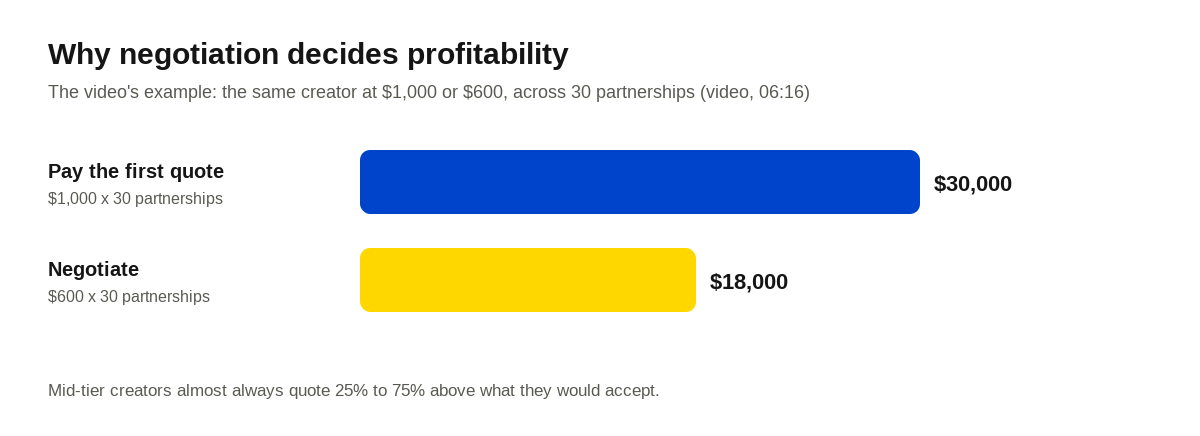
The difference between $1,000 and $600 for the same creator, across 30 partnerships, is $12,000. That's "the difference between a profitable channel and one that bleeds your budget dry." See what creators actually charge in consumer app creator rates.
Mistake four: not running enough tests
"The brands that make the most money with creator marketing aren't smarter than everyone else. They just test more." You need at least 20 to 50 creators in the mix before the data tells you anything. Most brands test three, get inconsistent results, and go back to ads that cost more every year.
What is the system that actually works?
Three steps.
- Find creators who already have your exact audience. Not the biggest creators in your space. The ones whose audience is made of the exact person you sell to, who watch every week and trust their opinion. Check audience demographics, engagement over the last 90 days and recent outlier performance. That's what Kiko's creator sourcing is built around.
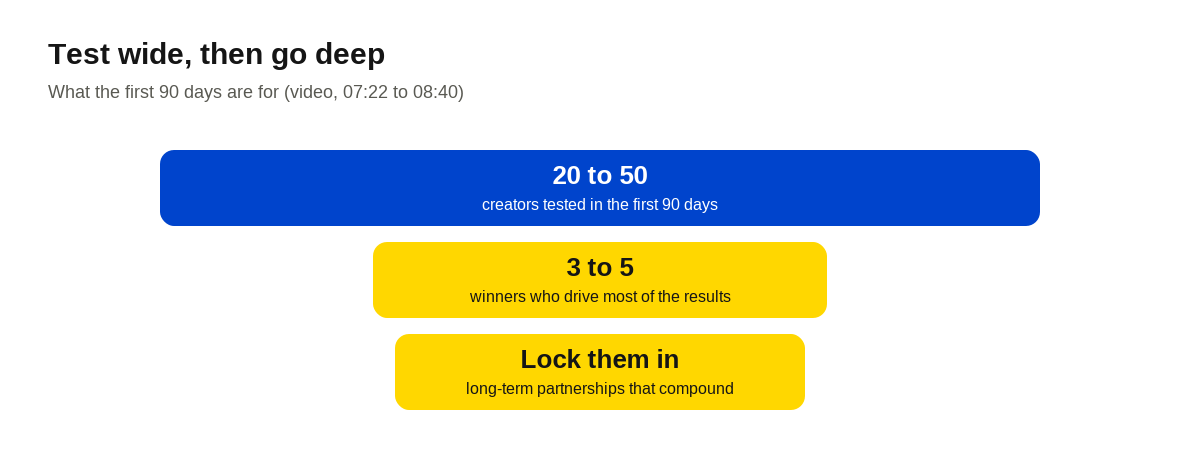
- Test volume before you go deep. "The goal in your first 90 days is not to find the perfect creator." It's enough low-cost tests across 20 to 50 creators for the data to show who drives attention and sales.
- Identify your winners. "Out of every 20 to 50 creators you test, typically three to five will drive the majority of your results." Stop spreading budget. Deepen those relationships.
Why does this become a competitive advantage?
"Long-term partnerships with proven performers compound in a way that one-off posts never will."
And here's what nobody tells you. You can copy a product, an ad or a pricing strategy. "But you cannot copy years of trust that a creator has spent building with their audience."
That's the moat. The only question is whether you build it before your competitors do.
For how to brief and run those partnerships, see creator marketing and the app demo creator brief template.
Frequently asked questions
Why is creator marketing replacing some paid advertising?
Platform ads got crowded and harder to target after iOS 14.5 in 2021, which pushed costs up. Creators bring trust their audiences chose to give, which no targeting tool can manufacture, so brands now pay people as well as platforms.
How many creators should a brand test?
Test at least 20 to 50 creators in the first 90 days. Typically 3 to 5 of them will drive the majority of results, and those are the relationships to deepen.
How do you pick creators if not by follower count?
Look for outlier performance: videos in the last 90 days that dramatically beat the creator's own average. Then judge audience fit and engagement depth, not audience size.
Should you negotiate with creators?
Yes. Mid-tier creators often quote 25% to 75% above what they would accept, and negotiation is standard practice. Across 30 partnerships the gap decides whether the channel is profitable.
Full transcript
YouTube's English captions for the video, grouped into paragraphs with start times. We fixed obvious caption errors (names, numbers, misheard words) and left the wording as spoken.
[00:00] Why do certain brands seem to show up everywhere without running a single ad? I'm sure you felt it before. I definitely have. You're scrolling on your favorite app. You're seeing the same product over and over again. Before you know it, you're on their website putting the details of your card number in. Brands like Gymshark, Liquid Death, and Prime are known for this, but there is a long list. The thing is, they haven't just mastered great products, they've mastered a completely different way of buying attention. It's a way that makes traditional advertising look like a waste of money. So, how are they doing it? These brands figured out the fastest way to grow isn't paying platforms, it's paying people. So, in today's video, I'm going to show you exactly what this new art of buying attention looks like, why it works so much better than anything you've tried before, and how you can start using it today. But, before we do that, we need to discuss how we got here in the first place. See, for most of the 20th century, getting your brand in front of people meant one thing, buying space. For example, picture yourself sitting in your living room sometime in the '60s or '70s. You're watching TV, you're completely relaxed, and out of nowhere, the same commercial you've seen a dozen times this week comes back on. Same jingle, same smiling face, same product.
[00:59] You never asked for it, but by the time it aired for the 12th time that month, it was practically living rent-free in your head. This is how things used to work. Or, imagine yourself driving to work one morning. You turn a corner, and there's a billboard the size of a house staring down at you from 50 ft away. But, the thing is, you see it every day, so eventually you can't help but start believing every word it says. That was how buying attention worked from the '50s all the way through to the '90s. The brands with the biggest budgets bought the most space. We've all seen Mad Men, we have an understanding of how it used to work. But, eventually a new tool would get released which spelled doom for this method of getting attention, and created the environment we live in today. Of course, I'm talking about the internet. The internet came with, among other things, two key resources that leveled the playing field. Suddenly, it wasn't just the giants with million-dollar TV budgets who could reach people at scale. First, the pie got a lot bigger, and nobody took advantage of that bigger pie more than Google and Facebook. First, Google launched AdWords in 2000, which meant any brand with a few hundred dollars could put their product in front of someone at the exact moment they were searching for a solution. No billboard or no TV slot needed. Just your product, their search, and a credit card. Then in 2007, Facebook opened its ad platform to every business on Earth. And now you could target someone based on their age, their interest, their behavior, their location, all of it. So it used to take a primetime TV slot hoping the right person was watching from their couch, now just took 15 minutes on a laptop.
[02:17] The barrier to entry completely collapsed overnight. And for over a decade, the brands that figured this out early and scaled faster than anyone were the winners. But here's the problem with the bigger pie. Everyone else can see it, too. Markets are very efficient. By 2021, the same tool that felt like a cheat code had become the most crowded room on the internet. For instance, Apple dropped iOS 14.5 that year, which completely dismantled Facebook's ability to track users across apps and websites. The targeting that brands had built their entire growth models around stopped working the way it used to. And at the same time, every business in the world was flooding back into ads post-pandemic. This led to the bidding wars getting brutal. CPMs spiked, and the economics that used to make Facebook and Google feel like money printers start feeling more like an incinerator. And that's when the smartest brands started asking a different question.
[03:03] Instead of asking, "How do we buy more space?" they started asking, "Who do people actually listen to?" And the answer wasn't a platform. It wasn't a billboard, a Facebook ad, or a Google search result. It was people. Specifically, the creators. The YouTubers, the podcasters, the niche voices that their ideal customer had been voluntarily tuning into every single day and every single week. The people who had spent years building genuine trust with an audience that no algorithm could manufacture. And that trust, it turned out, was worth way more than any targeting tool Facebook or Google had ever built. Which leads us to 2026, where we're now seeing the shift from paying platforms to paying people. This is what's known as creator marketing. Now, creator marketing isn't exactly a secret anymore, but most brands jumping in are making the same costly mistakes that end up costing them tens, if not hundreds of thousands of dollars. So let's talk about some of these mistakes now.
[03:53] The first mistake we'll discuss is how most brands walk into creator marketing with the totally wrong expectations. They believe they can find one creator, pay them, and then just watch the sales roll in. That's like going to the gym once and expecting to lose 20 lb. The channel does not work that way. Creator marketing is a system that needs to be built, tested, and then refined over time. The brands that walk in expecting a shortcut are the same ones that spend a little bit of money and walk away convinced the whole thing doesn't work. We work with a company building an AI tool for writers that had already convinced itself that creator marketing didn't work. They had a creator in the writing niche post two videos that completely flopped. And so they spent a few hundred dollars and gave up on the entire channel. The reality is is that this isn't a test. This is just guessing with invoices attached. When we rebuilt the program, we stopped treating creator marketing like one big bet and split the test into different lanes. So we tested novelist accounts, newsletter writers, productivity creators, and AI curious tech reviewers. Then we looked at which niche produced the trial users and which trial users actually converted to paid and retained. This is how to approach a real growth program. Mistake number two is picking creators based on follower count. Follower count tells you almost nothing about whether someone will actually drive results for your business. So a creator with 2 million disengaged, bought followers will consistently lose to a creator with 100,000 who has built genuine trust in a specific niche. What matters is not follower count. It's the depth of engagement with their community. And before a creator posts, you can judge this on views, engagement, comment sections. After they post, you can actually track who drove traffic and conversions. And so I just want to give another example here, which is a creator in the campaign I just mentioned. We tested the same AI writing tool across different creator lanes, and this is the kind of post that told us that the AI tool's niche was the right lane. His audience already knew the pain of using ChatGPT and getting a draft that doesn't sound like them, or asking for one small edit and watching the whole document get rewritten. So when you walk through the tool, it didn't feel like a product pitch. It felt like a better workflow for a problem they already had. And that's the point of the test. You're not asking who has the most followers, you're asking which creator type can make the product feel obvious to their audience. That one paid post paid back in under 24 hours and drove more revenue than the bigger creators in the test. It was a huge win. But then the question becomes, what should you be looking for?
[06:01] And the answer is outlier performance. So, has this creator produced content in the last 90 days that dramatically over performed their average? That's the real signal. Because then you know that creator has an engaged audience who trust them and enjoys watching their content. And once you finally find those creators, the next mistake is about what happens when it's time to pay them. See, the majority of brands pay whatever rate a creator throws at them on the first ask. But mid-tier creators almost always quote 25% to 75% above what they'd actually accept. Negotiation shouldn't feel awkward here, it's standard. Because the difference between paying a thousand bucks and six hundred for the same creator across 30 partnerships is the difference between a profitable channel and one that bleeds your budget dry. But even if you nail the negotiation, none of it matters if you're not testing with enough creators to begin with. So, the most costly mistake of all is just not running enough tests. The brands that make the most money with creator marketing aren't smarter than everyone else. They just test more. This is true in almost every marketing channel. So, from my experience, you need at least 20 to 50 creators in the mix before you get enough data to know anything meaningful.
[06:58] Most brands test three, see inconsistent results, and then quit. And then they go back to dumping money into ads that cost more every single year, convinced that creator marketing just isn't for them. When the reality is, they never gave it a real shot to begin with. So, now you understand some of the major mistakes brands make with creator marketing. But understanding what not to do means nothing if you don't have a system that tells you exactly what to do instead. So, let's go over the system me and my team use every single day. So, it starts with finding creators who already have your exact audience. And I want to be specific about what that means because most brands get this wrong from the jump. You're not looking for the biggest creators in your space. You're not even looking for the most popular ones in your general category. You're looking for the ones whose audience is already made up of the exact person you're trying to sell to. The one whose audience watches their content every week, trust their opinion, and would genuinely be interested in what you're offering. That's a completely different search than just typing a keyword into a platform search bar and picking whoever has the most followers.
[07:52] To do this, I use Kiko, which I built to solve this exact problem. This lets us look at actual audience demographics of a creator, their engagement rate over the last 90 days, and whether their content has had any outlier performance recently. That data tells us almost immediately whether this creator is worth testing. Now, once you've put a list together of potential creators, the next move is to test the volume before you ever go deep. So, the goal in your first 90 days is not to find the perfect creator. It's to get enough low-cost test running across 20 to 50 creators so that the data can tell you who is actually bringing in the most attention and sales for your product. But once you've gathered that data, you'll be ready for the next and final step, which is the most important moment in the entire system, identifying your winners. Out of every 20 to 50 creators you test, typically three to five will drive the majority of your results. And once you know who those creators are, you can stop spreading your budget around and start deepening those specific relationships. Because long-term partnerships with proven performers compound in a way that one-off posts never will. But here's the thing nobody tells you about this. The brands that commit to the system don't just build a better marketing channel. They build something that makes them fundamentally harder to compete with. Cuz you can copy a product or an ad or even a pricing strategy, but you cannot copy years of trust that a creator has spent building with their audience, which is why creator marketing is the best way to buy attention in 2026. Everything we covered today, from what creator marketing actually is to why brands can use it to build a sustainable competitive advantage, this is really just scratching the surface. Creator marketing goes so much deeper than what a single video can cover. There's an entire science behind finding the right creators, building the kinds of partnerships that compound over time, and turning this into the most profitable growth channel your brand will ever have. And that's exactly what I plan to bring you more of on this channel. So, if you want to understand this at a level you can actually go out and execute, make sure to hit that subscribe button, and I'll catch you in the next one.
Sources and scope
This article is the written version of the video above, published on YouTube on 2026-09-11. Quotes come from the full transcript. The writing-tool example is a Kiko engagement described in the video; the company is not named. Historical facts were checked against these sources, accessed 2026-11-14:
- Google's self-service AdWords launch, October 2000: InternetNews. https://www.internetnews.com/marketing/google-launches-self-service-ad-program/
- Facebook Ads launch, November 2007: Meta Newsroom. https://about.fb.com/news/2007/11/facebook-ads-launches-with-12-landmark-partners/
- iOS 14.5 App Tracking Transparency and Facebook: MacRumors, 2021-04-28. https://www.macrumors.com/2021/04/28/facebook-att-impact-manageable/
- Facebook CPMs up 38% in fall 2020 (Aisle Rocket data): AdExchanger, 2020-11-25. https://www.adexchanger.com/platforms/facebook-cpms-will-be-higher-than-ever-this-holiday-season/
The negotiation chart is arithmetic on the example given in the video. The 25% to 75% quote range and the 20 to 50 creator test size are my working ranges, not market studies.